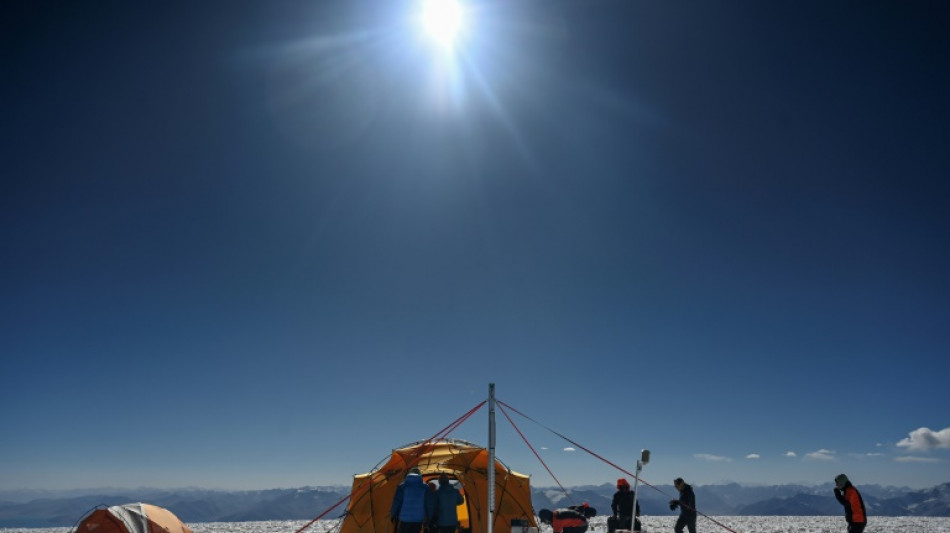
Scientists probe Tajik glacier for clues to climate resistance / Photo: Prakash MATHEMA - AFP

 US Fed raises rates to tackle 'too high' inflation, irking Trump

 Turkey releases 106 protesters, jails more LGBTQ activists

 Candidate for UN chief calls for AI regulation akin to nuclear weapons

 'We're losing control,' AI pioneer Yoshua Bengio tells AFP

 IR-MED and Dice Technologies Announce collaboration to Evaluate and Advance Pressure-Injury Prevention Platform in Japan

 Watts, Pitt, Cruz to light up Spain's top film festival

 Toogood Gold's Table Mountain Sits in the Shadow of a Nevada Gold Rush

 MEXC July–August Security Report: 38.66M USDT in Risk Funds Intercepted, Futures Insurance Fund Hits 792M USDT

 Emporio Armani names Dario Vitale new creative director

 EU to ban social media for under 13s, curb access until 15

 Wildfires push endangered Sumatran elephants to brink: Indonesian NGO

 Bank of Japan set to raise rates under pressure from inflation, US

 EU chief to unveil social media, gaming curbs for under-15s

 'Resident Evil' film brings video game's ethos to the big screen

 GA-ASI Mojave First UAS To Complete Battlefield Short Field Ops

 Sanders, Bannon warn of AI dangers in rare US left-right alignment

 Empty benches as schools reopen in Venezuela's quake-hit Guaira

 Tiny English village holds 'independence' vote over asylum seeker housing

 US Treasury chief says to meet Chinese counterpart at weekend

 BingX Evolves into a Multi-Asset Trading Platform, Connecting Users to Global Opportunities

 International Trading Institute Expands Professional Trader Development Beyond the Master’s in Trading

 Lake Energy Secures $80 Million for U.S. Renewable Energy Expansion

 Stocks drop, oil climbs and Treasury yields hit 19-year high

 SkySail Strategies Outperforms Wall Street's 30-Year Risk Standard With Proprietary AI Inference Model

 Just add fish: Scientists pursue more rice, less disease in Senegal paddies

Greenland is melting, the Alps are melting and the Himalayas are melting -- yet in one vast mountain region, huge glaciers have remained stable, or even gained mass, in recent decades. Can it last?
To find out, a dozen scientists, accompanied exclusively by an AFP photographer, trekked high over one glacier in eastern Tajikistan to drill for ice cores -- ancient, deep samples that can shed precious light on climate change.
In September and October, they first spent four days crossing the country from west to east in four-wheel drives, then climbed on foot to over 5,800 metres altitude on the Kon-Chukurbashi ice cap, near the Chinese border.
Camping for a week at the summit, in freezing temperatures and despite a day-long blizzard, the scientists from Switzerland, Japan, the United States and Tajikistan drilled the glacier to extract two 105-metre-long ice cores, in sections.
These layers of ice, compacted over centuries, perhaps millennia, form an archive of climate indicators, yielding data on past snowfall, temperatures, atmosphere and dust.
They must now be analysed in a laboratory to reveal their dates, said the leader of the team, Evan Miles, a glaciologist affiliated with the universities of Fribourg and Zurich.
"We're hopeful for a truly unique core, not just for the region, but for the broader region actually, probably extending back 20 to 25 or 30,000 years."
- Glacier temperature anomaly -
The apparently resistant glaciers are spread over thousands of kilometres of high mountain ranges in Central Asia, including Karakoram, Tian Shan, Kun Lun and the Pamir mountains of Tajikistan.
By delving back in time in the ice there, researchers hope to find out why these glaciers have resisted the general planetary warming of recent decades -- and whether this so-called "Karakoram anomaly" could be ending.
"This whole region is globally unique because over the last 25 years, these glaciers have shown very, very limited mass loss and even mass gain," said Miles.
The glaciers have shown some limited signs of loss in recent years, but scientists want to determine whether this is a natural variation or the beginning of a real decline.
"In order to understand that, we really, really need to have a longer time period of records of both temperature and precipitation at the glacier sites," said Miles.
"That's the type of information that an ice core can tell us."
- Glacier climate analysis -
One core will be sent to Japan for analysis and another stored in an underground sanctuary in Antarctica at minus 50C.
That naturally cold storage site is a project of the Ice Memory Foundation, which supported the Tajikistan expedition along with main funder, the Swiss Polar Institute.
The foundation, created in 2021 by French, Italian and Swiss universities and research centres, has already collected several cores in the Alps, Greenland, the Andes and elsewhere.
Future scientists will "be able to analyse (them) with their most modern analytical tools in 50, 100, 200 years and extract new information", said Ice Memory's president Thomas Stocker.
"We will probably lose 90 percent of our glacier mass on the Earth," Stocker told AFP. "So we are trying to help preserve a thing that is threatened by human action."
The scientists were scheduled to review their mission during a news conference in the Tajik capital Dushanbe on Monday.
Y.Ibrahim--CPN