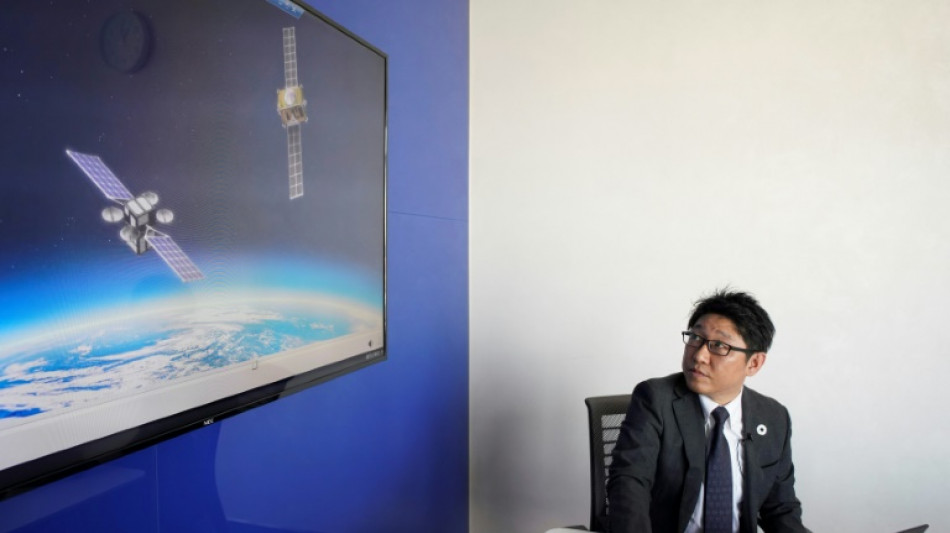
Using lasers and 'tow-trucks', Japanese firms target space debris / Photo: Kazuhiro NOGI - AFP

 Emporio Armani names Dario Vitale new creative director

 EU to ban social media for under 13s, curb access until 15

 Wildfires push endangered Sumatran elephants to brink: Indonesian NGO

 Bank of Japan set to raise rates under pressure from inflation, US

 EU chief to unveil social media, gaming curbs for under-15s

 'Resident Evil' film brings video game's ethos to the big screen

 i-payout Expands U.S. Money Transmitter Licensing Footprint and Advances European EMI Strategy

 US Senate crypto bill collapses amid partisan deadlock

 OpenAI, Anthropic and Google are working to create an AI standards body

 Protesting shepherds, farmers clash with Romanian police

 Foundation Lets Ledger Users Switch to Open Source Without Starting Over

 EU to propose curbing social media, online games for under 15s

 FX Junction Reaches 40,600 Members and 26 Million Trades

 'We unleashed the beast': the world's fears and hopes about AI

 Hospitality leaders ask Burnham to halve VAT amid rising costs

 Worcestershire invited to nominate groups for 2027 King’s volunteer award

 Berlin's run-down public spaces at heart of election campaign

 'Widow's Bay' and 'The Pitt' win big at Emmy Awards

 Most markets drop as oil extends gains ahead of expected US rate hike

 Sri Lanka's famed beach shack battles demolition

 Vserv targets ₹1,000 crore revenue by 2030 through AI expansion

 India prohibits bank fees on UPI payments up to ₹2,000

 Brazil's Amazon defender Raoni has cancer

 Trump rejects AI slowdown concerns as UN urges coordinated controls

 Higher wages draw migrant workers to Kashmir despite attacks

From laser beams and wooden satellites to galactic tow-truck services, start-ups in Japan are trying to imagine ways to deal with a growing environmental problem: space debris.
Junk like used satellites, parts of rockets and wreckage from collisions has been piling up since the space age began, with the problem accelerating in recent decades.
"We're entering an era when many satellites will be launched one after another. Space will become more and more crowded," said Miki Ito, general manager at Astroscale, a company dedicated to "space sustainability".
"There are simulations suggesting space won't be usable if we go on like this," she told AFP. "So we must improve the celestial environment before it's too late."
The European Space Agency (ESA) estimates that around one million pieces of debris larger than a centimetre -- big enough to "disable a spacecraft" -- are in Earth's orbit.
They are already causing problems, from a near-miss in January involving a Chinese satellite, to a five-millimetre hole knocked into a robotic arm on the International Space Station last year.
"It's hard to predict exactly how fast the amount of space debris will increase," said Toru Yamamoto, a senior researcher at the Japan Aerospace Exploration Agency (JAXA).
But "it's an issue that raises real concerns about the sustainable use of space."
With satellites now crucial for GPS, broadband and banking data, collisions pose significant risks on Earth.
Tadanori Fukushima has seen the scale of the problem in his job as an engineer with Tokyo-based satellite operator and broadcaster SKY Perfect JSAT.
"A stationary satellite would get roughly 100 'debris-approaching' alerts a year," he told AFP.
International "satellite disposal guidelines" include rules like moving used satellites to "graveyard orbit" -- but the increase in debris means more is needed, specialists say.
- 'No panacea' -
Fukushima launched an in-house start-up in 2018 and envisions using a laser beam to vaporise the surface of space debris, creating a pulse of energy that pushes the object into a new orbit.
The irradiating laser means there's no need to touch any debris, which is generally said to move about 7.5 kilometres per second -- much faster than a bullet.
For now, the project is experimental, but Fukushima hopes to test the idea in space by spring 2025, working with several research institutions.
Japanese firms, along with some in Europe and the United States, are leading the way on developing solutions, according to Fukushima.
Some projects are further along, including Astroscale's space "tow-truck", which uses a magnet to collect out-of-service satellites.
"If a car breaks down, you call a tow-truck service. If a satellite breaks down and stays there, it faces the risk of collision with debris and needs to be collected quickly," Ito explained.
The firm carried out a successful trial last year and imagines one day equipping customer satellites with a "docking plate" equivalent to a tow-truck's hook, allowing collection later on.
Astroscale, which has a contract with the ESA, plans a second test by the end of 2024 and hopes to launch its service soon after.
Other efforts approach the problem at the source, by creating satellites that don't produce debris.
Kyoto University and Sumitomo Forestry envisage a wooden satellite that goes into orbit in a rocket and burns up safely when it plunges to Earth.
That project is also in its infancy -- in March, pieces of wood were sent to the International Space Station to test how they respond to cosmic rays.
Space agencies have their own programmes, with JAXA focusing on large debris over three tonnes.
And internationally, firms including US-based Orbit Fab and Australia's Neumann Space have proposed ideas such as in-orbit refuelling to extend the life of satellites.
The problem is complex enough that a range of solutions will be needed, said JAXA's Yamamoto.
"There is no panacea."
H.Müller--CPN