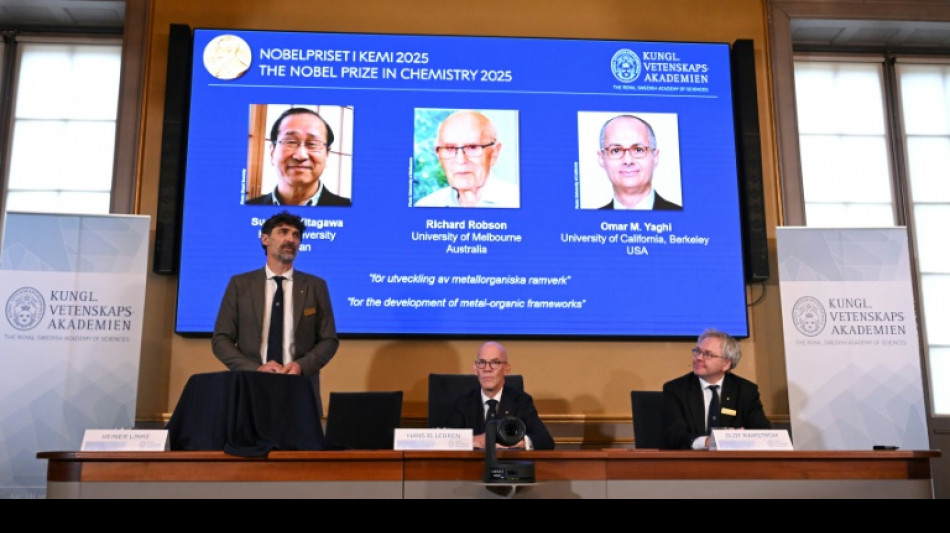
Trio wins chemistry Nobel for new form of molecular architecture / Photo: Jonathan Nackstrand - AFP

 US Fed raises rates to tackle 'too high' inflation, irking Trump

 Turkey releases 106 protesters, jails more LGBTQ activists

 Candidate for UN chief calls for AI regulation akin to nuclear weapons

 'We're losing control,' AI pioneer Yoshua Bengio tells AFP

 IR-MED and Dice Technologies Announce collaboration to Evaluate and Advance Pressure-Injury Prevention Platform in Japan

 Watts, Pitt, Cruz to light up Spain's top film festival

 Toogood Gold's Table Mountain Sits in the Shadow of a Nevada Gold Rush

 MEXC July–August Security Report: 38.66M USDT in Risk Funds Intercepted, Futures Insurance Fund Hits 792M USDT

 Emporio Armani names Dario Vitale new creative director

 EU to ban social media for under 13s, curb access until 15

 Wildfires push endangered Sumatran elephants to brink: Indonesian NGO

 Bank of Japan set to raise rates under pressure from inflation, US

 EU chief to unveil social media, gaming curbs for under-15s

 'Resident Evil' film brings video game's ethos to the big screen

 GA-ASI Mojave First UAS To Complete Battlefield Short Field Ops

 Sanders, Bannon warn of AI dangers in rare US left-right alignment

 Empty benches as schools reopen in Venezuela's quake-hit Guaira

 Tiny English village holds 'independence' vote over asylum seeker housing

 US Treasury chief says to meet Chinese counterpart at weekend

 BingX Evolves into a Multi-Asset Trading Platform, Connecting Users to Global Opportunities

 International Trading Institute Expands Professional Trader Development Beyond the Master’s in Trading

 Lake Energy Secures $80 Million for U.S. Renewable Energy Expansion

 Stocks drop, oil climbs and Treasury yields hit 19-year high

 SkySail Strategies Outperforms Wall Street's 30-Year Risk Standard With Proprietary AI Inference Model

 Just add fish: Scientists pursue more rice, less disease in Senegal paddies

Japan's Susumu Kitagawa, UK-born Richard Robson and American-Jordanian Omar M. Yaghi on Wednesday won the Nobel Prize in Chemistry for developing so-called metal–organic frameworks, the Nobel jury said.
"These constructions, metal–organic frameworks, can be used to harvest water from desert air, capture carbon dioxide, store toxic gases or catalyse chemical reactions," the jury said.
Commentators have for years suggested Yaghi was a strong contender for the prize, with Kitagawa's name also often floated alongside his.
"Metal–organic frameworks have enormous potential, bringing previously unforeseen opportunities for custom-made materials with new functions," Heiner Linke, chair of the Nobel Committee for Chemistry, said in a statement.
Last year, the chemistry prize went to Americans David Baker and John Jumper, together with Briton Demis Hassabis, for work on cracking the code of the structure of proteins, the building blocks of life, through computing and artificial intelligence.
The chemistry prize follows the physics prize, which on Tuesday honoured Briton John Clarke, Frenchman Michel Devoret and American John Martinis for work putting quantum mechanics into action -- enabling the development of all kinds of digital technology.
On Monday, the Nobel Prize in Medicine was awarded to a US-Japanese trio for research into the human immune system.
Mary Brunkow and Fred Ramsdell, of the United States, and Japan's Shimon Sakaguchi were recognised by the Nobel jury for identifying immunological "security guards".
Thursday will see the literature prize handed out, and the highly watched Nobel Peace Prize on Friday.
The economics prize wraps up the 2025 Nobel season on October 13.
The Nobel consists of a diploma, a gold medal and a $1.2-million cheque, to be shared if there is more than one winner in a discipline.
The laureates will receive their prizes at formal ceremonies in Stockholm and Oslo on December 10.
That date is the anniversary of the death in 1896 of scientist Alfred Nobel, who created the prizes in his will.
A.Zimmermann--CPN