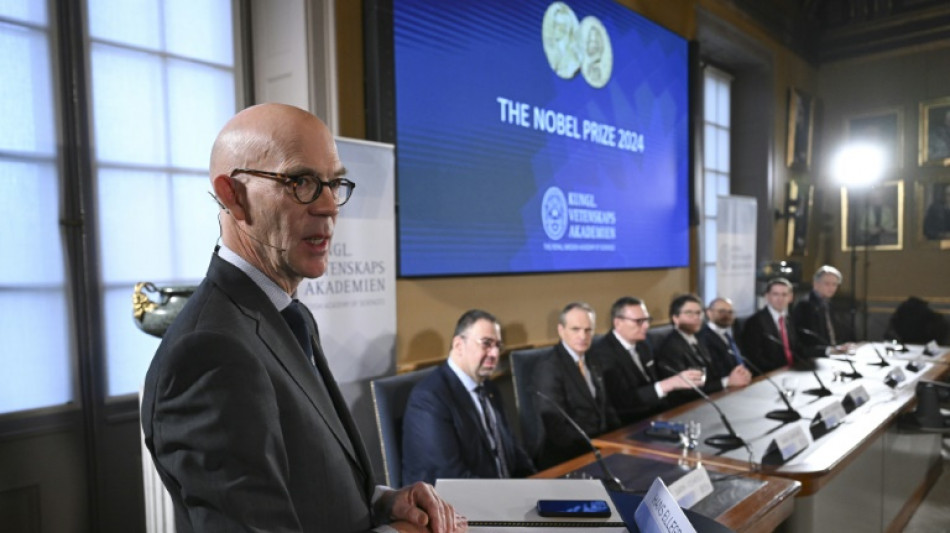
Trump jeopardising US role as scientific leader: Nobel officials / Photo: Jonathan NACKSTRAND - AFP

 US Fed raises rates to tackle 'too high' inflation, irking Trump

 Turkey releases 106 protesters, jails more LGBTQ activists

 Candidate for UN chief calls for AI regulation akin to nuclear weapons

 'We're losing control,' AI pioneer Yoshua Bengio tells AFP

 IR-MED and Dice Technologies Announce collaboration to Evaluate and Advance Pressure-Injury Prevention Platform in Japan

 Watts, Pitt, Cruz to light up Spain's top film festival

 Toogood Gold's Table Mountain Sits in the Shadow of a Nevada Gold Rush

 MEXC July–August Security Report: 38.66M USDT in Risk Funds Intercepted, Futures Insurance Fund Hits 792M USDT

 Emporio Armani names Dario Vitale new creative director

 EU to ban social media for under 13s, curb access until 15

 Wildfires push endangered Sumatran elephants to brink: Indonesian NGO

 Bank of Japan set to raise rates under pressure from inflation, US

 EU chief to unveil social media, gaming curbs for under-15s

 'Resident Evil' film brings video game's ethos to the big screen

 GA-ASI Mojave First UAS To Complete Battlefield Short Field Ops

 Sanders, Bannon warn of AI dangers in rare US left-right alignment

 Empty benches as schools reopen in Venezuela's quake-hit Guaira

 Tiny English village holds 'independence' vote over asylum seeker housing

 US Treasury chief says to meet Chinese counterpart at weekend

 BingX Evolves into a Multi-Asset Trading Platform, Connecting Users to Global Opportunities

 International Trading Institute Expands Professional Trader Development Beyond the Master’s in Trading

 Lake Energy Secures $80 Million for U.S. Renewable Energy Expansion

 Stocks drop, oil climbs and Treasury yields hit 19-year high

 SkySail Strategies Outperforms Wall Street's 30-Year Risk Standard With Proprietary AI Inference Model

 Just add fish: Scientists pursue more rice, less disease in Senegal paddies

Donald Trump's assault on science could threaten the United States' position as the world's leading research nation and have knock-on effects worldwide, Nobel Prize officials in Sweden told AFP.
Since taking office in January, the US president has cut billions of dollars in funding, attacked universities' academic freedoms and overseen mass layoffs of scientists across federal agencies.
Next week, the Nobel Prizes will be announced in Stockholm and Oslo, and chances are high that researchers working in the United States will take home some of the prestigious awards.
The United States is home to more Nobel science laureates than any other country, due largely to its longstanding investment in basic science and academic freedoms.
But that could change, said Hans Ellegren, secretary general of the Royal Swedish Academy of Sciences, which awards the Nobel prizes in physics, chemistry, and economics.
"In the post-war period, the US has taken over Germany's role as the world's leading scientific nation. When they now start cutting research funding, it threatens the country's position," he told AFP.
Since January, the National Institutes of Health (NIH) have terminated 2,100 research grants totalling around $9.5 billion and $2.6 billion in contracts, according to an independent database called Grant Watch.
Affected projects include studies on gender, the health effects of global warming, Alzheimer's disease and cancer.
Efforts are under way to restore some of the funding but uncertainty looms.
Other fields in Trump's line of fire include vaccines, climate change and diversity, equity and inclusion.
Thomas Perlmann, secretary general of the committee that awards the Nobel Prize for Medicine, said it was "no coincidence that the US has by far the most Nobel laureates".
"But there is now a creeping sense of uncertainty about the US' willingness to maintain their leading position in research," he said.
Perlmann called the United States "the very engine" of scientific research worldwide.
"There would be very serious consequences for research globally if it starts to falter," he added.
"It doesn't take very many years of large cutbacks to cause irreversible harm."
- 'China on the rise' -
Trump's cuts could lead to a brain drain and ripple effects on research in other countries, Ellegren and Perlmann said.
Scientists and researchers who have already lost their jobs or funding may not return to their fields even if budgets are restored, and younger would-be scientists may decide not to pursue a career in research, they said.
"There is a risk that a whole generation of young researchers will be lost," Ellegren warned.
While Trump's policies primarily affect US research, international cooperation is already suffering as a result, he said.
The NIH finance collaborations in other countries, "and that has become more difficult under the new administration".
"Any nationalist or chauvinistically inclined regulation of academic activity hampers the global exchange of ideas and data," Ellegren stressed.
"Research is by nature global. Researchers have always exchanged knowledge and experiences."
Some countries have tried to attract US scientists, while non-American researchers may be tempted to leave the United States to pursue their work elsewhere.
A US retreat could therefore open the door for other nations to take big strides.
"Research is an important basis for innovation and entrepreneurship. That means it could become easier for other countries to compete with the US," Ellegren suggested.
"The big global trend right now is that research in China is on the rise," he said, adding: "They are investing unbelievable resources."
Perlmann said Trump ought to protect the US legacy.
"You would hope that Trump doesn't want to give a walkover to China and other countries keen to take over the leader's jersey."
If given a chance to talk directly to Trump, Ellegren said he would impress upon him that it was in America's own interest to maintain academic freedoms and scientific funding.
"I would say that... one of the reasons your country has been so successful is that researchers have been able to seek new knowledge and have good resources."
"The United States has invested a lot in research in the post-war period, both privately and federally. And that is what has helped your country build its prosperity," he said.
L.Peeters--CPN