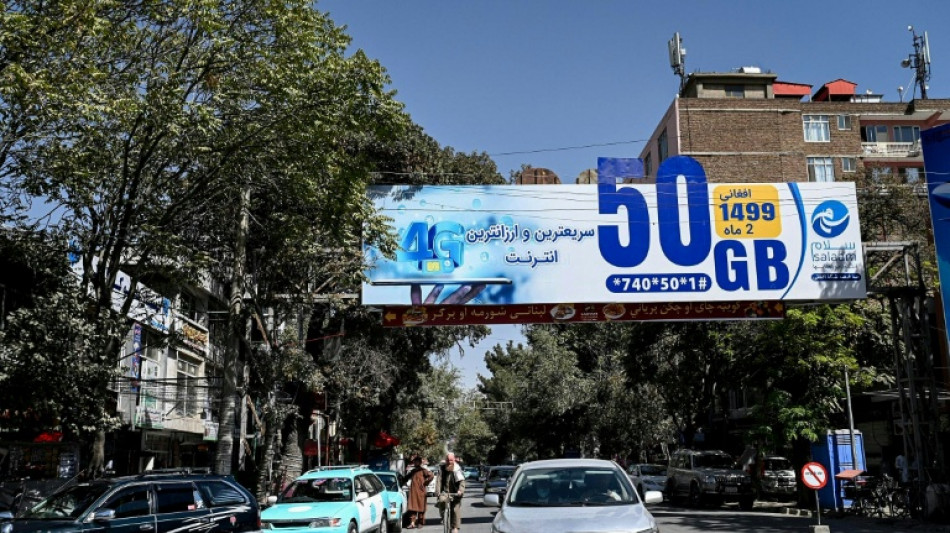
Mobile and data networks return across Afghanistan: AFP journalists / Photo: Wakil KOHSAR - AFP

 US Fed raises rates to tackle 'too high' inflation, irking Trump

 Turkey releases 106 protesters, jails more LGBTQ activists

 Candidate for UN chief calls for AI regulation akin to nuclear weapons

 'We're losing control,' AI pioneer Yoshua Bengio tells AFP

 IR-MED and Dice Technologies Announce collaboration to Evaluate and Advance Pressure-Injury Prevention Platform in Japan

 Watts, Pitt, Cruz to light up Spain's top film festival

 Toogood Gold's Table Mountain Sits in the Shadow of a Nevada Gold Rush

 MEXC July–August Security Report: 38.66M USDT in Risk Funds Intercepted, Futures Insurance Fund Hits 792M USDT

 Emporio Armani names Dario Vitale new creative director

 EU to ban social media for under 13s, curb access until 15

 Wildfires push endangered Sumatran elephants to brink: Indonesian NGO

 Bank of Japan set to raise rates under pressure from inflation, US

 EU chief to unveil social media, gaming curbs for under-15s

 'Resident Evil' film brings video game's ethos to the big screen

 GA-ASI Mojave First UAS To Complete Battlefield Short Field Ops

 Sanders, Bannon warn of AI dangers in rare US left-right alignment

 Empty benches as schools reopen in Venezuela's quake-hit Guaira

 Tiny English village holds 'independence' vote over asylum seeker housing

 US Treasury chief says to meet Chinese counterpart at weekend

 BingX Evolves into a Multi-Asset Trading Platform, Connecting Users to Global Opportunities

 International Trading Institute Expands Professional Trader Development Beyond the Master’s in Trading

 Lake Energy Secures $80 Million for U.S. Renewable Energy Expansion

 Stocks drop, oil climbs and Treasury yields hit 19-year high

 SkySail Strategies Outperforms Wall Street's 30-Year Risk Standard With Proprietary AI Inference Model

 Just add fish: Scientists pursue more rice, less disease in Senegal paddies

Mobile networks returned to several provinces across Afghanistan on Wednesday, including the capital Kabul, 48 hours after the Taliban authorities shut down telecommunications.
Confusion gripped the South Asian country on Monday night when mobile phone service and the internet went down.
The massive blackout came weeks after the government began cutting high-speed internet connections to some provinces to prevent "immorality", on the orders of shadowy supreme leader Hibatullah Akhundzada.
AFP journalists reported on Wednesday that mobile phone signals and wifi had returned to provinces across the country, including Kandahar in the south, Khost in the east, central Ghazni, and Herat in the west.
The Taliban government has yet to comment on the telecommunications shutdown.
It is the first time since the Taliban government won their insurgency in 2021 and imposed a strict version of Islamic law that communications have been cut in the country.
Netblocks, a watchdog organisation that monitors cybersecurity and internet governance, said the blackout "appears consistent with the intentional disconnection of service".
It said connectivity had slowed to one percent of ordinary levels.
A government official warned AFP minutes before the shutdown on Monday evening that the fibre optic network would be cut, affecting mobile phone services, "until further notice".
There were widespread closures of businesses, airports, and markets, while banks and post offices were unable to operate.
Afghans were unable to contact each other in or out of the country, and many families stopped their children from going to school during the uncertainty.
Those living in Herat and Kandahar travelled to border towns to catch signals from neighbouring Iran and Pakistan.
The United Nations said on Tuesday the shutdown "left Afghanistan almost completely cut off from the outside world", and called on authorities to restore access.
Internet connections have been extremely slow or intermittent over the past weeks.
On September 16, when the first internet services were first cut in northern provinces, Balkh provincial spokesman Attaullah Zaid said the ban had been ordered by the Taliban's leader.
"This measure was taken to prevent vice, and alternative options will be put in place across the country to meet connectivity needs," he wrote on social media.
"Recent studies in Afghanistan found that internet applications have badly affected the ongoing, economic, cultural and religious foundations of society," he said.
L.Peeters--CPN