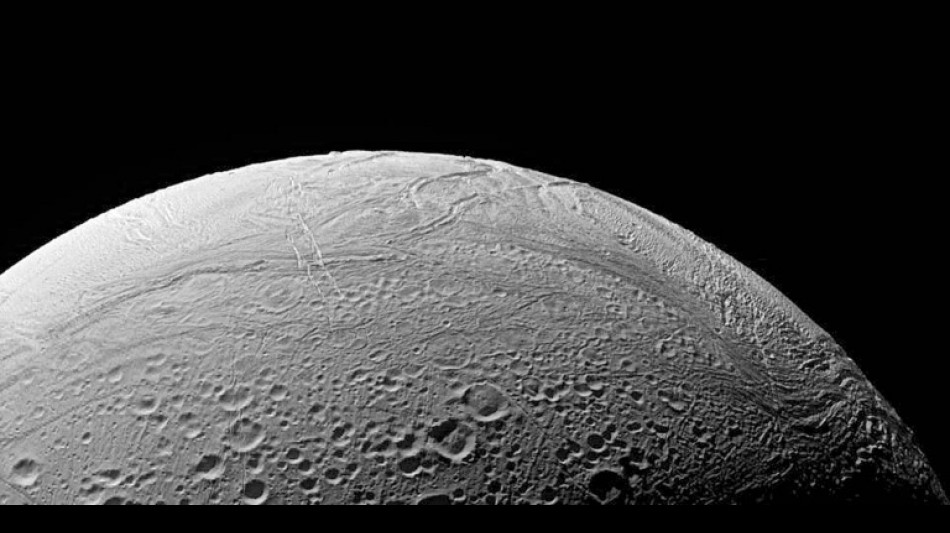
More ingredients for life discovered in ocean on Saturn moon / Photo: HO - AFP/File

 US Fed raises rates to tackle 'too high' inflation, irking Trump

 Turkey releases 106 protesters, jails more LGBTQ activists

 Candidate for UN chief calls for AI regulation akin to nuclear weapons

 'We're losing control,' AI pioneer Yoshua Bengio tells AFP

 IR-MED and Dice Technologies Announce collaboration to Evaluate and Advance Pressure-Injury Prevention Platform in Japan

 Watts, Pitt, Cruz to light up Spain's top film festival

 Toogood Gold's Table Mountain Sits in the Shadow of a Nevada Gold Rush

 MEXC July–August Security Report: 38.66M USDT in Risk Funds Intercepted, Futures Insurance Fund Hits 792M USDT

 Emporio Armani names Dario Vitale new creative director

 EU to ban social media for under 13s, curb access until 15

 Wildfires push endangered Sumatran elephants to brink: Indonesian NGO

 Bank of Japan set to raise rates under pressure from inflation, US

 EU chief to unveil social media, gaming curbs for under-15s

 'Resident Evil' film brings video game's ethos to the big screen

 GA-ASI Mojave First UAS To Complete Battlefield Short Field Ops

 Sanders, Bannon warn of AI dangers in rare US left-right alignment

 Empty benches as schools reopen in Venezuela's quake-hit Guaira

 Tiny English village holds 'independence' vote over asylum seeker housing

 US Treasury chief says to meet Chinese counterpart at weekend

 BingX Evolves into a Multi-Asset Trading Platform, Connecting Users to Global Opportunities

 International Trading Institute Expands Professional Trader Development Beyond the Master’s in Trading

 Lake Energy Secures $80 Million for U.S. Renewable Energy Expansion

 Stocks drop, oil climbs and Treasury yields hit 19-year high

 SkySail Strategies Outperforms Wall Street's 30-Year Risk Standard With Proprietary AI Inference Model

 Just add fish: Scientists pursue more rice, less disease in Senegal paddies

The ocean hidden under the icy shell of Saturn's moon Enceladus harbours complex organic molecules, a study said Wednesday, offering further evidence that the small world could have all the right ingredients to host extraterrestrial life.
Just 500 kilometres (310 miles) wide and invisible to the naked eye, the white, scar-covered Enceladus is one of hundreds of moons orbiting the sixth planet from the Sun.
For a long time, scientists believed Enceladus was too far away from the Sun -- and therefore too cold -- to be habitable.
Then the Cassini space probe flew past the moon several times during a 2004-2017 trip to Saturn and its rings, discovering evidence that a vast saltwater ocean is concealed under the moon's kilometres-thick layer of ice.
Since then, scientists have been sifting through the data collected by Cassini, revealing that the ocean has many of the elements thought to be needed to host life, including salt, methane, carbon dioxide and phosphorus.
When the spacecraft passed over the moon's south pole, it discovered jets of water bursting through cracks on the surface.
These jets were propelling tiny ice particles -- smaller than grains of sand -- into space. While some of these ice grains fell back to the moon's surface, others collected around one of Saturn's many rings.
When Cassini flew through Saturn's outermost "E" ring, it was "detecting samples from Enceladus all the time," Nozair Khawaja, a planetary scientist at the Free University of Berlin and lead author of the new study, said in a statement from the European Space agency.
By looking through these samples, scientists had previously identified numerous organic molecules -- including the precursors of amino acids, which are fundamental building blocks of life.
But these ice grains could have been altered after being trapped in the ring for hundreds of years -- or beaten up by blasts of cosmic radiation.
So the scientists wanted to look at some fresh ice grains.
Luckily, they already had access to some.
When Cassini flew directly into the spray spewing from the moon's surface in 2008, grains of ice hit the spacecraft's Cosmic Dust Analyzer at around 18 kilometres a second.
But it took years to complete a detailed chemical analysis of these particles, which was the subject of the study published in the journal Nature Astronomy.
- Back to the moon? -
Study co-author Frank Postberg said the research proves that "the complex organic molecules Cassini detected in Saturn's E ring are not just a product of long exposure to space, but are readily available in Enceladus's ocean".
French astrochemist Caroline Freissinet, who was not involved in the study, told AFP that there was "not much doubt" that these molecules were in the moon's ocean.
But this confirmation provides "another piece in the puzzle," she added.
It also shows that recent technology such as artificial intelligence allows scientists to perform new kinds of analysis on old data, she said.
But to get the best idea about what is happening on Enceladus, a mission would need to land near the icy geysers and collect samples, she added.
The European Space Agency has been studying the potential of a mission that would do just that.
After all, "Enceladus ticks all the boxes to be a habitable environment that could support life," the agency said in the statement.
Khawaja added that "even not finding life on Enceladus would be a huge discovery, because it raises serious questions about why life is not present in such an environment when the right conditions are there."
X.Cheung--CPN