AI tool helps researchers treat child epilepsy / Photo: John SAEKI, Laurence CHU, Nicholas SHEARMAN - AFP

 US Fed raises rates to tackle 'too high' inflation, irking Trump

 Turkey releases 106 protesters, jails more LGBTQ activists

 Candidate for UN chief calls for AI regulation akin to nuclear weapons

 'We're losing control,' AI pioneer Yoshua Bengio tells AFP

 IR-MED and Dice Technologies Announce collaboration to Evaluate and Advance Pressure-Injury Prevention Platform in Japan

 Watts, Pitt, Cruz to light up Spain's top film festival

 Toogood Gold's Table Mountain Sits in the Shadow of a Nevada Gold Rush

 MEXC July–August Security Report: 38.66M USDT in Risk Funds Intercepted, Futures Insurance Fund Hits 792M USDT

 Emporio Armani names Dario Vitale new creative director

 EU to ban social media for under 13s, curb access until 15

 Wildfires push endangered Sumatran elephants to brink: Indonesian NGO

 Bank of Japan set to raise rates under pressure from inflation, US

 EU chief to unveil social media, gaming curbs for under-15s

 'Resident Evil' film brings video game's ethos to the big screen

 GA-ASI Mojave First UAS To Complete Battlefield Short Field Ops

 Sanders, Bannon warn of AI dangers in rare US left-right alignment

 Empty benches as schools reopen in Venezuela's quake-hit Guaira

 Tiny English village holds 'independence' vote over asylum seeker housing

 US Treasury chief says to meet Chinese counterpart at weekend

 BingX Evolves into a Multi-Asset Trading Platform, Connecting Users to Global Opportunities

 International Trading Institute Expands Professional Trader Development Beyond the Master’s in Trading

 Lake Energy Secures $80 Million for U.S. Renewable Energy Expansion

 Stocks drop, oil climbs and Treasury yields hit 19-year high

 SkySail Strategies Outperforms Wall Street's 30-Year Risk Standard With Proprietary AI Inference Model

 Just add fish: Scientists pursue more rice, less disease in Senegal paddies

An artificial intelligence tool that can detect tiny, hard-to-spot brain malformations in children with epilepsy could help patients access life-changing surgery quicker, Australian researchers said on Wednesday.
It is the latest example of how AI, which can crunch vast amounts of data, is changing healthcare by assisting doctors with diagnoses.
Epilepsy has several different causes, and overall around three in 10 cases are down to structural abnormalities in the brain, experts say.
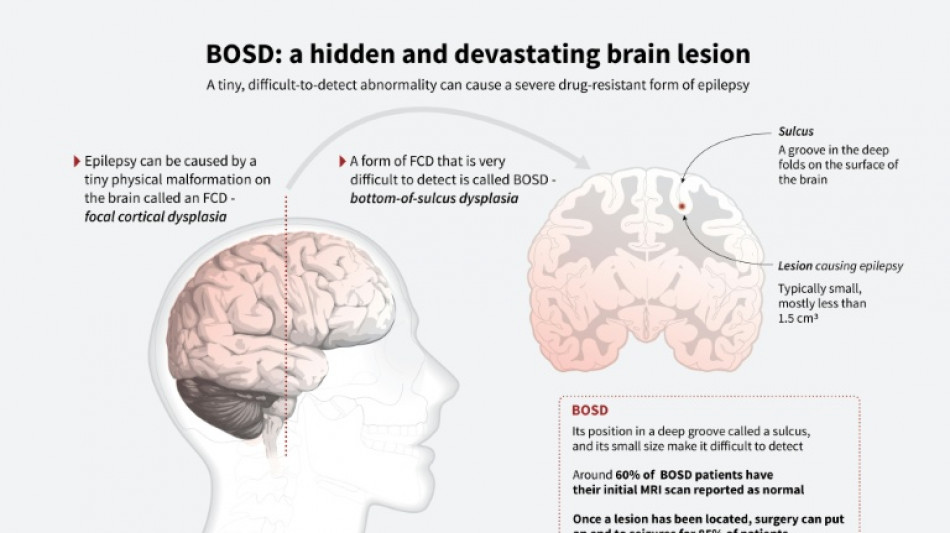
These are often missed on MRI scans -- especially the smallest lesions, sometimes hidden at the bottom of a brain fold.
A team led by Emma Macdonald-Laurs, a paediatric neurologist at the Royal Children's Hospital in Melbourne, trained an AI tool on child brain images to find lesions the size of a blueberry or smaller.
"They're frequently missed and many children are not considered as surgical candidates," Macdonald-Laurs told a briefing ahead of the publication of her team's study in the journal Epilepsia.
"The tool doesn't replace radiologists or epilepsy doctors, but it's like a detective that helps us put the puzzle pieces together quicker so we can offer potentially life-changing surgery," she said.
Of the patients who took part, with conditions known as cortical dysplasia and focal epilepsy, 80 percent had previously had an MRI scan come back as normal.
When the researchers used the AI tool to analyse both MRI and another type of medical scan called a PET, its success rate was 94 percent for one test group and 91 percent for another.
Out of 17 children in the first group, 12 had surgery to remove their brain lesions, and 11 are now seizure-free, said Macdonald-Laurs's team at the Murdoch Children's Research Institute.
"Our next plans are to test this detector in more real-life hospital settings on new undiagnosed patients," she said.
Epilepsy, which causes recurrent seizures, affects about one in 200 children, and about a third of cases are drug-resistent.
"This work is really exciting" as a proof of concept and the results are "really impressive", Konrad Wagstyl, a biomedical computing expert at King's College London (KCL), told AFP.
Similar research published in February by a KCL team using AI on MRI data spotted 64 percent of epilepsy-linked brain lesions that were missed by radiologists.
The Australian researchers used MRI with PET, "but some caveats are that PET is expensive, it's not as widely available as MRI, and there is a dose of radiation like a CT scan or an X-ray associated with it," Wagstyl noted.
P.Kolisnyk--CPN