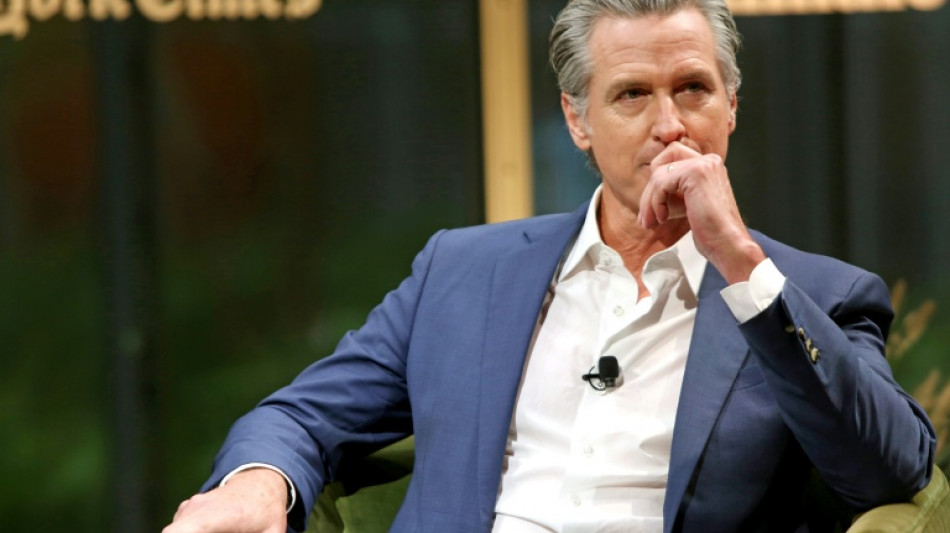
California enacts AI safety law targeting tech giants / Photo: Yana Paskova - GETTY IMAGES NORTH AMERICA/AFP

 US Fed raises rates to tackle 'too high' inflation, irking Trump

 Turkey releases 106 protesters, jails more LGBTQ activists

 Candidate for UN chief calls for AI regulation akin to nuclear weapons

 'We're losing control,' AI pioneer Yoshua Bengio tells AFP

 IR-MED and Dice Technologies Announce collaboration to Evaluate and Advance Pressure-Injury Prevention Platform in Japan

 Watts, Pitt, Cruz to light up Spain's top film festival

 Toogood Gold's Table Mountain Sits in the Shadow of a Nevada Gold Rush

 MEXC July–August Security Report: 38.66M USDT in Risk Funds Intercepted, Futures Insurance Fund Hits 792M USDT

 Emporio Armani names Dario Vitale new creative director

 EU to ban social media for under 13s, curb access until 15

 Wildfires push endangered Sumatran elephants to brink: Indonesian NGO

 Bank of Japan set to raise rates under pressure from inflation, US

 EU chief to unveil social media, gaming curbs for under-15s

 'Resident Evil' film brings video game's ethos to the big screen

 GA-ASI Mojave First UAS To Complete Battlefield Short Field Ops

 Sanders, Bannon warn of AI dangers in rare US left-right alignment

 Empty benches as schools reopen in Venezuela's quake-hit Guaira

 Tiny English village holds 'independence' vote over asylum seeker housing

 US Treasury chief says to meet Chinese counterpart at weekend

 BingX Evolves into a Multi-Asset Trading Platform, Connecting Users to Global Opportunities

 International Trading Institute Expands Professional Trader Development Beyond the Master’s in Trading

 Lake Energy Secures $80 Million for U.S. Renewable Energy Expansion

 Stocks drop, oil climbs and Treasury yields hit 19-year high

 SkySail Strategies Outperforms Wall Street's 30-Year Risk Standard With Proprietary AI Inference Model

 Just add fish: Scientists pursue more rice, less disease in Senegal paddies

California Governor Gavin Newsom has signed into law groundbreaking legislation requiring the world's largest artificial intelligence companies to publicly disclose their safety protocols and report critical incidents, state lawmakers announced Monday.
Senate Bill 53 marks California's most significant move yet to regulate Silicon Valley's rapidly advancing AI industry while also maintaining its position as a global tech hub.
"With a technology as transformative as AI, we have a responsibility to support that innovation while putting in place commonsense guardrails," State Senator Scott Wiener, the bill's sponsor, said in a statement.
The new law represents a successful second attempt by Wiener to establish AI safety regulations after Newsom vetoed his previous bill, SB 1047, after furious pushback from the tech industry.
It also comes after a failed attempt by the Trump administration to prevent states from enacting AI regulations, under the argument that they would create regulatory chaos and slow US-made innovation in a race with China.
The new law says major AI companies have to publicly disclose their safety and security protocols in redacted form to protect intellectual property.
They must also report critical safety incidents -- including model-enabled weapons threats, major cyber-attacks, or loss of model control -- within 15 days to state officials.
The legislation also establishes whistleblower protections for employees who reveal evidence of dangers or violations.
According to Wiener, California's approach differs from the European Union's landmark AI Act, which requires private disclosures to government agencies.
SB 53, meanwhile, mandates public disclosure to ensure greater accountability.
In what advocates describe as a world-first provision, the law requires companies to report instances where AI systems engage in dangerous deceptive behavior during testing.
For example, if an AI system lies about the effectiveness of controls designed to prevent it from assisting in bioweapon construction, developers must disclose the incident if it materially increases catastrophic harm risks.
The working group behind the law was led by prominent experts including Stanford University's Fei-Fei Li, known as the "godmother of AI."
S.F.Lacroix--CPN