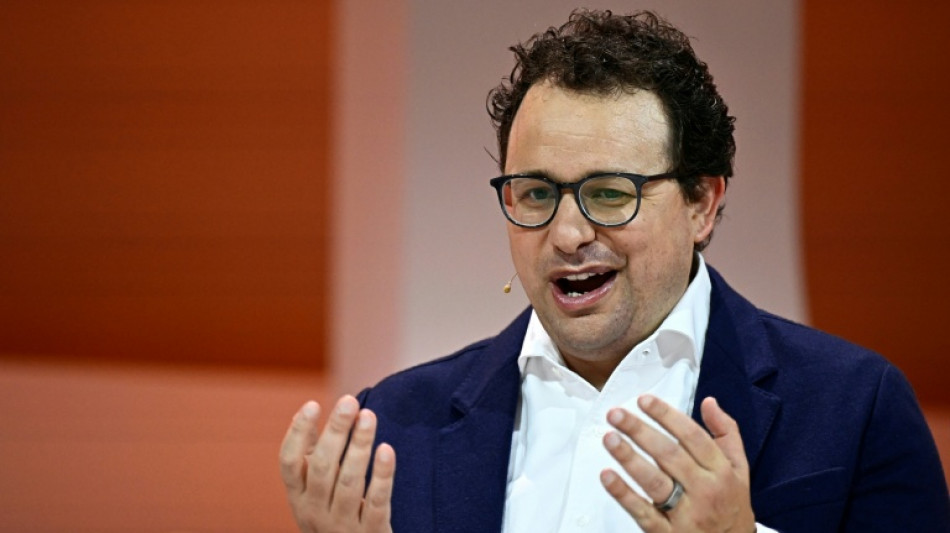
Anthropic launches new AI model, touting coding supremacy / Photo: JULIEN DE ROSA - AFP

 US Fed raises rates to tackle 'too high' inflation, irking Trump

 Turkey releases 106 protesters, jails more LGBTQ activists

 Candidate for UN chief calls for AI regulation akin to nuclear weapons

 'We're losing control,' AI pioneer Yoshua Bengio tells AFP

 IR-MED and Dice Technologies Announce collaboration to Evaluate and Advance Pressure-Injury Prevention Platform in Japan

 Watts, Pitt, Cruz to light up Spain's top film festival

 Toogood Gold's Table Mountain Sits in the Shadow of a Nevada Gold Rush

 MEXC July–August Security Report: 38.66M USDT in Risk Funds Intercepted, Futures Insurance Fund Hits 792M USDT

 Emporio Armani names Dario Vitale new creative director

 EU to ban social media for under 13s, curb access until 15

 Wildfires push endangered Sumatran elephants to brink: Indonesian NGO

 Bank of Japan set to raise rates under pressure from inflation, US

 EU chief to unveil social media, gaming curbs for under-15s

 'Resident Evil' film brings video game's ethos to the big screen

 GA-ASI Mojave First UAS To Complete Battlefield Short Field Ops

 Sanders, Bannon warn of AI dangers in rare US left-right alignment

 Empty benches as schools reopen in Venezuela's quake-hit Guaira

 Tiny English village holds 'independence' vote over asylum seeker housing

 US Treasury chief says to meet Chinese counterpart at weekend

 BingX Evolves into a Multi-Asset Trading Platform, Connecting Users to Global Opportunities

 International Trading Institute Expands Professional Trader Development Beyond the Master’s in Trading

 Lake Energy Secures $80 Million for U.S. Renewable Energy Expansion

 Stocks drop, oil climbs and Treasury yields hit 19-year high

 SkySail Strategies Outperforms Wall Street's 30-Year Risk Standard With Proprietary AI Inference Model

 Just add fish: Scientists pursue more rice, less disease in Senegal paddies

US startup Anthropic on Monday announced the launch of its new generative artificial intelligence model, Claude Sonnet 4.5, which it says is the world's best for computer programming.
Anthropic was created in early 2021 by former OpenAI staff who felt their employer, led by CEO Sam Altman, was not doing enough to control and prevent the potentially harmful effects of its models.
Backed by Amazon, it quickly joined the major players in generative AI that embarked on a frantic race after the arrival of ChatGPT from OpenAI in November 2022, with new models being released at a furious pace with ever-expanding capabilities.
While trailing OpenAI in terms of users and name recognition, Anthropic had been considered for several months the top performer in generative AI for computer coding.
This is seen as a highly strategic accomplishment, with programming often cited as the specialty most ripe for disruption -- and revenue generation -- by AI in the near term.
But OpenAI's most recent assistant, GPT-5, launched in early August, had taken the lead in certain rankings for AI-generated programming, putting pressure on Anthropic to deliver more capability in its next offering.
In a key benchmark, Claude Sonnet 4.5, a new generation of language model, can operate autonomously for 30 hours straight once it is assigned a task.
This is a significant leap from Anthropic's most powerful version until now, Claude 4 Opus, which could only run for seven hours.
These generative AI programs function alone for several hours as they regularly evaluate their own output and make changes and corrections autonomously.
Claude Sonnet 4.5 achieved the highest score when tested by the independent evaluation system SWE-Bench Verified, developed by researchers from Princeton and Stanford universities.
It is also, according to Anthropic, the most advanced model for developing AI agents capable of making real-world decisions for which they have not been trained or specifically programmed.
Anthropic's new release is also the most sophisticated for applications that allow an AI assistant to use a computer as a human would.
Upon request in everyday language, the interface can perform a Google search or update a calendar.
This functionality was first offered by Anthropic in October 2024.
OpenAI launched an equivalent product, Operator, in January 2025.
A.Mykhailo--CPN