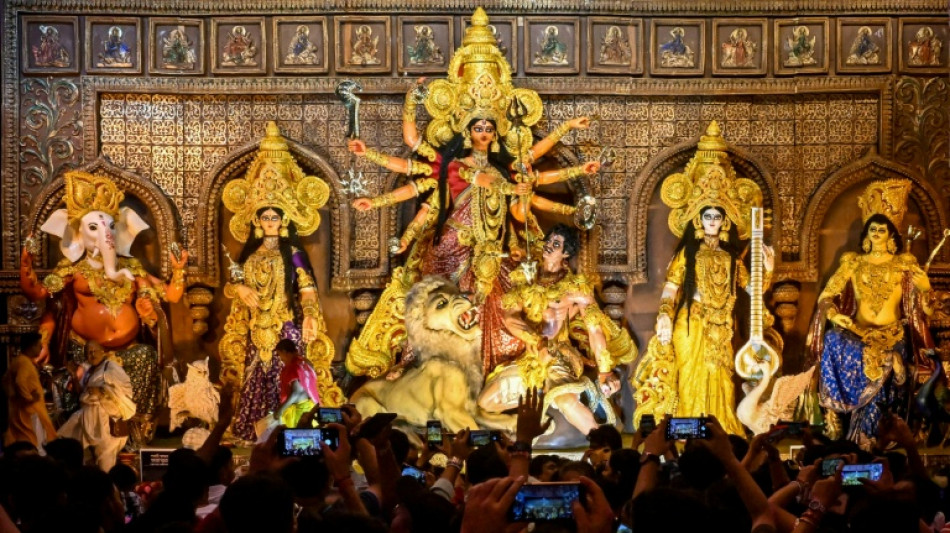
India's divine designs meld with AI at Durga Puja festival / Photo: Dibyangshu SARKAR - AFP

 US Fed raises rates to tackle 'too high' inflation, irking Trump

 Turkey releases 106 protesters, jails more LGBTQ activists

 Candidate for UN chief calls for AI regulation akin to nuclear weapons

 'We're losing control,' AI pioneer Yoshua Bengio tells AFP

 IR-MED and Dice Technologies Announce collaboration to Evaluate and Advance Pressure-Injury Prevention Platform in Japan

 Watts, Pitt, Cruz to light up Spain's top film festival

 Toogood Gold's Table Mountain Sits in the Shadow of a Nevada Gold Rush

 MEXC July–August Security Report: 38.66M USDT in Risk Funds Intercepted, Futures Insurance Fund Hits 792M USDT

 Emporio Armani names Dario Vitale new creative director

 EU to ban social media for under 13s, curb access until 15

 Wildfires push endangered Sumatran elephants to brink: Indonesian NGO

 Bank of Japan set to raise rates under pressure from inflation, US

 EU chief to unveil social media, gaming curbs for under-15s

 'Resident Evil' film brings video game's ethos to the big screen

 GA-ASI Mojave First UAS To Complete Battlefield Short Field Ops

 Sanders, Bannon warn of AI dangers in rare US left-right alignment

 Empty benches as schools reopen in Venezuela's quake-hit Guaira

 Tiny English village holds 'independence' vote over asylum seeker housing

 US Treasury chief says to meet Chinese counterpart at weekend

 BingX Evolves into a Multi-Asset Trading Platform, Connecting Users to Global Opportunities

 International Trading Institute Expands Professional Trader Development Beyond the Master’s in Trading

 Lake Energy Secures $80 Million for U.S. Renewable Energy Expansion

 Stocks drop, oil climbs and Treasury yields hit 19-year high

 SkySail Strategies Outperforms Wall Street's 30-Year Risk Standard With Proprietary AI Inference Model

 Just add fish: Scientists pursue more rice, less disease in Senegal paddies
Millions in India's eastern city of Kolkata will draw on millennia-old traditions when they celebrate the Hindu festival of Durga Puja this week with street parties and worshipping idols in elaborate pavilions.
The ancient and divine now increasingly interact with the digital and futuristic as wildly popular artificial intelligence apps help generate new design ideas.
"Artisans are now using artificial intelligence to find new designs, helping them to stay updated," potter Monti Paul said as he admired his statue of the goddess Durga.
The statue, made of clay moulded onto a wire-and-straw frame and painted in neon pinks and blues, depicts the 10-armed, three-eyed goddess riding a lion while slaying a demon buffalo in a celebration of the triumph of good over evil.
Paul, 70, learnt his craft from his father, like hundreds of other potters in the narrow alleys of Kumartuli, the city's centuries-old idol-making hub.
Kolkata is home to more than 15 million people and each year it erupts in a 10-day celebration of art, music, and devotion, an event UNESCO has recognised as part of humanity's "intangible cultural heritage".
At its heart are the intricately crafted idols and the temporary temples, or "pandals", commissioned by thousands of community clubs.
Many reflect contemporary themes, from politics to pop culture.
- 'AI-driven images' -
Artisans race each year to create works more striking than before.
For decades, designs were either drawn on paper or described verbally by the thousands of committees commissioning them, Paul explained.
But the commissioning communities now also use AI apps, which generate fantastical pictures through text prompts, to translate ideas into images.
"This year, many festival organisers are opting for AI-driven images -- they give us pictures of idols from ChatGPT," he said, noting that they draw on the "thousands of images of Durga idols from ancient times".
"We then try to create the designs of the idols as the organisers wish."
India, with 900 million internet users, according to the Internet and Mobile Association of India, has become one of the world's largest markets for AI tools.
It is the biggest user base for Google's Nano Banana image-generation model and the second-largest for ChatGPT.
China has more internet users, but India is open to US tech companies.
- 'Blessing or a curse' -
The fusion of AI with Durga Puja has itself become a theme for some.
Subal Paul, secretary at a century-old community club in north Kolkata, said they chose artificial intelligence as their motif.
"We took the help of ChatGPT and other AI tools to get the idea of the pandal and idol of the goddess Durga," he said.
"We took the help of chatbots... highlighting how artificial intelligence is shaping our life."
Their pavilion is decorated with giant computer keyboards and flashing lights, set against a backdrop resembling IT office towers.
Two life-size robots guard the entrance, while another whirls atop the pandal roof before the idol.
"The old order has changed, yielding place to a new one," 45-year-old Subal Paul said. "We don't know if it is a blessing or a curse."
For many, the technology only enhances a festival famed for transcending barriers of class, religion and community.
"There is nothing as spectacular and soulful like this tradition," said Ajoy Bhattacharya, 80, a scholar of Sanskrit scriptures.
"It's an amalgamation of tradition, culture and modernity."
M.Anderson--CPN