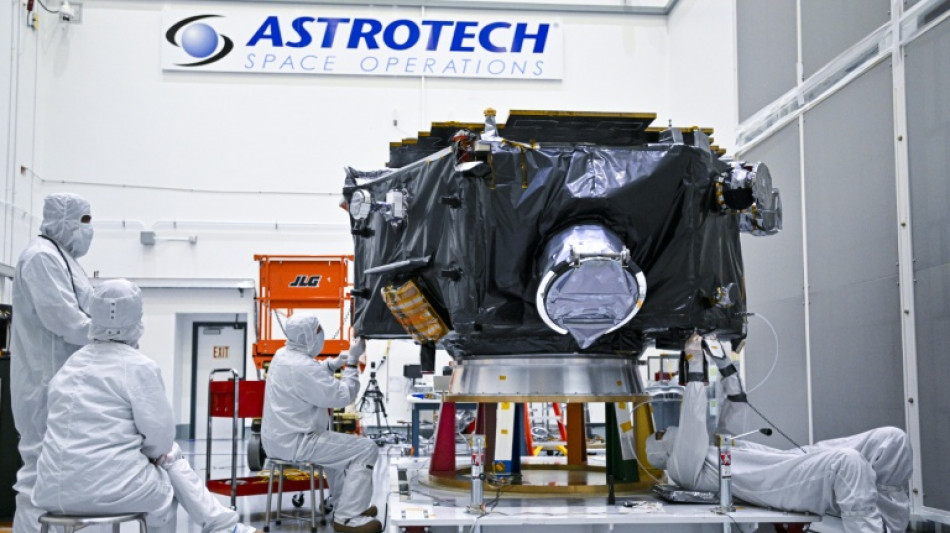
NASA launches mission to study space weather / Photo: Miguel J. Rodriguez Carrillo - AFP

 US Fed raises rates to tackle 'too high' inflation, irking Trump

 Turkey releases 106 protesters, jails more LGBTQ activists

 Candidate for UN chief calls for AI regulation akin to nuclear weapons

 'We're losing control,' AI pioneer Yoshua Bengio tells AFP

 IR-MED and Dice Technologies Announce collaboration to Evaluate and Advance Pressure-Injury Prevention Platform in Japan

 Watts, Pitt, Cruz to light up Spain's top film festival

 Toogood Gold's Table Mountain Sits in the Shadow of a Nevada Gold Rush

 MEXC July–August Security Report: 38.66M USDT in Risk Funds Intercepted, Futures Insurance Fund Hits 792M USDT

 Emporio Armani names Dario Vitale new creative director

 EU to ban social media for under 13s, curb access until 15

 Wildfires push endangered Sumatran elephants to brink: Indonesian NGO

 Bank of Japan set to raise rates under pressure from inflation, US

 EU chief to unveil social media, gaming curbs for under-15s

 'Resident Evil' film brings video game's ethos to the big screen

 GA-ASI Mojave First UAS To Complete Battlefield Short Field Ops

 Sanders, Bannon warn of AI dangers in rare US left-right alignment

 Empty benches as schools reopen in Venezuela's quake-hit Guaira

 Tiny English village holds 'independence' vote over asylum seeker housing

 US Treasury chief says to meet Chinese counterpart at weekend

 BingX Evolves into a Multi-Asset Trading Platform, Connecting Users to Global Opportunities

 International Trading Institute Expands Professional Trader Development Beyond the Master’s in Trading

 Lake Energy Secures $80 Million for U.S. Renewable Energy Expansion

 Stocks drop, oil climbs and Treasury yields hit 19-year high

 SkySail Strategies Outperforms Wall Street's 30-Year Risk Standard With Proprietary AI Inference Model

 Just add fish: Scientists pursue more rice, less disease in Senegal paddies

The United States launched three spacecraft on Wednesday in an effort to better monitor space weather such as solar storms, which can interfere with technology and power systems on Earth.
The three probes blasted off from Florida's Kennedy Space Center aboard a Falcon 9 rocket, built by the private company SpaceX.
Once in space, the probes will begin a long journey to reach the Lagrange 1 point -- a spot approximately 1.5 million kilometers (930,000 miles) from the Sun that offers a stable vantage point for observation.
The "Interstellar Mapping and Acceleration Probe" (IMAP) will use its instruments to study the Sun's high-energy particles and the protective magnetic bubble surrounding our solar system known as the heliosphere, data that can offer insight into space weather and cosmic radiation.
Solar storms are high-radiation events caused by flares on the Sun's surface, and are very difficult to predict.
They can impact activities on Earth, including aviation, mobile communications and power grids -- and potentially endanger astronauts and satellites in space.
The Space Weather Follow-on (SWFO-L1) spacecraft, operated by the National Oceanic and Atmospheric Administration (NOAA), aims to detect the weather patterns in advance.
"It can't stop an incoming threat, but it can give us time to prepare," said Irene Parker of NOAA.
With notice, authorities could shelter astronauts, warn aircraft pilots of forthcoming disruptions of GPS systems and adapt power grids in anticipation.
And the Carruthers Geocorona Observatory, the third passenger on the rocket, will study the Earth's exosphere in a bid to better understand how space weather affects it.
J.Bondarev--CPN