Ukrainian becomes second woman to win Fields maths medal / Photo: Vesa Moilanen - Lehtikuva/AFP

 Emporio Armani names Dario Vitale new creative director

 EU to ban social media for under 13s, curb access until 15

 Wildfires push endangered Sumatran elephants to brink: Indonesian NGO

 Bank of Japan set to raise rates under pressure from inflation, US

 EU chief to unveil social media, gaming curbs for under-15s

 'Resident Evil' film brings video game's ethos to the big screen

 i-payout Expands U.S. Money Transmitter Licensing Footprint and Advances European EMI Strategy

 US Senate crypto bill collapses amid partisan deadlock

 OpenAI, Anthropic and Google are working to create an AI standards body

 Protesting shepherds, farmers clash with Romanian police

 Foundation Lets Ledger Users Switch to Open Source Without Starting Over

 EU to propose curbing social media, online games for under 15s

 FX Junction Reaches 40,600 Members and 26 Million Trades

 'We unleashed the beast': the world's fears and hopes about AI

 Hospitality leaders ask Burnham to halve VAT amid rising costs

 Worcestershire invited to nominate groups for 2027 King’s volunteer award

 Berlin's run-down public spaces at heart of election campaign

 'Widow's Bay' and 'The Pitt' win big at Emmy Awards

 Most markets drop as oil extends gains ahead of expected US rate hike

 Sri Lanka's famed beach shack battles demolition

 Vserv targets ₹1,000 crore revenue by 2030 through AI expansion
 India prohibits bank fees on UPI payments up to ₹2,000

 Brazil's Amazon defender Raoni has cancer

 Trump rejects AI slowdown concerns as UN urges coordinated controls

 Higher wages draw migrant workers to Kashmir despite attacks

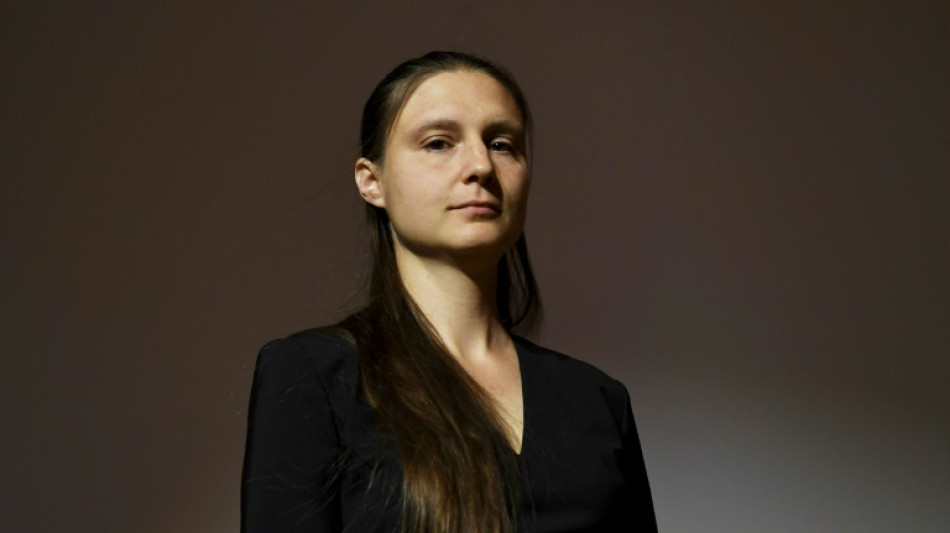
Ukraine's Maryna Viazovska paid tribute to those suffering in her war-torn country on Tuesday when she became the second woman to be awarded the Fields Medal, known as the Nobel prize for mathematics.
Viazovska, a 37-year-old maths professor, received the prestigious award alongside three other winners at a ceremony in Helsinki.
"I am from Kyiv, Ukraine, and in February my life changed forever" when Moscow invaded, she said in a video displayed at the ceremony.
"Not only for me but for everyone in the world and especially the people in my country," she said, adding that her two sisters had been evacuated from Kyiv.
"Right now Ukrainians are really paying the highest price for our beliefs and our freedom."
The International Congress of Mathematicians, the event where the prize is awarded, was initially scheduled to be held in Russia's second city, Saint Petersburg, and opened by President Vladimir Putin.
Earlier in the year hundreds of mathematicians signed an open letter protesting at the choice of the host city, and after Moscow invaded Ukraine the event was moved to the Finnish capital.
The other Fields winners were France's Hugo Duminil-Copin of the University of Geneva, Britain's James Maynard of Oxford University and June Huh of Princeton in the United States.
The medal, along with $15,000 Canadian dollars ($11,600), is awarded every four years to between two to four candidates under the age of 40 for "outstanding mathematical achievement".
- 'Sad and angry' -
Viazovska was born in 1984 in Ukraine and has been chair of number theory at the Ecole Polytechnique Federale de Lausanne since 2018.
At the ceremony she paid tribute to Yulia Zdanovska, a young mathematician who was killed by a Russian missile attack on the Ukrainian city of Kharkiv in March.
"Her dream was to raise this new generation of scientist, doctors, teachers," Viazovska told AFP.
"The fact that these dreams will not be realised, it's terrible. We could just think of what kind of great future we could have had and what the war is robbing us of."
She felt "very sad and angry" and "feels a lot of pain every time I read the news", she added.
In a decision made before the war in Ukraine began, Viazovska was awarded the Fields Medal for her work in sphere packing -- a problem posed by German astronomer and mathematician Johannes Kepler nearly 400 years ago.
He proposed that the most compact way to pack spheres was in a pyramid, like oranges at a supermarket.
It was such a complex problem that it was not considered proved correct in the third dimension until 1998 via intense computer number-crunching.
Then in 2016, Viazovska solved the problem in the eighth dimension, using what is called an E8 lattice, and later also solved it in the 24th dimension.
Marcus du Sautoy, a British mathematics professor at Oxford University, told AFP it was a surprise when Viazovska came up with such "slick proof" compared to the "tortuous proof needed in three dimensions".
The only previous female laureate in the prize's 86-year history was Iranian mathematician Maryam Mirzakhani, who died of breast cancer in 2017 just three years after winning the award.
Du Sautoy said he hoped Viazovska's win "will contribute to inspiring more women to choose mathematics as a career".
- 'Express the inexpressible' -
Duminil-Copin, 36, is a professor at both the University of Geneva and the French Institut des Hautes Etudes Scientifiques.
He was honoured for solving "long-standing problems in the probabilistic theory of phase transitions", which, according to the jury, has opened up several new research directions.
Maynard, 35, received the medal "for contributions to analytic number theory, which have led to major advances in the understanding in the structure of prime numbers".
Du Sautoy said that even though prime numbers "get rarer and rarer as you count through the universe of numbers", his Oxford colleague had been "able to show that infinitely often you'll see two primes close together".
June Huh, 39, was given the award for "transforming" the field of geometric combinatorics, "using methods of Hodge theory, tropical geometry and singularity theory".
He is one of the rare Fields winner not to have focussed on mathematics in his teen years, after a bad elementary school test score convinced him he didn't have a talent for it, he told Quanta Magazine.
"When I was young, math was like a faraway land, surrounded by giant walls that I could not climb," Huh said in his video.
"I grew up in Korea and I dreamed of becoming a poet, to express the inexpressible. I eventually learned that mathematics is a way of doing that."
T.Morelli--CPN