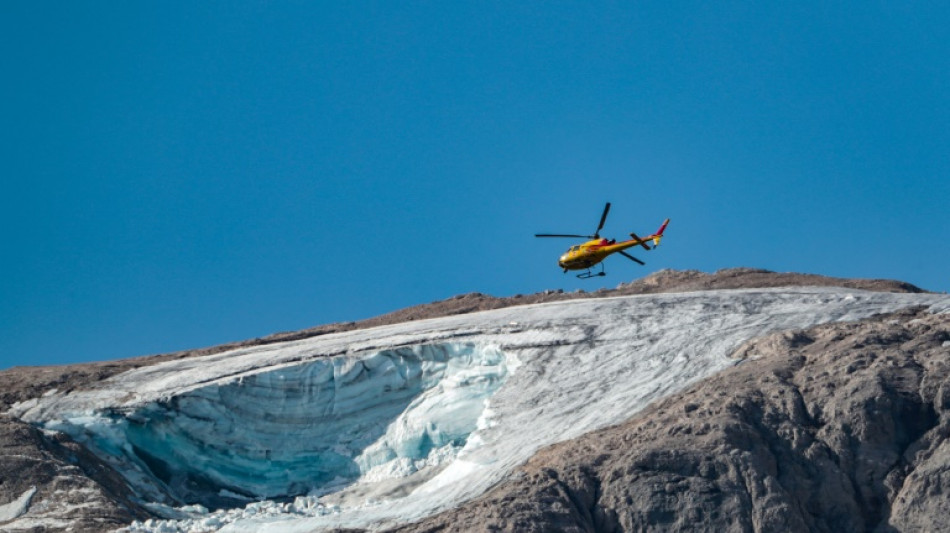
Italy blames climate change for glacier collapse, 7 dead / Photo: Pierre TEYSSOT - AFP

 Emporio Armani names Dario Vitale new creative director

 EU to ban social media for under 13s, curb access until 15

 Wildfires push endangered Sumatran elephants to brink: Indonesian NGO

 Bank of Japan set to raise rates under pressure from inflation, US

 EU chief to unveil social media, gaming curbs for under-15s

 'Resident Evil' film brings video game's ethos to the big screen

 i-payout Expands U.S. Money Transmitter Licensing Footprint and Advances European EMI Strategy

 US Senate crypto bill collapses amid partisan deadlock

 OpenAI, Anthropic and Google are working to create an AI standards body

 Protesting shepherds, farmers clash with Romanian police

 Foundation Lets Ledger Users Switch to Open Source Without Starting Over

 EU to propose curbing social media, online games for under 15s

 FX Junction Reaches 40,600 Members and 26 Million Trades

 'We unleashed the beast': the world's fears and hopes about AI

 Hospitality leaders ask Burnham to halve VAT amid rising costs

 Worcestershire invited to nominate groups for 2027 King’s volunteer award

 Berlin's run-down public spaces at heart of election campaign

 'Widow's Bay' and 'The Pitt' win big at Emmy Awards

 Most markets drop as oil extends gains ahead of expected US rate hike
 Sri Lanka's famed beach shack battles demolition

 Vserv targets ₹1,000 crore revenue by 2030 through AI expansion

 India prohibits bank fees on UPI payments up to ₹2,000

 Brazil's Amazon defender Raoni has cancer

 Trump rejects AI slowdown concerns as UN urges coordinated controls

 Higher wages draw migrant workers to Kashmir despite attacks

Italy's prime minister on Monday linked the collapse of the country's biggest Alpine glacier to climate change, as hopes faded of finding further survivors from a disaster that killed at least seven people.
Eight people were injured and another 14 were reported missing, authorities said, cautioning that it was not clear how many climbers were caught when the glacier gave way on Sunday.
Ice and rock thundered down Marmolada, the highest mountain in the Italian Dolomites, at 300 kilometres an hour (185 miles per hour), according to the head of Trento province, Maurizio Fugatti.
Rescuers used thermal drones to seek heat from potential survivors, although chances of finding them were "slim to nothing", the region's Alpine Rescue Service head Giorgio Gajer told AGI news agency.
The bodies recovered so far were found "torn apart", rescuer Gino Comelli said.
The disaster struck one day after a record-high temperature of 10 degrees Celsius (50 degrees Fahrenheit) was recorded at the summit of the glacier, the largest in the Italian Alps.
Prime Minister Mario Draghi said it was "without doubt linked to the deterioration of the environment and the climate situation".
Alpine Rescue spokeswoman Michela Canova told AFP an "avalanche of snow, ice and rock" hit an access path at a time when there were several roped parties, "some of whom were swept away".
- 'Heard a roar' -
She said the total number of climbers involved was "not yet known".
The civil protection agency said there were four cars at base camp unaccounted for: two Czech, one German and one Hungarian.
"I heard a roar, I turned to my left and saw a mass of ice coming down from the mountain," ski instructor Luca Medici, 54, told AFP.
Bodies dug out of the ice and rock were taken to the village of Canazei.
A physical search of the disaster scene was impossible on Monday due to fears the glacier may still be unstable, and helicopters could only fly part of the time due to bouts of bad weather.
"It is difficult for the rescuers in (such) a dangerous situation," Canazei mayor Giovanni Bernard told AFP.
Images of the avalanche filmed from a nearby refuge show snow and rock hurtling down the mountain slopes.
"It's a miracle we're alive," Stefano Dal Moro, an engineer who was hiking with his Israeli partner, told Corriere della Sera.
"It's useless to run. You can only pray that it doesn't come your way. We crouched down and hugged each other tightly as the ice passed".
- Heat 'beyond normal' -
Massimo Frezzotti, a science professor at Roma Tre University, told AFP the collapse was caused by unusually warm weather linked to global warming. Last winter was very dry, with precipitation down 40 to 50 percent.
"The current state of the glacier is something we'd expect to see in mid-August, not early July," he said.
Glacier specialist Renato Colucci told AGI the phenomenon was "bound to repeat itself" because "for weeks the temperatures at altitude in the Alps have been well above normal values".
The recent warm temperatures had generated a large quantity of water from the melting glacier. It had accumulated at the bottom of the block of ice and caused it to collapse, he added.
Pope Francis tweeted his prayers for the victims, saying tragedies provoked by climate change such as this, "must push us to seek urgently new ways to respect people and nature".
The Trento public prosecutor's office has opened an investigation to determine the causes of the tragedy.
Jonathan Bamber, director of the Glaciology Centre at Bristol University, said glacier decline was "making the high mountains of Europe an increasing dangerous and unpredictable environment to be in".
A.Leibowitz--CPN