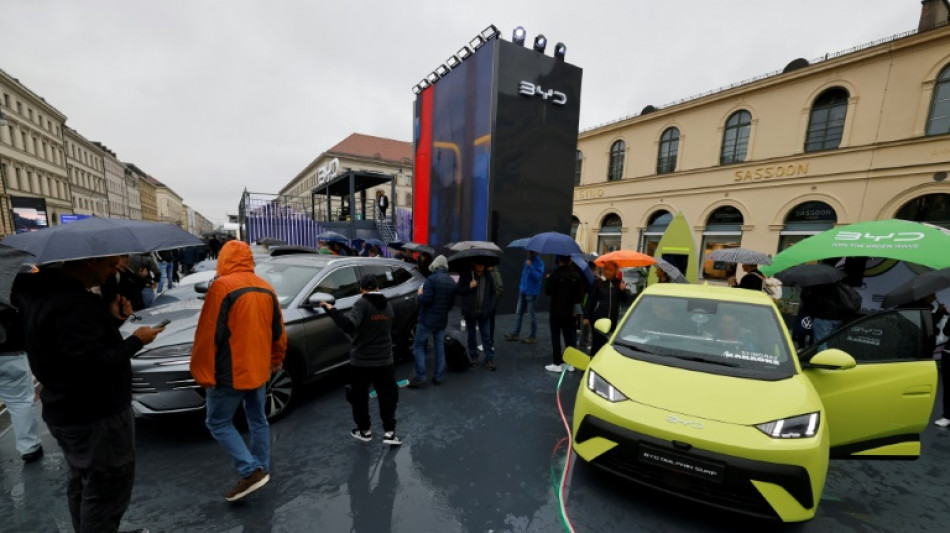
'Why not?' Europeans warming up to Chinese electric cars / Photo: Alexandra BEIER - AFP

 US Fed raises rates to tackle 'too high' inflation, irking Trump

 Turkey releases 106 protesters, jails more LGBTQ activists

 Candidate for UN chief calls for AI regulation akin to nuclear weapons

 'We're losing control,' AI pioneer Yoshua Bengio tells AFP

 IR-MED and Dice Technologies Announce collaboration to Evaluate and Advance Pressure-Injury Prevention Platform in Japan

 Watts, Pitt, Cruz to light up Spain's top film festival

 Toogood Gold's Table Mountain Sits in the Shadow of a Nevada Gold Rush

 MEXC July–August Security Report: 38.66M USDT in Risk Funds Intercepted, Futures Insurance Fund Hits 792M USDT

 Emporio Armani names Dario Vitale new creative director

 EU to ban social media for under 13s, curb access until 15

 Wildfires push endangered Sumatran elephants to brink: Indonesian NGO

 Bank of Japan set to raise rates under pressure from inflation, US

 EU chief to unveil social media, gaming curbs for under-15s

 'Resident Evil' film brings video game's ethos to the big screen

 GA-ASI Mojave First UAS To Complete Battlefield Short Field Ops

 Sanders, Bannon warn of AI dangers in rare US left-right alignment

 Empty benches as schools reopen in Venezuela's quake-hit Guaira

 Tiny English village holds 'independence' vote over asylum seeker housing

 US Treasury chief says to meet Chinese counterpart at weekend

 BingX Evolves into a Multi-Asset Trading Platform, Connecting Users to Global Opportunities

 International Trading Institute Expands Professional Trader Development Beyond the Master’s in Trading

 Lake Energy Secures $80 Million for U.S. Renewable Energy Expansion

 Stocks drop, oil climbs and Treasury yields hit 19-year high

 SkySail Strategies Outperforms Wall Street's 30-Year Risk Standard With Proprietary AI Inference Model

 Just add fish: Scientists pursue more rice, less disease in Senegal paddies

Checking out an electric vehicle made by China's BYD at the Munich auto show, German designer Tayo Osobu was impressed by the interior and said she would consider buying one.
"And why not?," said the 59-year-old from Frankfurt, in a country where domestic titans Volkswagen, BMW and Mercedes-Benz have long dominated.
"If they are sold here, it means they meet European standards."
At the IAA auto fair in the German city this week, Chinese electric vehicle (EV) makers were out in force, highlighting the determination of the country's fast-growing car giants to make inroads into Europe.
Some 100 Chinese auto companies flocked to Munich, out of a total 700 exhibitors at the biennial show, ranging from big-name manufacturers to smaller suppliers and start-ups.
While they still lag far behind Europe's long-established carmakers in terms of market share on the continent, firms from the world's number two economy have been gaining ground with their technology-packed EVs.
Leading the pack is giant BYD, whose sales in Europe surged by 250 percent in the first half of the year.
In Munich, the manufacturer was showcasing flagship models like the Dolphin Surf, a small EV with a starting price of around 20,000 euros ($23,400) -- cheaper than many offerings from European carmakers.
Volkswagen, Europe's biggest automaker, in contrast has seen sales and profits fall in the face of fierce competition and weak demand, prompting it to announce plans for mass layoffs in Germany.
And American EV pioneer Tesla, which was not present at the show in Munich, has also seen its market share drop -- in part because many consumers have been put off by its boss Elon Musk's support for far-right political parties.
- EU tariffs -
Chinese carmakers have grown rapidly as they have benefited from lower labour costs, generous government support and strong consumer demand for their high-tech models in the world's biggest auto market, according to experts.
"What has changed in five years is that, at a lower price, the Chinese are now on par in terms of technology and quality in many respects," said Stefan Bratzel, director of the Center of Automotive Management in Germany.
To combat the influx of Chinese cars and protect European manufacturers, the EU last year slapped hefty new tariffs on Chinese-made EVs over what the bloc said were unfair state subsidies.
But sales of Chinese electric cars have continued to grow, and BYD looks set to skirt the levies -- its first European factory, in Hungary, will start production later this year.
Bratzel however said it was "too early" to talk about an invasion. Chinese carmakers still need to establish "a relationship of trust" with European consumers and build up networks of dealerships and after-sales services, he said.
There was scepticism about Chinese cars among some of those attending the Munich fair.
"If you drive a Chinese car, which garage would you go to if there are problems?" said Pamina Lohrmann, a 22-year-old German woman, at the Volkswagen stand where an old model of the popular Polo was on display.
"I grew up with German brands, they appeal to me more."
- European 'heritage, legacy' -
Despite such concerns, some Chinese carmakers, such as Xpeng, are hoping to attract a tech-savvy, younger demographic.
President Brian Gu said the manufacturer was aiming for "the first wave of tech enthusiasts".
Europe's storied carmakers are fighting back, hoping their trustworthy reputations, built over many decades, will stand them in good stead.
Among a series of more affordable EVs unveiled by Volkswagen in Munich this week was one named "ID.Polo", aiming to capitalise on the popularity of its classic small car.
European carmakers are also adopting new battery technology and looking at using more Chinese components in their vehicles, according to industry expert Matthias Schmidt.
They aim to focus on their "heritage, legacy and DNA," said Schmidt, adding that these are characteristics that "Chinese new market entrants simply don't have".
T.Morelli--CPN