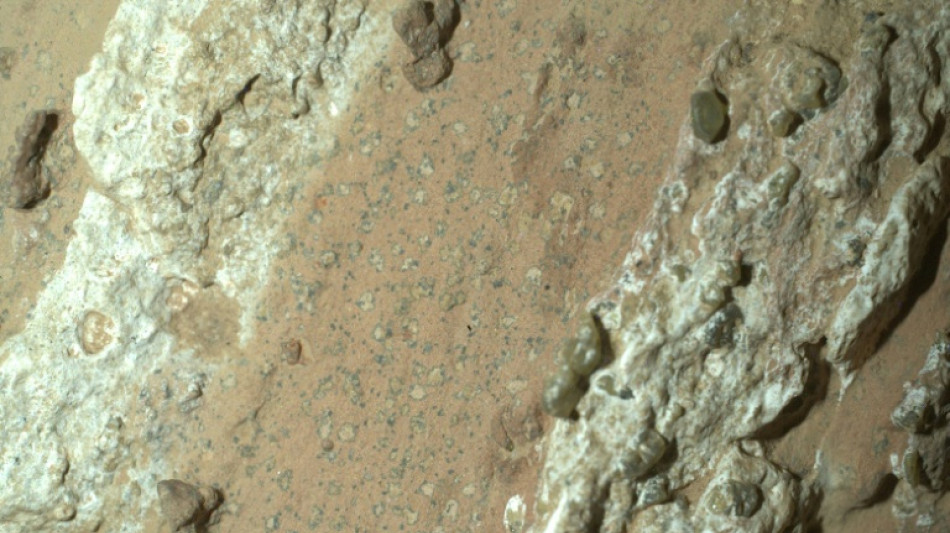
Martian rocks offer clues that might indicate ancient life / Photo: HANDOUT - NASA/JPL-Caltech/MSSS/AFP

 US Fed raises rates to tackle 'too high' inflation, irking Trump

 Turkey releases 106 protesters, jails more LGBTQ activists

 Candidate for UN chief calls for AI regulation akin to nuclear weapons

 'We're losing control,' AI pioneer Yoshua Bengio tells AFP

 IR-MED and Dice Technologies Announce collaboration to Evaluate and Advance Pressure-Injury Prevention Platform in Japan

 Watts, Pitt, Cruz to light up Spain's top film festival

 Toogood Gold's Table Mountain Sits in the Shadow of a Nevada Gold Rush

 MEXC July–August Security Report: 38.66M USDT in Risk Funds Intercepted, Futures Insurance Fund Hits 792M USDT

 Emporio Armani names Dario Vitale new creative director

 EU to ban social media for under 13s, curb access until 15

 Wildfires push endangered Sumatran elephants to brink: Indonesian NGO

 Bank of Japan set to raise rates under pressure from inflation, US

 EU chief to unveil social media, gaming curbs for under-15s

 'Resident Evil' film brings video game's ethos to the big screen

 GA-ASI Mojave First UAS To Complete Battlefield Short Field Ops

 Sanders, Bannon warn of AI dangers in rare US left-right alignment

 Empty benches as schools reopen in Venezuela's quake-hit Guaira

 Tiny English village holds 'independence' vote over asylum seeker housing

 US Treasury chief says to meet Chinese counterpart at weekend

 BingX Evolves into a Multi-Asset Trading Platform, Connecting Users to Global Opportunities

 International Trading Institute Expands Professional Trader Development Beyond the Master’s in Trading

 Lake Energy Secures $80 Million for U.S. Renewable Energy Expansion

 Stocks drop, oil climbs and Treasury yields hit 19-year high

 SkySail Strategies Outperforms Wall Street's 30-Year Risk Standard With Proprietary AI Inference Model

 Just add fish: Scientists pursue more rice, less disease in Senegal paddies

Colorful, speckled rocks found on the surface of Mars have offered among the most encouraging evidence yet of ancient life on our neighboring planet, scientists at NASA announced Wednesday.
The Perseverance Mars rover collected the "Sapphire Canyon" rock samples in July 2024 from what's thought to be an ancient lakebed, and its poppyseed and leopard-esque spots pointed to potential chemical reactions that piqued the interest of researchers.
If the features resulted from microbial activity that created minerals in the way they do on Earth -- well, that might point to life on Mars.
It's far too soon for scientists to say that definitively, but the findings, which were detailed in research published in the journal Nature, are alluring, scientists said.
"It's kind of the equivalent of seeing like leftover fossils, you know, leftovers from a meal, and maybe that meal has been excreted by a microbe. And that's what we're seeing in this sample," Nicky Fox, administrator of NASA's Science Mission Directorate, told journalists.
When those kinds of mineral and textured features form in sediment on Earth, it's frequently the product of reactions from mud and organic matter, explained the study's lead author Joel Hurowitz -- a potential "biosignature," or sign of life.
Specifically, Perserverance's instruments identified the minerals vivianite and greigite. On Earth, vivianite is often found in sediments, peat bogs, and around decaying organic matter. Some forms of microbial life on Earth can produce greigite.
"But there are non-biological ways to make these features that we cannot completely rule out on the basis of the data that we collected," Hurowitz said.
Still, the findings are "exciting," he told journalists, explaining that researchers would need to analyze the sample in person to better understand if microbial activity had created the "fantastic textures" and colors including blue and green.
- Return to Earth -
That's no small feat, particularly in light of President Donald Trump administration's plans to cancel the Mars Sample Return program -- a robotic mission planned for the 2030s to bring Perseverance's samples back to Earth.
Asked by journalists if that was still the plan, acting director of NASA Sean Duffy was non-committal, hinting the samples might be brought back by a future crewed mission instead.
"We care about resources, we care about the timeframe, we believe there's a better way to do this, a faster way to get these samples back. And so that is the analysis that we've gone through. Can we do it faster? Can we do it cheaper? And we think we can," he said.
"We're going to actually figure out a different way to bring it back again, and we think we can do it faster and more cost effectively."
There are several rovers ambling across Mars -- Perseverance has been there since 2021 -- seeking signs of life that could have existed millions to billions of years ago, when the planet was thought to have been more habitable.
Evidence that ancient rivers and lakes carved into the planet's surface would indicate that water once flowed there.
And the latest discovery, said Fox, brought researchers "one step closer" to answering the burning question: "Are we truly alone in the universe?"
M.García--CPN