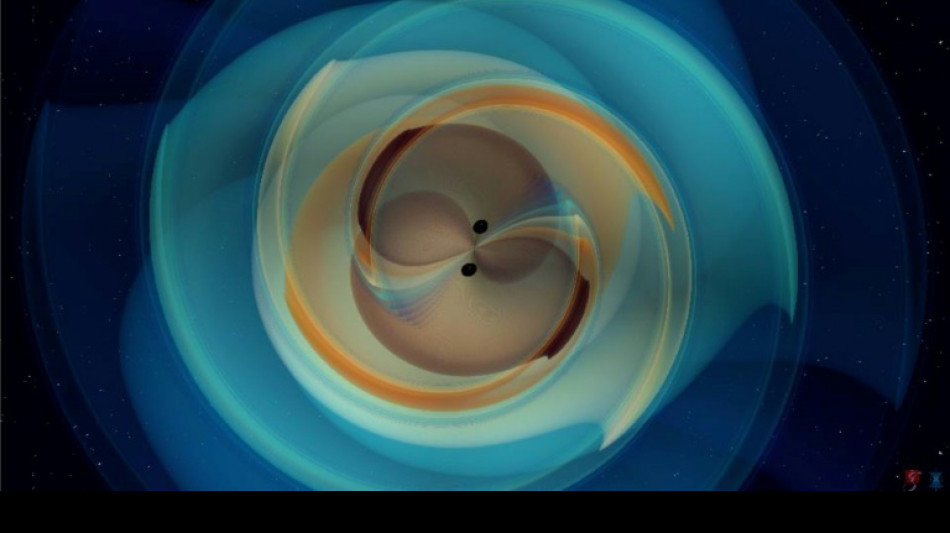
Gravitational waves from black hole smash confirm Hawking theory / Photo: N. Fischer, H. Pfeiffer, A. Buonanno - MAX PLANCK INSTISTUTE FOR GRAVITATIONAL PHYSICS/AFP/File

 US Fed raises rates to tackle 'too high' inflation, irking Trump

 Turkey releases 106 protesters, jails more LGBTQ activists

 Candidate for UN chief calls for AI regulation akin to nuclear weapons

 'We're losing control,' AI pioneer Yoshua Bengio tells AFP

 IR-MED and Dice Technologies Announce collaboration to Evaluate and Advance Pressure-Injury Prevention Platform in Japan

 Watts, Pitt, Cruz to light up Spain's top film festival

 Toogood Gold's Table Mountain Sits in the Shadow of a Nevada Gold Rush

 MEXC July–August Security Report: 38.66M USDT in Risk Funds Intercepted, Futures Insurance Fund Hits 792M USDT

 Emporio Armani names Dario Vitale new creative director

 EU to ban social media for under 13s, curb access until 15

 Wildfires push endangered Sumatran elephants to brink: Indonesian NGO

 Bank of Japan set to raise rates under pressure from inflation, US

 EU chief to unveil social media, gaming curbs for under-15s

 'Resident Evil' film brings video game's ethos to the big screen

 GA-ASI Mojave First UAS To Complete Battlefield Short Field Ops

 Sanders, Bannon warn of AI dangers in rare US left-right alignment

 Empty benches as schools reopen in Venezuela's quake-hit Guaira

 Tiny English village holds 'independence' vote over asylum seeker housing

 US Treasury chief says to meet Chinese counterpart at weekend

 BingX Evolves into a Multi-Asset Trading Platform, Connecting Users to Global Opportunities

 International Trading Institute Expands Professional Trader Development Beyond the Master’s in Trading

 Lake Energy Secures $80 Million for U.S. Renewable Energy Expansion

 Stocks drop, oil climbs and Treasury yields hit 19-year high

 SkySail Strategies Outperforms Wall Street's 30-Year Risk Standard With Proprietary AI Inference Model

 Just add fish: Scientists pursue more rice, less disease in Senegal paddies

Ripples in spacetime sent hurtling through the universe when two black holes smash into each other -- a phenomenon predicted by Albert Einstein -- have confirmed a theory proposed by fellow physicist Stephen Hawking over 50 years ago, scientists announced Wednesday.
These ripples, which are called gravitational waves, were detected for the first time in 2015 by the Laser Interferometer Gravitational-Wave Observatory (LIGO) in the United States.
In his 1916 theory of general relativity, Einstein predicted that the cataclysmic merger of two black holes would produce gravitational waves that would ripple across the universe and eventually arrive at Earth.
On January 14 this year, LIGO detected another of these signals from the distant universe.
That is no longer such a surprise.
Scientists in the LVK collaboration -- a vast network of scientists whose facilities includes gravitational wave detectors in Italy and Japan -- now record a new black hole merger roughly once every three days.
However January was "the loudest gravitational wave event we have detected to date," LIGO member Geraint Pratten of the University of Birmingham, England, said in a statement.
- From a whisper to a shout -
"It was like a whisper becoming a shout," added the co-author of a new study in the Physical Review Letters.
The latest event bore striking similarities to the first one detected a decade ago.
Both involved collisions of black holes with masses of between 30-40 times that of our Sun. And both smash-ups occurred around 1.3 billion light years away.
But thanks to technological improvements over the years, scientists are now able to greatly reduce the background noise, giving them far clearer data.
This allowed the researchers to confirm a theory by another great physicist.
In 1971, Stephen Hawking predicted that a black hole's event horizon -- the area from which nothing including light can escape -- cannot shrink.
This means that when two black holes merge, the new monster they create must have the same or larger surface area than the pair started out with.
Scientists analysing January's merger, called GW250114, were able to show that Hawking was right.
- Ringing like a struck bell -
The black holes collectively started out at 240,000 square kilometres wide, which is roughly the size of the United Kingdom.
But after the collision, the resulting mega-black hole took up 400,000 square kilometres -- about the size of Sweden.
The California Institute of Technology said that working out the final merged surface area was "the trickiest part of this type of analysis".
"The surface areas of pre-merger black holes can be more readily gleaned as the pair spiral together, roiling space-time and producing gravitational waves," it said in a statement.
But the signal gets muddier once the black holes start combining into a single new monster.
This period is called the "ringdown phase", because the merged black hole rings like a struck bell -- a phenomenon that Einstein also predicted.
The scientists were able to measure different frequencies emanating from this rung bell, allowing them to determine the size of the new post-merger black hole.
- Kerr theory vindicated -
This also enabled them to confirm the event aligned with another theory, made by New Zealand mathematician Roy Kerr in 1963.
Kerr predicted that "two black holes with the same mass and spin are mathematically identically," a feature unique to black holes, Maximiliano Isi of Columbia University said in a statement.
Gregorio Carullo of the University of Birmingham said that "given the clarity of the signal produced by GW250114, for the first time we could pick out two 'tones' from the black hole voices and confirm that they behave according to Kerr's prediction."
Scientists are working to find out more about black hole mergers, with several new gravitational wave detectors planned for the coming years -- including one in India.
A.Mykhailo--CPN