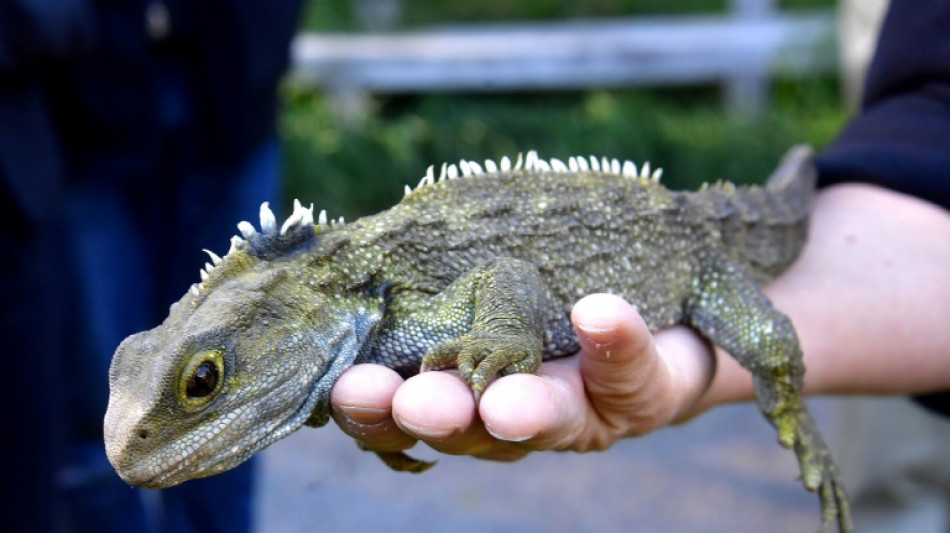
Oldest known lizard ancestor discovered in England / Photo: Marty MELVILLE - POOL/AFP/File

 US Fed raises rates to tackle 'too high' inflation, irking Trump

 Turkey releases 106 protesters, jails more LGBTQ activists

 Candidate for UN chief calls for AI regulation akin to nuclear weapons

 'We're losing control,' AI pioneer Yoshua Bengio tells AFP

 IR-MED and Dice Technologies Announce collaboration to Evaluate and Advance Pressure-Injury Prevention Platform in Japan

 Watts, Pitt, Cruz to light up Spain's top film festival

 Toogood Gold's Table Mountain Sits in the Shadow of a Nevada Gold Rush

 MEXC July–August Security Report: 38.66M USDT in Risk Funds Intercepted, Futures Insurance Fund Hits 792M USDT

 Emporio Armani names Dario Vitale new creative director

 EU to ban social media for under 13s, curb access until 15

 Wildfires push endangered Sumatran elephants to brink: Indonesian NGO

 Bank of Japan set to raise rates under pressure from inflation, US

 EU chief to unveil social media, gaming curbs for under-15s

 'Resident Evil' film brings video game's ethos to the big screen

 GA-ASI Mojave First UAS To Complete Battlefield Short Field Ops

 Sanders, Bannon warn of AI dangers in rare US left-right alignment

 Empty benches as schools reopen in Venezuela's quake-hit Guaira

 Tiny English village holds 'independence' vote over asylum seeker housing

 US Treasury chief says to meet Chinese counterpart at weekend

 BingX Evolves into a Multi-Asset Trading Platform, Connecting Users to Global Opportunities

 International Trading Institute Expands Professional Trader Development Beyond the Master’s in Trading

 Lake Energy Secures $80 Million for U.S. Renewable Energy Expansion

 Stocks drop, oil climbs and Treasury yields hit 19-year high

 SkySail Strategies Outperforms Wall Street's 30-Year Risk Standard With Proprietary AI Inference Model

 Just add fish: Scientists pursue more rice, less disease in Senegal paddies

Scientists announced Wednesday they have discovered the oldest-known member of the lizard family in southwest England, a tiny creature that used its surprisingly large teeth to hunt cockroaches 242 million years ago.
The ancient reptile, which lived during the Middle Triassic epoch shortly before the rise of the dinosaurs, was so small its entire body could fit in the palm of a human hand.
"The new animal is unlike anything yet discovered and has made us all think again about the evolution of the lizard, snakes and the tuatara," the latter of which is a New Zealand reptile, Dan Marke of the University of Bristol said in a statement.
The skeleton of the oldest known member of the lepidosauria order, a family of reptiles, was found at a fossil-rich beach in Devon, southwest England, in 2015.
But figuring out what it actually was took the scientists years, and the discovery was announced in a study in the journal Nature on Wednesday.
"The new fossil shows almost none of what we expected," said Marke, the study's lead author.
Modern lizards and snakes have a partially hinged skull and plenty of teeth on the roof of their mouth -- but this ancient ancestor had neither.
"Not only this but it possesses some spectacularly large teeth compared to its closest relatives," the palaeobiologist said.
It also has a bone running from cheek to jaw, a feature it shares only with the unique tuatara that is often referred to as a "living fossil".
"The new beast" used these teeth "to pierce and shear the hard cuticles of its insect prey, pretty much as the tuatara does today," said study co-author Michael Benton, also from Bristol University.
The fossil was difficult to study because it is so small -- the skull is just 1.5 centimetres (0.6 of an inch) wide -- and was preserved in a large rock.
So the British researchers scanned it using the European Synchrotron Radiation Facility, which works as a kind of huge microscope producing X-rays 100 billion times brighter than those used in hospitals.
The Synchrotron allowed the scientists to "zoom in on large objects and obtain very high-resolution images," said Vincent Fernandez, a palaeontologist at the facility in France.
The scientists named the lizard ancestor Agriodontosaurus helsbypetrae, after the Helsby Sandstone Formation where it was discovered.
O.Ignatyev--CPN