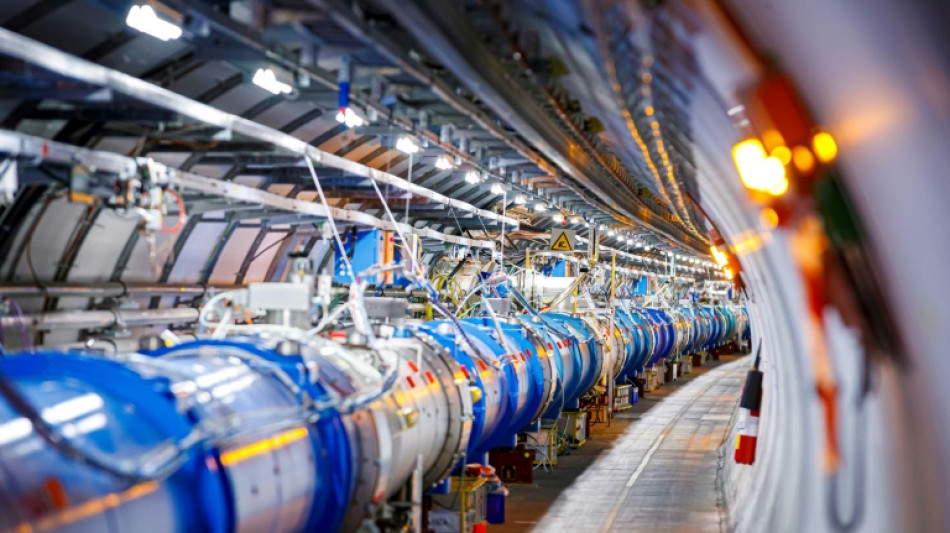
Large Hadron Collider revs up to unprecedented energy level / Photo: VALENTIN FLAURAUD - AFP/File

 Emporio Armani names Dario Vitale new creative director

 EU to ban social media for under 13s, curb access until 15

 Wildfires push endangered Sumatran elephants to brink: Indonesian NGO

 Bank of Japan set to raise rates under pressure from inflation, US

 EU chief to unveil social media, gaming curbs for under-15s

 'Resident Evil' film brings video game's ethos to the big screen

 i-payout Expands U.S. Money Transmitter Licensing Footprint and Advances European EMI Strategy

 US Senate crypto bill collapses amid partisan deadlock

 OpenAI, Anthropic and Google are working to create an AI standards body

 Protesting shepherds, farmers clash with Romanian police

 Foundation Lets Ledger Users Switch to Open Source Without Starting Over

 EU to propose curbing social media, online games for under 15s

 FX Junction Reaches 40,600 Members and 26 Million Trades

 'We unleashed the beast': the world's fears and hopes about AI

 Hospitality leaders ask Burnham to halve VAT amid rising costs

 Worcestershire invited to nominate groups for 2027 King’s volunteer award

 Berlin's run-down public spaces at heart of election campaign
 'Widow's Bay' and 'The Pitt' win big at Emmy Awards

 Most markets drop as oil extends gains ahead of expected US rate hike

 Sri Lanka's famed beach shack battles demolition

 Vserv targets ₹1,000 crore revenue by 2030 through AI expansion

 India prohibits bank fees on UPI payments up to ₹2,000

 Brazil's Amazon defender Raoni has cancer
 Trump rejects AI slowdown concerns as UN urges coordinated controls

 Higher wages draw migrant workers to Kashmir despite attacks

Ten years after it discovered the Higgs boson, the Large Hadron Collider is about to start smashing protons together at unprecedented energy levels in its quest to reveal more secrets about how the universe works.
The world's largest and most powerful particle collider started back up in April after a three-year break for upgrades in preparation for its third run.
From Tuesday it will run around the clock for nearly four years at a record energy of 13.6 trillion electronvolts, the European Organisation for Nuclear Research (CERN) announced at a press briefing last week.
It will send two beams of protons -- particles in the nucleus of an atom -- in opposite directions at nearly the speed of light around a 27-kilometre (17-mile) ring buried 100 metres under the Swiss-French border.
The resulting collisions will be recorded and analysed by thousands of scientists as part of a raft of experiments, including ATLAS, CMS, ALICE and LHCb, which will use the enhanced power to probe dark matter, dark energy and other fundamental mysteries.
- 1.6 billion collisions a second -
"We aim to be delivering 1.6 billion proton-proton collisions per second" for the ATLAS and CMS experiments, CERN's head of accelerators and technology Mike Lamont said.
This time around the proton beams will be narrowed to less than 10 microns -- a human hair is around 70 microns thick -- to increase the collision rate, he added.
The new energy rate will allow them to further investigate the Higgs boson, which the Large Hadron Collider first observed on July 4, 2012.
The discovery revolutionised physics in part because the boson fit within the Standard Model -- the mainstream theory of all the fundamental particles that make up matter and the forces that govern them.
However several recent findings have raised questions about the Standard Model, and the newly upgraded collider will look at the Higgs boson in more depth.
"The Higgs boson is related to some of the most profound open questions in fundamental physics today," said CERN director-general Fabiola Gianotti, who first announced the boson's discovery a decade ago.
Compared to the collider's first run that discovered the boson, this time around there will be 20 times more collisions.
"This is a significant increase, paving the way for new discoveries," Lamont said.
Joachim Mnich, CERN's head of research and computing, said there was still much more to learn about the boson.
"Is the Higgs boson really a fundamental particle or is it a composite?" he asked.
"Is it the only Higgs-like particle that exists -- or are there others?"
- 'New physics season' -
Past experiments have determined the mass of the Higgs boson, as well as more than 60 composite particles predicted by the Standard Model, such as the tetraquark.
But Gian Giudice, head of CERN's theoretical physics department, said observing particles is only part of the job.
"Particle physics does not simply want to understand the how -- our goal is to understand the why," he said.
Among the Large Hadron Collider's nine experiments is ALICE, which probes the matter that existed in the first 10 microseconds after the Big Bang, and LHCf, which uses the collisions to simulate cosmic rays.
After this run, the collider will come back in 2029 as the High-Luminosity LHC, increasing the number of detectable events by a factor of 10.
Beyond that, the scientists are planning a Future Circular Collider -- a 100-kilometre ring that aims to reach energies of a whopping 100 trillion electronvolts.
But for now, physicists are keenly awaiting results from the Large Hadron Collider's third run.
"A new physics season is starting," CERN said.
X.Wong--CPN