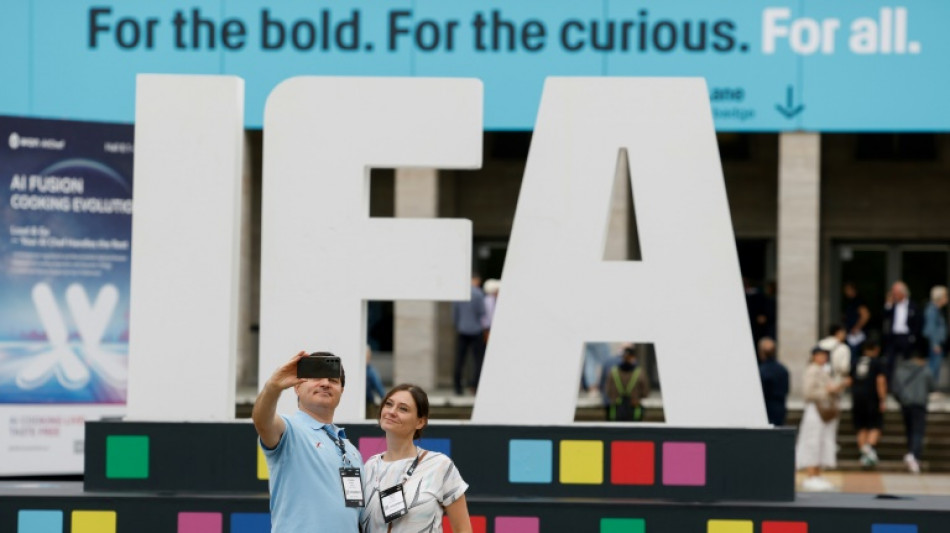
At consumer tech show, German firms fret about US tariffs / Photo: Odd ANDERSEN - AFP

 US Fed raises rates to tackle 'too high' inflation, irking Trump

 Turkey releases 106 protesters, jails more LGBTQ activists

 Candidate for UN chief calls for AI regulation akin to nuclear weapons

 'We're losing control,' AI pioneer Yoshua Bengio tells AFP

 IR-MED and Dice Technologies Announce collaboration to Evaluate and Advance Pressure-Injury Prevention Platform in Japan

 Watts, Pitt, Cruz to light up Spain's top film festival

 Toogood Gold's Table Mountain Sits in the Shadow of a Nevada Gold Rush

 MEXC July–August Security Report: 38.66M USDT in Risk Funds Intercepted, Futures Insurance Fund Hits 792M USDT

 Emporio Armani names Dario Vitale new creative director

 EU to ban social media for under 13s, curb access until 15

 Wildfires push endangered Sumatran elephants to brink: Indonesian NGO

 Bank of Japan set to raise rates under pressure from inflation, US

 EU chief to unveil social media, gaming curbs for under-15s

 'Resident Evil' film brings video game's ethos to the big screen

 GA-ASI Mojave First UAS To Complete Battlefield Short Field Ops

 Sanders, Bannon warn of AI dangers in rare US left-right alignment

 Empty benches as schools reopen in Venezuela's quake-hit Guaira

 Tiny English village holds 'independence' vote over asylum seeker housing

 US Treasury chief says to meet Chinese counterpart at weekend

 BingX Evolves into a Multi-Asset Trading Platform, Connecting Users to Global Opportunities

 International Trading Institute Expands Professional Trader Development Beyond the Master’s in Trading

 Lake Energy Secures $80 Million for U.S. Renewable Energy Expansion

 Stocks drop, oil climbs and Treasury yields hit 19-year high

 SkySail Strategies Outperforms Wall Street's 30-Year Risk Standard With Proprietary AI Inference Model

 Just add fish: Scientists pursue more rice, less disease in Senegal paddies

Displaying one of her company's hot plates proudly labelled "Made in Germany", Sigrid Klenk concedes that maintaining production at home could become harder due in part to US tariffs.
Continuing to make goods in Germany "is becoming less and less simple," Klenk, boss of the small firm Rommelsbacher, said at the IFA consumer tech show in Berlin.
Particularly problematic for Rommelsbacher, whose products range from kettles to coffee makers, is a 50-percent US levy on steel and aluminium.
"Now we have to specify the amount of steel contained in our products, especially our hot plates," she told AFP. "This has kept us very busy in recent days."
Europe's already struggling top economy is under huge pressure from President Donald Trump's tariff blitz -- official data released Monday showed German exports to the US plunged to their lowest level for nearly four years in July.
The concern was palpable at this year's IFA show in Berlin, where the ZVEI industry federation warned that German electronics exports to the US, the sector's second-largest market, could fall by as much as 20 percent.
While the European Union and Trump struck a deal in July agreeing on import levies of 15 percent on most goods from the bloc, there remains much uncertainty.
Businesses complain that, in reality, the list of products facing extra tariffs continues to grow.
As well as small- and medium-sized businesses, home appliance giants like Miele are worried.
"When consumers don't know what will happen tomorrow, it's the worst situation," and "it's the same for businesses", Markus Miele, the executive director of the group, told AFP.
The group has already had to raise prices as a result of the tariffs, he said.
- 'Costs too high' -
Adding to the company's problems is continued weak demand in many countries, he added -- pointing in particular to its home market, where consumers are reluctant to spend even after recent falls in inflation.
In contrast the economic situation is better in the US, he said, noting that Miele opened its first production site there even before the return of Trump, who is aiming with his tariffs to bring manufacturing jobs back to America.
The long-running woes of Germany's small businesses were plain to see at the IFA show -- even before the US tariffs, they had been battling problems from rising labour costs to high energy prices and a lack of skilled workers.
Vacuum cleaner maker Fakir, for instance, had to abandon production in Germany a year and a half ago.
"It was impossible to continue -- the costs were too high," said an employee, who spoke anonymously, at the show.
In contrast to ailing German manufacturers, Chinese companies at the event were attracting crowds with their innovations: such as robot vacuum cleaners that climb stairs and robotic arms that play chess.
Once considered of lower quality, their offerings are now giving German-made products a run for their money.
German companies are racing to keep up but it is an uphill battle. For now, many simply hope that consumers at home begin to spend again.
"I hope the Christmas season will bring a bit more enthusiasm to German consumers," said Klenk.
H.Müller--CPN