'Correcting The Map': reshaping perceptions of Africa / Photo: Valentin RAKOVSKY, Jean-Michel CORNU - AFP

 US Fed raises rates to tackle 'too high' inflation, irking Trump

 Turkey releases 106 protesters, jails more LGBTQ activists

 Candidate for UN chief calls for AI regulation akin to nuclear weapons

 'We're losing control,' AI pioneer Yoshua Bengio tells AFP

 IR-MED and Dice Technologies Announce collaboration to Evaluate and Advance Pressure-Injury Prevention Platform in Japan

 Watts, Pitt, Cruz to light up Spain's top film festival

 Toogood Gold's Table Mountain Sits in the Shadow of a Nevada Gold Rush

 MEXC July–August Security Report: 38.66M USDT in Risk Funds Intercepted, Futures Insurance Fund Hits 792M USDT

 Emporio Armani names Dario Vitale new creative director

 EU to ban social media for under 13s, curb access until 15

 Wildfires push endangered Sumatran elephants to brink: Indonesian NGO

 Bank of Japan set to raise rates under pressure from inflation, US

 EU chief to unveil social media, gaming curbs for under-15s

 'Resident Evil' film brings video game's ethos to the big screen

 GA-ASI Mojave First UAS To Complete Battlefield Short Field Ops

 Sanders, Bannon warn of AI dangers in rare US left-right alignment

 Empty benches as schools reopen in Venezuela's quake-hit Guaira

 Tiny English village holds 'independence' vote over asylum seeker housing

 US Treasury chief says to meet Chinese counterpart at weekend

 BingX Evolves into a Multi-Asset Trading Platform, Connecting Users to Global Opportunities

 International Trading Institute Expands Professional Trader Development Beyond the Master’s in Trading

 Lake Energy Secures $80 Million for U.S. Renewable Energy Expansion

 Stocks drop, oil climbs and Treasury yields hit 19-year high

 SkySail Strategies Outperforms Wall Street's 30-Year Risk Standard With Proprietary AI Inference Model

 Just add fish: Scientists pursue more rice, less disease in Senegal paddies

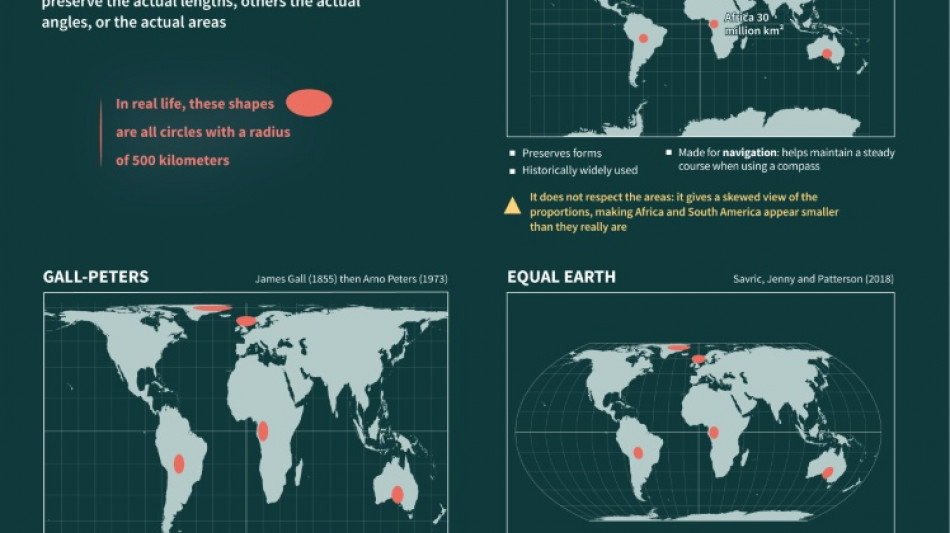
The Mercator world map, long a fixture in classrooms globally, makes the European Union appear almost as large as Africa. In reality, Africa is more than seven times bigger.
It is a distortion that has prompted a new African initiative, "Correct the Map", calling for depictions that show Africa's true scale.
"For centuries, this map has minimised Africa, feeding into a narrative that the continent is smaller, peripheral and less important," said Fara Ndiaye, co-founder of Speak Up Africa, which is leading the campaign alongside another advocacy group, Africa No Filter.
Accurately translating the Earth's sphere into a flat map always calls for compromises, requiring parts to be stretched, cut or left out, experts told AFP.
Historically, maps have reflected the worldview of their makers.
Babylonian clay tablets from the sixth century BC placed their empire at the centre of the world, while medieval European charts often focused on religious sites.
Choices must be made: a world map will look very different depending on whether Australia, Siberia or Europe is placed at its centre.
Today's most-used map was designed for maritime navigation by Flemish cartographer Gerardus Mercator in 1569.
It focused on accurate depictions of the shapes and angles of land masses, but their relative sizes were often inaccurate.
Mercator's projection inflated northern regions and compressed equatorial ones, making Europe and North America appear much larger, while shrinking Africa and South America.
The distortions are stark: a 100-square-kilometre patch around Oslo, Norway, looks four times larger than the same area around Nairobi, Kenya.
Greenland appears as large as Africa, even though it is 14 times smaller.
- Striking a balance -
Alternatives to the Mercator emerged in the 20th century, including one from 1921 by Oswald Winkel and another in 1963 by Arthur Robinson that reduced distortions but sacrificed precision. The 1970s Gall-Peters projection restored proportional sizes but stretched shapes.
To strike a balance between accuracy and aesthetics, cartographers Tom Patterson, Bojan Savric and Bernhard Jenny launched the Equal Earth projection in 2018.
It makes Africa, Latin America, South Asia and Oceania appear vastly larger.
"Equal Earth preserves the relative surface areas of continents and, as much as possible, shows their shapes as they appear on a globe," Savric told AFP.
This is the projection now endorsed by the African Union.
Speak Up Africa says the next steps of their campaign are to push for adoption by African schools, media and publishers.
"We are also engaging the UN and UNESCO (its cultural body), because sustainable change requires global institutions," Ndiaye said.
- 'Naive' controversy –
Some critics reject claims of bias.
"Any claim that Mercator is flagrantly misleading people seems naive," Mark Monmonier, a Syracuse University geography professor and author of "How to Lie with Maps", told AFP.
"If you want to compare country sizes, use a bar graph or table, not a map."
Despite its distortions, Mercator remains useful for digital platforms because its focus on accurate land shapes and angles makes "direction easy to calculate", Ed Parsons, a former geospatial technologist at Google, told AFP.
"While a Mercator map may distort the size of features over large areas, it accurately represents small features which is by far the most common use for digital platforms," he said.
Having accurate relative sizes, as with the Equal Earth map, can complicate navigation calculations, but technology is adapting.
"Most mapping software has supported Equal Earth since 2018," Savric said. "The challenge is usage. People are creatures of habit."
Some dismiss the whole thrust of the African campaign.
Ghanaian policy analyst Bright Simons says the continent needs more than a larger size on maps to "earn global respect".
"South Korea, no matter how Mercator renders it, has almost the same GDP as all 50 African countries combined," he said.
But advocates remain convinced of their cause.
"Success will be when children everywhere open their textbooks and see Africa as it truly is: vast, central and indispensable," Ndiaye said.
H.Meyer--CPN