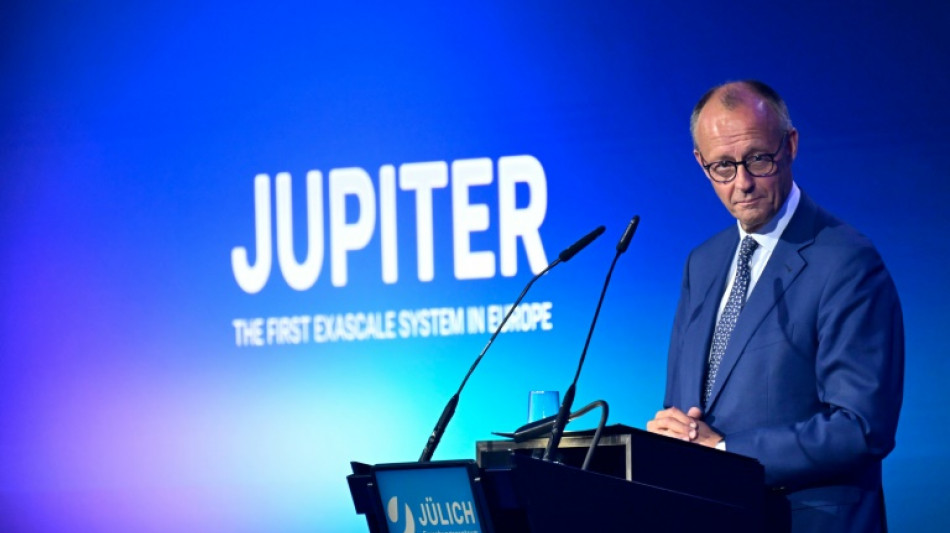
Europe bets on supercomputer to catch up in AI race / Photo: INA FASSBENDER - AFP

 US Fed raises rates to tackle 'too high' inflation, irking Trump

 Turkey releases 106 protesters, jails more LGBTQ activists

 Candidate for UN chief calls for AI regulation akin to nuclear weapons

 'We're losing control,' AI pioneer Yoshua Bengio tells AFP

 IR-MED and Dice Technologies Announce collaboration to Evaluate and Advance Pressure-Injury Prevention Platform in Japan

 Watts, Pitt, Cruz to light up Spain's top film festival

 Toogood Gold's Table Mountain Sits in the Shadow of a Nevada Gold Rush

 MEXC July–August Security Report: 38.66M USDT in Risk Funds Intercepted, Futures Insurance Fund Hits 792M USDT

 Emporio Armani names Dario Vitale new creative director

 EU to ban social media for under 13s, curb access until 15

 Wildfires push endangered Sumatran elephants to brink: Indonesian NGO

 Bank of Japan set to raise rates under pressure from inflation, US

 EU chief to unveil social media, gaming curbs for under-15s

 'Resident Evil' film brings video game's ethos to the big screen

 GA-ASI Mojave First UAS To Complete Battlefield Short Field Ops

 Sanders, Bannon warn of AI dangers in rare US left-right alignment

 Empty benches as schools reopen in Venezuela's quake-hit Guaira

 Tiny English village holds 'independence' vote over asylum seeker housing

 US Treasury chief says to meet Chinese counterpart at weekend

 BingX Evolves into a Multi-Asset Trading Platform, Connecting Users to Global Opportunities

 International Trading Institute Expands Professional Trader Development Beyond the Master’s in Trading

 Lake Energy Secures $80 Million for U.S. Renewable Energy Expansion

 Stocks drop, oil climbs and Treasury yields hit 19-year high

 SkySail Strategies Outperforms Wall Street's 30-Year Risk Standard With Proprietary AI Inference Model

 Just add fish: Scientists pursue more rice, less disease in Senegal paddies

Europe's fastest supercomputer Jupiter was inaugurated Friday in Germany with Chancellor Friedrich Merz saying it could help the continent catch up in the global artificial intelligence race.
"We in Germany, and we in Europe, have every opportunity to catch up and then keep pace" with AI pioneers the United States and China, said Merz.
Here is all you need to know about the system, which boasts the power of around one million smartphones.
- What is the Jupiter supercomputer? -
Based at Juelich Supercomputing Centre in western Germany, it is Europe's first "exascale" supercomputer -- meaning it will be able to perform at least one quintillion (or one billion billion) calculations per second.
The United States already has three such computers, all operated by the Department of Energy.
Jupiter is housed in a centre covering some 3,600 metres (38,000 square feet) -- about half the size of a football pitch -- containing racks of processors, and packed with about 24,000 Nvidia chips, which are favoured by the AI industry.
Half the 500 million euros ($580 million) to develop and run the system over the next few years comes from the European Union and the rest from Germany.
Its vast computing power can be accessed by researchers across numerous fields as well as companies for purposes such as training AI models.
"Jupiter is a leap forward in the performance of computing in Europe," Thomas Lippert, head of the Juelich centre, told AFP, adding that it was 20 times more powerful than any other computer in Germany.
- How can it help Europe in the AI race? -
Lippert said Jupiter is the first supercomputer that could be considered internationally competitive for training AI models in Europe, which has lagged behind the United States and China in the sector.
According to a Stanford University report this year, US-based institutions produced 40 "notable" AI models -- meaning those regarded as particularly influential -- in 2024, compared to 15 for China and just three for Europe.
In a speech at the inauguration in Juelich, Merz conceded that the United States and China were currently in a "neck-and-neck race" for dominance in the AI field.
But he insisted that Europe could make up lost ground -- and that it was crucial the continent do so.
"In Germany and in Europe as a whole, we need sovereign computing capacities that are on a par with our international competitors," Merz said.
"This is a question of competitiveness as well as the security of our country."
Jupiter was built by a consortium consisting of Eviden, a subsidiary of French tech giant Atos, and German group ParTec.
But, with Nvidia chips powering the machine, it is still heavily reliant on US technology.
The dominance of the US tech sector has become a source of growing concern as US-European relations have soured.
- What else can the computer be used for? -
Jupiter has a wide range of other potential uses beyond training AI models.
Researchers want to use it to create more detailed, long-term climate forecasts that they hope can more accurately predict the likelihood of extreme weather events.
Le Roux said that current models can simulate climate change over the next decade.
"With Jupiter, scientists believe they will be able to forecast up to at least 30 years, and in some models, perhaps even up to 100 years," he added.
Others hope to simulate processes in the brain more realistically, research that could be useful in areas such as developing drugs to combat diseases like Alzheimer's.
It can also be used for research related to the clean energy transition, for instance by simulating air flows around wind turbines to optimise their design.
- Does Jupiter consume a lot of energy? -
Yes, Jupiter will require on average around 11 megawatts of power, according to estimates -- equivalent to the energy used to power thousands of homes or a small industrial plant.
But its operators insist that Jupiter is the most energy-efficient among the fastest computer systems in the world.
It uses the latest, most energy-efficient hardware, has water-cooling systems and the waste heat that it generates will be used to heat nearby buildings, according to the Juelich centre.
M.P.Jacobs--CPN