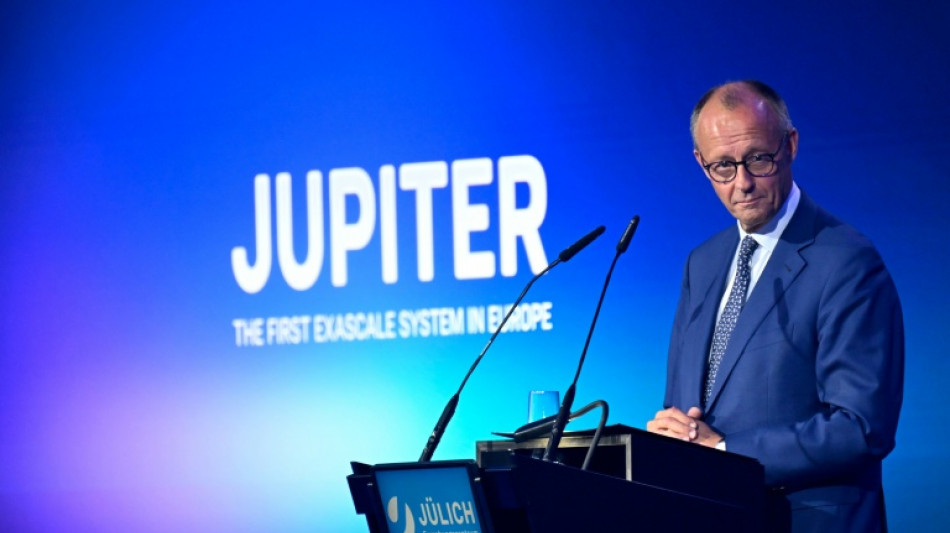
Merz inaugurates supercomputer, says Europe can catch up in AI race / Photo: INA FASSBENDER - AFP

 US Fed raises rates to tackle 'too high' inflation, irking Trump

 Turkey releases 106 protesters, jails more LGBTQ activists

 Candidate for UN chief calls for AI regulation akin to nuclear weapons

 'We're losing control,' AI pioneer Yoshua Bengio tells AFP

 IR-MED and Dice Technologies Announce collaboration to Evaluate and Advance Pressure-Injury Prevention Platform in Japan

 Watts, Pitt, Cruz to light up Spain's top film festival

 Toogood Gold's Table Mountain Sits in the Shadow of a Nevada Gold Rush

 MEXC July–August Security Report: 38.66M USDT in Risk Funds Intercepted, Futures Insurance Fund Hits 792M USDT

 Emporio Armani names Dario Vitale new creative director

 EU to ban social media for under 13s, curb access until 15

 Wildfires push endangered Sumatran elephants to brink: Indonesian NGO

 Bank of Japan set to raise rates under pressure from inflation, US

 EU chief to unveil social media, gaming curbs for under-15s

 'Resident Evil' film brings video game's ethos to the big screen

 GA-ASI Mojave First UAS To Complete Battlefield Short Field Ops

 Sanders, Bannon warn of AI dangers in rare US left-right alignment

 Empty benches as schools reopen in Venezuela's quake-hit Guaira

 Tiny English village holds 'independence' vote over asylum seeker housing

 US Treasury chief says to meet Chinese counterpart at weekend

 BingX Evolves into a Multi-Asset Trading Platform, Connecting Users to Global Opportunities

 International Trading Institute Expands Professional Trader Development Beyond the Master’s in Trading

 Lake Energy Secures $80 Million for U.S. Renewable Energy Expansion

 Stocks drop, oil climbs and Treasury yields hit 19-year high

 SkySail Strategies Outperforms Wall Street's 30-Year Risk Standard With Proprietary AI Inference Model

 Just add fish: Scientists pursue more rice, less disease in Senegal paddies

German Chancellor Friedrich Merz said on Friday that Europe can catch up in the global artificial intelligence race as he inaugurated the continent's fastest supercomputer.
"The United States and China are in a neck-and-neck race to compete for future market share in an AI-supported global economy," he said at the inauguration of the Jupiter computer, which will be able to perform at least one quintillion (or one billion billion) calculations per second.
"We in Germany, and we in Europe, have every opportunity to catch up and then keep pace."
Jupiter, based in Juelich, western Germany, is housed in a centre about half the size of a football pitch and is packed with about 24,000 Nvidia chips, which are favoured by the AI industry.
With the power of about one million smartphones, experts say it is the first supercomputer that can be considered internationally competitive in training AI models in Europe.
"In Germany and in Europe as a whole, we need sovereign computing capacities that are on a par with our international competitors," Merz said.
"This is a question of competitiveness as well as the security of our country."
Researchers across numerous different fields will be able to access the 500-million-euro ($580-million) supercomputer, whose uses go far beyond AI.
They range from creating more detailed climate forecasts that can help predict extreme weather events to medical research and studies related to the energy transition.
H.Cho--CPN