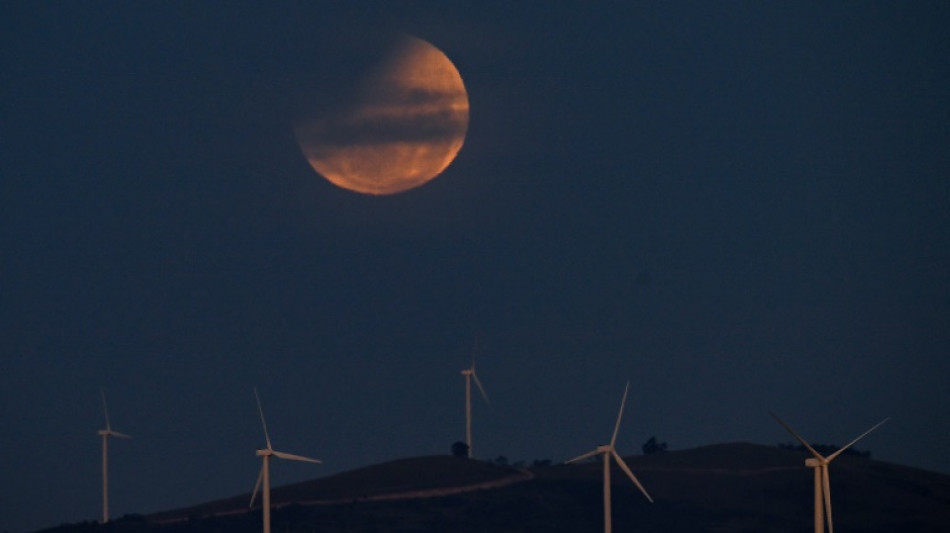
'Blood Moon' to rise during total lunar eclipse Sunday night / Photo: Izhar KHAN - AFP/File

 US Fed raises rates to tackle 'too high' inflation, irking Trump

 Turkey releases 106 protesters, jails more LGBTQ activists

 Candidate for UN chief calls for AI regulation akin to nuclear weapons

 'We're losing control,' AI pioneer Yoshua Bengio tells AFP

 IR-MED and Dice Technologies Announce collaboration to Evaluate and Advance Pressure-Injury Prevention Platform in Japan

 Watts, Pitt, Cruz to light up Spain's top film festival

 Toogood Gold's Table Mountain Sits in the Shadow of a Nevada Gold Rush

 MEXC July–August Security Report: 38.66M USDT in Risk Funds Intercepted, Futures Insurance Fund Hits 792M USDT

 Emporio Armani names Dario Vitale new creative director

 EU to ban social media for under 13s, curb access until 15

 Wildfires push endangered Sumatran elephants to brink: Indonesian NGO

 Bank of Japan set to raise rates under pressure from inflation, US

 EU chief to unveil social media, gaming curbs for under-15s

 'Resident Evil' film brings video game's ethos to the big screen

 GA-ASI Mojave First UAS To Complete Battlefield Short Field Ops

 Sanders, Bannon warn of AI dangers in rare US left-right alignment

 Empty benches as schools reopen in Venezuela's quake-hit Guaira

 Tiny English village holds 'independence' vote over asylum seeker housing

 US Treasury chief says to meet Chinese counterpart at weekend

 BingX Evolves into a Multi-Asset Trading Platform, Connecting Users to Global Opportunities

 International Trading Institute Expands Professional Trader Development Beyond the Master’s in Trading

 Lake Energy Secures $80 Million for U.S. Renewable Energy Expansion

 Stocks drop, oil climbs and Treasury yields hit 19-year high

 SkySail Strategies Outperforms Wall Street's 30-Year Risk Standard With Proprietary AI Inference Model

 Just add fish: Scientists pursue more rice, less disease in Senegal paddies

Stargazers will have a chance to see a "Blood Moon" on Sunday night during a total lunar eclipse visible across Asia and swathes of Europe and Africa.
When the Sun, Earth and Moon line up, the shadow cast by the planet on its satellite makes it appear an eerie, deep red colour that has astounded humans for millennia.
People in Asia, including India and China, will be best placed to see Sunday's total eclipse, which will also be visible on the eastern edge of Africa as well as in western Australia.
The total lunar eclipse will last from 1730 GMT to 1852 GMT.
Stargazers in Europe and Africa will get a brief chance to see a partial eclipse just as the Moon rises during the early evening, while the Americas will miss out.
The Moon appears red during lunar eclipses because the only sunlight reaching it is "reflected and scattered through the Earth's atmosphere", said Ryan Milligan, an astrophysicist at Northern Ireland's Queen's University Belfast.
Blue wavelengths of light are shorter than red ones, so are more easily dispersed as they travel through Earth's atmosphere, he told AFP.
"That's what gives the moon its red, bloody colour."
While special glasses or pinhole projectors are needed to safely observe solar eclipses, all that is required to see a lunar eclipse is clear weather -- and being in the right spot.
The last total lunar eclipse was in March this year, while the one before that was in 2022.
Milligan, a self-described "solar eclipse chaser", said he considered Sunday's event a prelude to what he called the "big one" next year.
A rare total solar eclipse, when the Moon blocks out the light from the Sun, will be visible in a sliver of Europe on August 12, 2026.
For more than a decade, Milligan has travelled the world to witness 12 totalities, which is when the Moon completely obscures the Sun.
Next year's totality -- the first in mainland Europe since 2006 -- will be visible only in Spain and Iceland, though other countries will be able to see a significant partial eclipse.
In Spain, the totality will be visible in a roughly 160-kilometre (100-mile) band between Madrid and Barcelona, but neither city will see the full phenomenon, Milligan said.
It will be the first total solar eclipse since one swept across North America in April 2024.
St.Ch.Baker--CPN