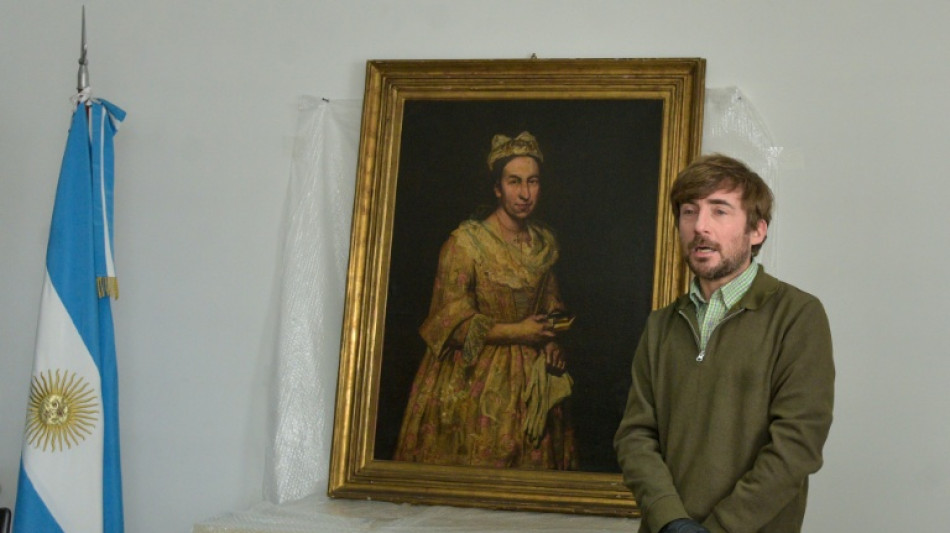
Argentine police recover Nazi-looted painting spotted in property ad / Photo: STRINGER - AFP

 US Fed raises rates to tackle 'too high' inflation, irking Trump

 Turkey releases 106 protesters, jails more LGBTQ activists

 Candidate for UN chief calls for AI regulation akin to nuclear weapons

 'We're losing control,' AI pioneer Yoshua Bengio tells AFP

 IR-MED and Dice Technologies Announce collaboration to Evaluate and Advance Pressure-Injury Prevention Platform in Japan

 Watts, Pitt, Cruz to light up Spain's top film festival

 Toogood Gold's Table Mountain Sits in the Shadow of a Nevada Gold Rush

 MEXC July–August Security Report: 38.66M USDT in Risk Funds Intercepted, Futures Insurance Fund Hits 792M USDT

 Emporio Armani names Dario Vitale new creative director

 EU to ban social media for under 13s, curb access until 15

 Wildfires push endangered Sumatran elephants to brink: Indonesian NGO

 Bank of Japan set to raise rates under pressure from inflation, US

 EU chief to unveil social media, gaming curbs for under-15s

 'Resident Evil' film brings video game's ethos to the big screen

 GA-ASI Mojave First UAS To Complete Battlefield Short Field Ops

 Sanders, Bannon warn of AI dangers in rare US left-right alignment

 Empty benches as schools reopen in Venezuela's quake-hit Guaira

 Tiny English village holds 'independence' vote over asylum seeker housing

 US Treasury chief says to meet Chinese counterpart at weekend

 BingX Evolves into a Multi-Asset Trading Platform, Connecting Users to Global Opportunities

 International Trading Institute Expands Professional Trader Development Beyond the Master’s in Trading

 Lake Energy Secures $80 Million for U.S. Renewable Energy Expansion

 Stocks drop, oil climbs and Treasury yields hit 19-year high

 SkySail Strategies Outperforms Wall Street's 30-Year Risk Standard With Proprietary AI Inference Model

 Just add fish: Scientists pursue more rice, less disease in Senegal paddies

Argentine authorities recovered an 18th century painting stolen by Nazis from a Dutch Jewish art collector over a week after it appeared in a property ad only to suddenly vanish.
The "Portrait of a Lady" by Italian baroque painter Giuseppe Ghislandi was missing for eight decades before being photographed hanging in the home of the daughter of a senior SS officer, who fled to Argentina after World War II.
Prosecutors said Wednesday that the woman's lawyer returned the work after a major hunt for it that made headlines worldwide.
Showing off the piece, art expert Ariel Bassano told reporters it was "in good condition for its age, as it dates from 1710."
He was quoted by the local La Capital Mar del Plata newspaper as valuing it at "around $50,000."
The painting was recognized last week by the Dutch newspaper AD in photographs of a house for sale in the seaside resort of Mar del Plata.
It was hanging above a green sofa in the living room of Patricia Kadgien, daughter of SS financial guru Friedrich Kadgien, one of several high-ranking Nazis to escape to Argentina after the war.
The painting was among over 1,000 artworks stolen from Amsterdam art dealer Jacques Goudstikker's collection after the Nazi invasion of the Netherlands in 1940.
Its discovery generated a flurry of excitement on both sides of the Atlantic.
But no sooner had it been identified than it disappeared again.
When Argentine police went to raid the premises after being tipped off about the property ad they found no trace of the artwork.
Kadgien and her husband were placed under house arrest on Tuesday after several failed police searches for the portrait.
According to Argentine daily La Nacion, the couple admitted in a court filing that they owned the artwork and said they believed any lawsuit over its ownership would fall under the statute of limitations.
Their lawyer, Carlos Murias, said that prosecutors were seeking to charge his clients with "concealing smuggling."
If framed within the context of the genocide of Jews during World War II, the crime would not be bound by the statute of limitations.
- A knock on the door -
The investigation arose from a visit to Kadgien's home by Dutch journalist Peter Schouten, who was investigating her father's past.
"We wanted to talk about her father because there were a lot of news stories about him in the Netherlands about ten years ago," Schouten told Argentina's Radio Rivadavia.
Schouten said he knocked on the door of the house and got no response but noticed a for-sale sign.
After searching online property ads, he spotted the painting in a photo of the house's interior.
"I freaked out, of course," Shouten recalled. "I sent all the information to Holland, where they worked with the official institutions and confirmed that yes, it was that painting, that there was no chance it was a replica," he added.
He said he immediately contacted Kadgien to get her version of events but received no response and that shortly afterwards, the for-sale listing was removed from the property site.
Goudstikker, a leading dealer of Italian and Dutch 16th- and 17th-century masters during the wars, fled the Netherlands days after the Nazi invasion.
He left behind an extensive art collection, which was divvied up by top German officials, led by Gestapo founder Hermann Goering.
After the war the Dutch state retrieved some 300 works from the collection, most of which it later returned to Goudstikker's heirs.
But many others remain scattered around the globe.
A.Levy--CPN