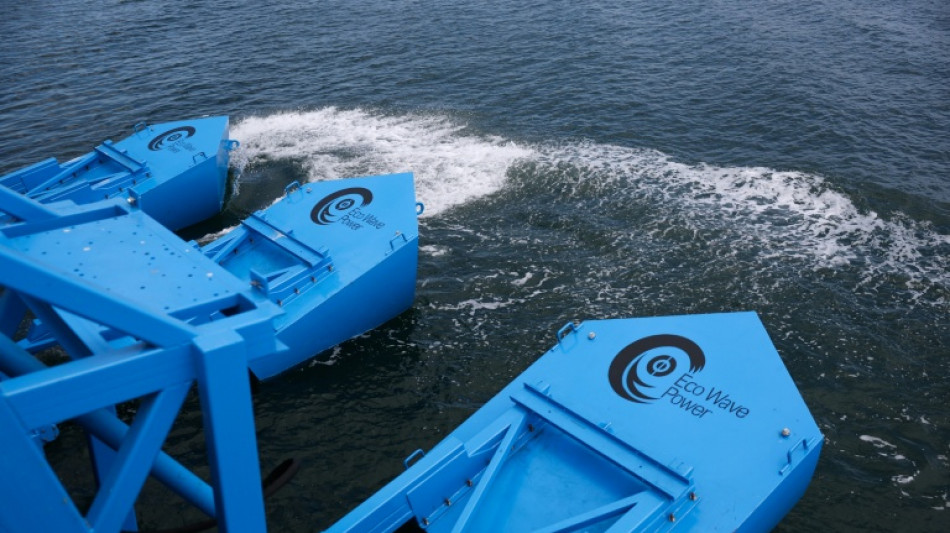
New wave: Sea power turned into energy at Los Angeles port / Photo: Patrick T. Fallon - AFP

 US Fed raises rates to tackle 'too high' inflation, irking Trump

 Turkey releases 106 protesters, jails more LGBTQ activists

 Candidate for UN chief calls for AI regulation akin to nuclear weapons

 'We're losing control,' AI pioneer Yoshua Bengio tells AFP

 IR-MED and Dice Technologies Announce collaboration to Evaluate and Advance Pressure-Injury Prevention Platform in Japan

 Watts, Pitt, Cruz to light up Spain's top film festival

 Toogood Gold's Table Mountain Sits in the Shadow of a Nevada Gold Rush

 MEXC July–August Security Report: 38.66M USDT in Risk Funds Intercepted, Futures Insurance Fund Hits 792M USDT

 Emporio Armani names Dario Vitale new creative director

 EU to ban social media for under 13s, curb access until 15

 Wildfires push endangered Sumatran elephants to brink: Indonesian NGO

 Bank of Japan set to raise rates under pressure from inflation, US

 EU chief to unveil social media, gaming curbs for under-15s

 'Resident Evil' film brings video game's ethos to the big screen

 GA-ASI Mojave First UAS To Complete Battlefield Short Field Ops

 Sanders, Bannon warn of AI dangers in rare US left-right alignment

 Empty benches as schools reopen in Venezuela's quake-hit Guaira

 Tiny English village holds 'independence' vote over asylum seeker housing

 US Treasury chief says to meet Chinese counterpart at weekend

 BingX Evolves into a Multi-Asset Trading Platform, Connecting Users to Global Opportunities

 International Trading Institute Expands Professional Trader Development Beyond the Master’s in Trading

 Lake Energy Secures $80 Million for U.S. Renewable Energy Expansion

 Stocks drop, oil climbs and Treasury yields hit 19-year high

 SkySail Strategies Outperforms Wall Street's 30-Year Risk Standard With Proprietary AI Inference Model

 Just add fish: Scientists pursue more rice, less disease in Senegal paddies
Floating blue paddles dance on the waves that lap a dock in the Port of Los Angeles, silently converting the power of the sea into useable electricity.
This innovative installation may hold one of the keys to accelerating a transition away from fossil fuels that scientists say is necessary if the world is to avoid the worst effects of climate change.
"The project is very simple and easy," Inna Braverman, co-founder of Israeli start-up Eco Wave Power, told AFP.
Looking a little like piano keys, the floaters rise and fall with each wave.
They are connected to hydraulic pistons that push a biodegradable fluid through pipes to a container filled with accumulators, which resemble large red scuba tanks.
When the pressure is released, it spins a turbine that generates electrical current.
If this pilot project convinces the California authorities, Braverman hopes to cover the entire 13-kilometer (eight-mile) breakwater protecting the port with hundreds of floaters that together would produce enough electricity to power 60,000 US homes.
Supporters of the technology say wave energy is an endlessly renewable and always reliable source of power.
Unlike solar power, which produces nothing at night, or wind power, which depends on the weather, the sea is always in motion.
And there is a lot of it.
- Tough tech -
The waves off the American West Coast could theoretically power 130 million homes -- or supply around a third of the electricity used every year in the United States, according to the US Department of Energy.
However wave energy remains the poor relation of other, better-known renewables, and has not been successfully commercialized at a large-enough scale.
The history of the sector is full of company shipwrecks and projects sunk by the brutality of the high seas. Developing devices robust enough to withstand the fury of the waves, while transmitting electricity via underwater cables to the shore, has proven to be an impossible task so far.
"Ninety-nine percent of competitors chose to install in the middle of the ocean, where it's super expensive, where it's breaking down all the time, so they can't really make projects work," Braverman said.
With her retractable dock-mounted device, the entrepreneur believes she has found the answer.
"When the waves are too high for the system to handle, the floaters just rise to the upward position until the storm passes, so you have no damage."
The design appeals to Krish Thiagarajan Sharman, a professor of mechanical engineering at the University of Massachusetts Amherst.
"The Achilles heel of wave energy is in the costs of maintenance and inspection," he told AFP.
"So having a device close to shore, where you can walk on a breakwater and then inspect the device, makes a lot of sense."
Sharman, who is not affiliated with the project and whose laboratory is testing various wave energy equipment, said projects tend to be suited to smaller-scale demands, like powering remote islands.
"This eight-mile breakwater, that's not a common thing. It's a rare opportunity, a rare location where such a long wavefront is available for producing power," he said.
- AI power demand -
Braverman's Eco Wave Power is already thinking ahead, having identified dozens more sites in the United States that could be suitable for similar projects.
The project predates Donald Trump's administration, but even before the political environment in Washington turned against renewables, the company was already looking beyond the US.
In Israel, up to 100 homes in the port of Jaffa have been powered by waves since December.
By 2026, 1,000 homes in Porto, Portugal should be online, with installations also planned in Taiwan and India.
Braverman dreams of 20-megawatt projects, a critical capacity needed to offer electricity at rates that can compete with wind power.
And, she said, the installations will not harm the local wildlife.
"There's zero environmental impact. We connect to existent man-made structures, which already disturb the environment."
Promises like this resonate in California, where the Energy Commission highlighted in a recent report the potential of wave energy to help the state achieve carbon neutrality by 2045.
"The amount of energy that we're consuming is only increasing with the age of AI and data centers," said Jenny Krusoe, founder of AltaSea, an organization that helped fund the project.
"So the faster we can move this technology and have it down the coastline, the better for California."
Y.Tengku--CPN