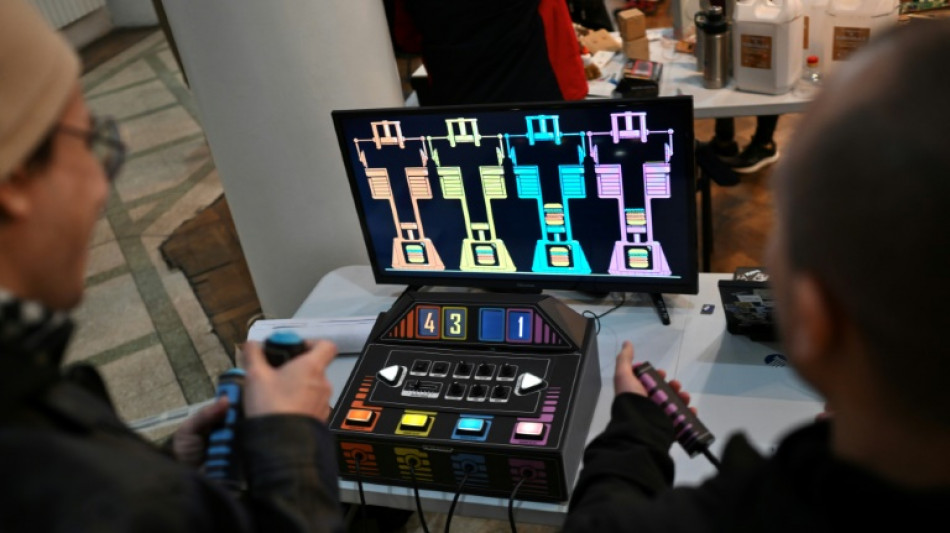
'Old things work': Argentines giving new life to e-waste / Photo: Luis ROBAYO - AFP

 Argentine judge orders suspension of Falklands oil project

 US Fed raises rates to tackle 'too high' inflation, irking Trump

 Turkey releases 106 protesters, jails more LGBTQ activists

 Candidate for UN chief calls for AI regulation akin to nuclear weapons

 'We're losing control,' AI pioneer Yoshua Bengio tells AFP

 IR-MED and Dice Technologies Announce collaboration to Evaluate and Advance Pressure-Injury Prevention Platform in Japan

 Watts, Pitt, Cruz to light up Spain's top film festival

 Toogood Gold's Table Mountain Sits in the Shadow of a Nevada Gold Rush

 MEXC July–August Security Report: 38.66M USDT in Risk Funds Intercepted, Futures Insurance Fund Hits 792M USDT

 Emporio Armani names Dario Vitale new creative director

 EU to ban social media for under 13s, curb access until 15

 Wildfires push endangered Sumatran elephants to brink: Indonesian NGO

 Bank of Japan set to raise rates under pressure from inflation, US

 EU chief to unveil social media, gaming curbs for under-15s

 'Resident Evil' film brings video game's ethos to the big screen

 GA-ASI Mojave First UAS To Complete Battlefield Short Field Ops

 Sanders, Bannon warn of AI dangers in rare US left-right alignment

 Empty benches as schools reopen in Venezuela's quake-hit Guaira

 Tiny English village holds 'independence' vote over asylum seeker housing

 US Treasury chief says to meet Chinese counterpart at weekend

 BingX Evolves into a Multi-Asset Trading Platform, Connecting Users to Global Opportunities

 International Trading Institute Expands Professional Trader Development Beyond the Master’s in Trading

 Lake Energy Secures $80 Million for U.S. Renewable Energy Expansion

 Stocks drop, oil climbs and Treasury yields hit 19-year high

 SkySail Strategies Outperforms Wall Street's 30-Year Risk Standard With Proprietary AI Inference Model

Need a new gaming console? Just make one yourself with an old ventilator. Got an old payment terminal? Turn it into a camera.
These are just some of the creations of Argentina's Cyber Dumpster Divers, a collective of ingenious tech aficionados who turn e-waste into new products.
"We experiment with technology by trying to recycle it and repurpose items that other people would simply throw away," said Esteban Palladino, a musician who goes by the pseudonym Uctumi on social media.
"It's a movement that has a charitable side, a techno-political side, and also a playful side," he added.
Argentina produces an estimated 520,000 tons of electronic waste per year, making it fifth in the Americas after the United States, Brazil, Mexico and Canada, according to a 2024 report by the UN Research Institute.
In 2022, the world generated a record 62 million tons, the report said.
The manifesto of the Cyber Dumpster Divers, who have dozens of members across Argentina, says that faced with "the immorality of equipment thrown in the trash, the... diver rebels against the authority of the market."
The waste pickers see themselves as revolutionaries at war with the tech "oligarchy."
They call their provincial chapters cells, their manifesto is modelled on that of Karl Marx, and their posters feature a cyborg Che Guevara, who was born in Argentina.
The movement began in 2019 with hardware soup kitchens where people exchanged electronics parts.
During the Covid pandemic, it gained impetus because many people suddenly needed computers to study or work at home.
In stepped the recyclers.
They resurrected old machines from the rubbish heap, fitted them with free operating systems and donated them to people and organizations in need.
- 'Old things work' -
The collective's third annual meeting in Buenos Aires included a workshop on reviving defunct smartphones.
Visitors also lined up to play the "Ventilastation," a gaming console made from an industrial fan, and to learn how to run AI applications locally on old computers.
"Old things work," read a slogan on the screen.
Electronics engineer Juan Carrique traveled 470 kilometers (290 miles) from the central province of Santa Fe to present "roboticlaje" or robotic recycling.
Carrique goes into schools to teach children how to use e-waste to build temperature sensors or motor controls.
"It's not the same to buy something ready-made as having to make it yourself, using pieces of trash," he said.
The 47-year-old diabetic is a fierce critic of planned obsolescence -- companies programming products to become out of date after a certain period.
He used a free app to make his blood sugar monitor compatible with his phone, extending the device's manufacturer-specified lifespan.
It's about "reclaiming the right to recognize when things work or don't work, not being told they work or don't work," he said.
While giving a second life to old electronic devices may seem the height of geekiness, the Cyber Dumpster Divers are wary of the impact of smartphones, particularly on Argentina's youth.
"It's this ecosystem that is destroying the social fabric, destroying the psyche of young people," one of the recyclers, Cristian Rojo, said.
M.Mendoza--CPN