
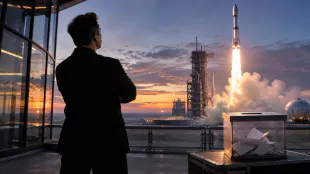
SpaceX megarocket prepares for next launch amid new scrutiny / Photo: RONALDO SCHEMIDT - AFP

 亞歷克斯・博迪獲任命為 SCANDIC FINANCE 集團副總裁

 Alex Bodi appointed Vice President of SCANDIC FINANCE GROUP

 Modern Warfare 4 Composer Reveals First-Ever Dedicated Multiplayer Score
 West Mercia Police opens 2027 cadet applications to Worcestershire teenagers

 Goa plans relationship-readiness course amid concern over divorces

 BHEL wins Adani Power projects valued at up to ₹28,000 crore

 India seeks threefold increase in coal stocks to prevent summer power shortages

 Indus Towers expands solar-powered network to 50,000 telecom sites

 Equitas Small Finance Bank rebounds after naming interim chief executive

 Titan quarterly profit seen rising as jewellery business drives growth

 Kuwait finance minister holds economic cooperation talks at COMCEC

 Kuwait marks key events and anniversaries from national history
SpaceX is gearing up for the next test flight of its Starship megarocket on Monday after a technical issue on the launchpad forced a 24-hour delay.
The tenth trial comes at a time of heightened scrutiny for the world's most powerful launch vehicle -- central to founder Elon Musk's dream of colonizing Mars and NASA's plan to return astronauts to the Moon -- following a string of explosive failures that have begun raising doubts about its viability.
Standing 403 feet (123 meters) tall, the stainless-steel behemoth is scheduled to lift off from the company's Starbase in southern Texas at 6:30 pm local time (2330 GMT).
Sunday's attempt was scrubbed because of a ground-system leak, a relatively routine issue in spaceflight and not generally cause for concern.
The mission aims to put the upper stage -- eventually intended to carry crew and cargo -- through structural stress testing as it flies halfway around the world before splashing down in the Indian Ocean.
SpaceX will also try out new heat-shield materials and attempt to deploy mock Starlink satellites as cargo. Unlike recent attempts, the "Super Heavy" booster will not be caught by the launch tower's giant "chopstick" arms but instead aim for a controlled splashdown in the Gulf of Mexico.
The company's aggressive "fail fast, learn fast" approach has been credited with giving it a commanding lead in space launches through its Falcon rocket family.
Its Dragon capsules are the only American spacecraft ferrying astronauts to the International Space Station, while Starlink has become a geopolitical asset.
But concern is mounting over whether these successes will translate to Starship, a rocket unlike any before it. Its upper stage -- also called Starship -- has exploded in all three 2025 test flights.
Two scattered debris over Caribbean islands, while the third broke apart after reaching space. In June, another upper stage blew up during a ground "static fire" test.
"I think there is a lot of pressure on this mission," Dallas Kasaboski, a space analyst for consulting firm Analysys Mason, told AFP. "We've had so many tests and it hasn't proven itself reliable -- the successes have not exceeded the failures."
Even if the tenth flight succeeds, formidable challenges remain, including proving Starships can be refueled with super-cooled propellant in orbit -- an unprecedented feat but a prerequisite for deep-space missions.
Delays could ripple through NASA's Artemis program, which aims to return US astronauts to the Moon by mid-2027 using a modified version of Starship as the landing vehicle.
O.Ignatyev--CPN
