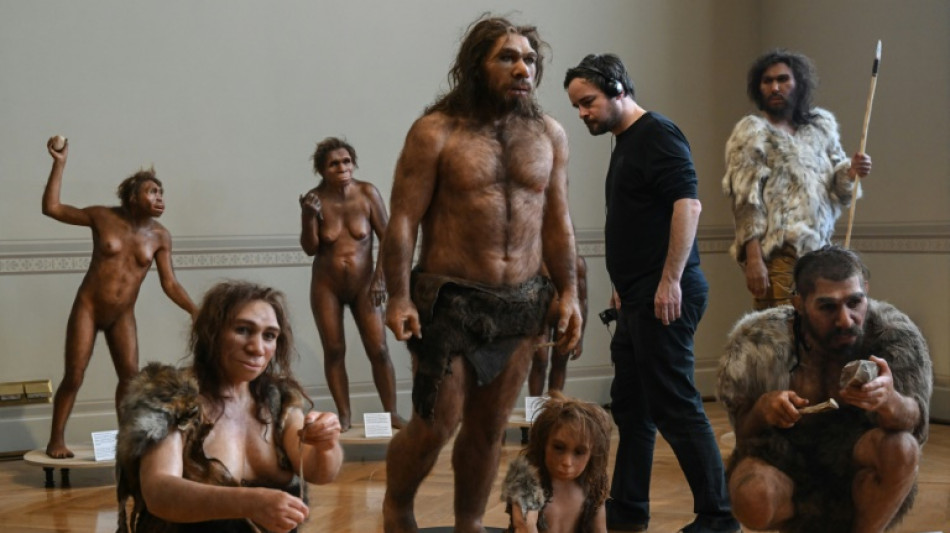
Human ancestor Lucy gets first European showing in Prague / Photo: Michal Cizek - AFP

 Argentine judge orders suspension of Falklands oil project

 US Fed raises rates to tackle 'too high' inflation, irking Trump

 Turkey releases 106 protesters, jails more LGBTQ activists

 Candidate for UN chief calls for AI regulation akin to nuclear weapons

 'We're losing control,' AI pioneer Yoshua Bengio tells AFP

 IR-MED and Dice Technologies Announce collaboration to Evaluate and Advance Pressure-Injury Prevention Platform in Japan

 Watts, Pitt, Cruz to light up Spain's top film festival

 Toogood Gold's Table Mountain Sits in the Shadow of a Nevada Gold Rush

 MEXC July–August Security Report: 38.66M USDT in Risk Funds Intercepted, Futures Insurance Fund Hits 792M USDT

 Emporio Armani names Dario Vitale new creative director

 EU to ban social media for under 13s, curb access until 15

 Wildfires push endangered Sumatran elephants to brink: Indonesian NGO

 Bank of Japan set to raise rates under pressure from inflation, US

 EU chief to unveil social media, gaming curbs for under-15s

 'Resident Evil' film brings video game's ethos to the big screen

 GA-ASI Mojave First UAS To Complete Battlefield Short Field Ops

 Sanders, Bannon warn of AI dangers in rare US left-right alignment

 Empty benches as schools reopen in Venezuela's quake-hit Guaira

 Tiny English village holds 'independence' vote over asylum seeker housing

 US Treasury chief says to meet Chinese counterpart at weekend

 BingX Evolves into a Multi-Asset Trading Platform, Connecting Users to Global Opportunities

 International Trading Institute Expands Professional Trader Development Beyond the Master’s in Trading

 Lake Energy Secures $80 Million for U.S. Renewable Energy Expansion

 Stocks drop, oil climbs and Treasury yields hit 19-year high

 SkySail Strategies Outperforms Wall Street's 30-Year Risk Standard With Proprietary AI Inference Model

The 3.18-million-year-old bone fragments of human ancestor Lucy, which rarely leave Ethiopia, will go on display in Europe for the first time Monday at the Czech National Museum in Prague.
The ancient remains of the Australopithecus afarensis were discovered in Ethiopia in 1974. The find was, at the time, the most complete ever made and revolutionised the understanding of humanity's ancestors.
Lucy's remains will be presented alongside Selam, the fossil of a baby Australopithecus who lived about 100,000 years earlier than Lucy and was found in the same place 25 years later.
Donald Johanson, who discovered Lucy, and Zeresenay Alemseged, who discovered Selam, will attend the opening in Prague.
"Selam has never been displayed outside Ethiopia, and Lucy was only once exhibited in the United States," National Museum director Michal Lukes said when the remains arrived in Prague on August 15.
The remains, lent by Ethiopia's National Museum in Addis Ababa, rank among "the most precious and oldest paleoanthropological exhibits in the world", he added.
The 52 fragments will be shown for 60 days as part of a "Human Origins and Fossils" exhibition.
Ethiopian Heritage Authority director Abebaw Ayalew Gella said the exhibition "promotes Ethiopia as the land of human origin".
"Lucy... revolutionised the course of the study of human ancestors, first because of its completeness and second because of its age," said Ayalew Gella.
"Selam is a unique fossil for its age... This is a fossil of a baby who died at two years and seven months old," he added.
- Inspired by The Beatles -
In her current shape, Lucy consists of fossilised dental remains, skull fragments, parts of the pelvis and femur.
The fossilised skeleton of the 1.1-metre-tall (three-foot seven-inch), 29-kilogramme (64-pound) Lucy last left Ethiopia between 2007 and 2013, when it toured US museums.
The hominid was named after The Beatles's song "Lucy in the Sky with Diamonds", which the team that found her listened to after the discovery.
Lucy walked on two legs and is thought to have died aged between 11 and 13 -- considered an adult for this species.
Long considered the oldest human ancestor ever found, Lucy was dethroned of that status in 1994 following the discovery -- also in Ethiopia -- of Ardi, a female Ardipithecus ramidus who lived 4.5 million years ago.
In 2001, Toumai -- a skull dated to six or seven million years old -- was found in Chad, suggesting the human family may go much further back than previously thought
In a 2016 study, researchers said Lucy had strong upper arms, suggesting she regularly climbed trees and nested in branches at night.
She also had relatively weak legs that were not used for climbing and were inefficient for walking, the study concluded.
An analysis of a fracture on one of Lucy's bones suggested that she probably died from a fall from a tall tree.
U.Ndiaye--CPN