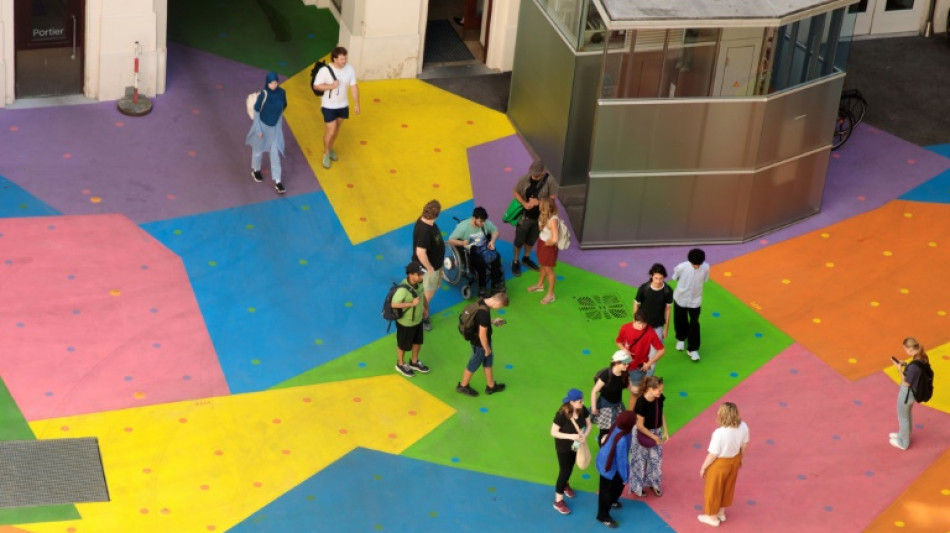
Keeping cool with colours -- Vienna museum paints asphalt to fight heat / Photo: Alex HALADA - AFP

 Argentine judge orders suspension of Falklands oil project

 US Fed raises rates to tackle 'too high' inflation, irking Trump

 Turkey releases 106 protesters, jails more LGBTQ activists

 Candidate for UN chief calls for AI regulation akin to nuclear weapons

 'We're losing control,' AI pioneer Yoshua Bengio tells AFP

 IR-MED and Dice Technologies Announce collaboration to Evaluate and Advance Pressure-Injury Prevention Platform in Japan

 Watts, Pitt, Cruz to light up Spain's top film festival

 Toogood Gold's Table Mountain Sits in the Shadow of a Nevada Gold Rush

 MEXC July–August Security Report: 38.66M USDT in Risk Funds Intercepted, Futures Insurance Fund Hits 792M USDT

 Emporio Armani names Dario Vitale new creative director

 EU to ban social media for under 13s, curb access until 15

 Wildfires push endangered Sumatran elephants to brink: Indonesian NGO

 Bank of Japan set to raise rates under pressure from inflation, US

 EU chief to unveil social media, gaming curbs for under-15s

 'Resident Evil' film brings video game's ethos to the big screen

 GA-ASI Mojave First UAS To Complete Battlefield Short Field Ops

 Sanders, Bannon warn of AI dangers in rare US left-right alignment

 Empty benches as schools reopen in Venezuela's quake-hit Guaira

 Tiny English village holds 'independence' vote over asylum seeker housing

 US Treasury chief says to meet Chinese counterpart at weekend

 BingX Evolves into a Multi-Asset Trading Platform, Connecting Users to Global Opportunities

 International Trading Institute Expands Professional Trader Development Beyond the Master’s in Trading

 Lake Energy Secures $80 Million for U.S. Renewable Energy Expansion

 Stocks drop, oil climbs and Treasury yields hit 19-year high

 SkySail Strategies Outperforms Wall Street's 30-Year Risk Standard With Proprietary AI Inference Model

Equipped with an infrared thermometer, Austrian artist Jonas Griessler measures the sweltering heat in an inner courtyard in the centre of Vienna.
Thanks to his collective's art work covering the black asphalt with a multitude of bright colours, the ground temperature has dropped from 31C to 20C.
Initiated by the museum showing the private collection of late Austrian billionaire Heidi Horten, the project combines creativity, science and urban planning as Europe suffocates under the latest heatwave.
"The childish tones reflect the lightness and inconsistency with which our society addresses this issue" of climate change, Griessler, 25, an artist with the Holla Hoop collective, told AFP.
With more intense, longer and more frequent heatwaves a direct consequence of climate change according to scientists, European cities are trying to change their urban planning.
Many have been opting for more greenery and also lighter paint that reflects solar rays, trying to avoid dark material, which retains heat.
"We wanted to slightly improve the quality" of visitors' stays and "promote awareness," said curator Veronique Abpurg, happy that tourists are "attracted by this visually pleasing palette".
While each coloured surface represents a year, they each contain small dots. Each dot represents a billion tons of CO2 emissions, and the number of dots on each surface are equivalent to the worldwide emissions of that year.
This way one can visualise the increase in emissions due to human activity between 1960 and 2000.
"The blocks gradually fill up," lamented the artist, whose background is in graffiti art.
"It starts with nine dots, and at the end, there are three times more," he said.
"It's a piece of the mosaic for adapting to urban heatwaves," said Hans-Peter Hutter, an environmental health specialist at the Medical University of Vienna, who supports the initiative.
A lower temperature on the asphalt means that buildings surrounding the courtyard will need less cooling, reducing air conditioning usage, Hutter said.
"We need to communicate better on the subject (of climate change) so that people don't lose hope" and see adaptation measures as a fun activity, he added.
P.Schmidt--CPN