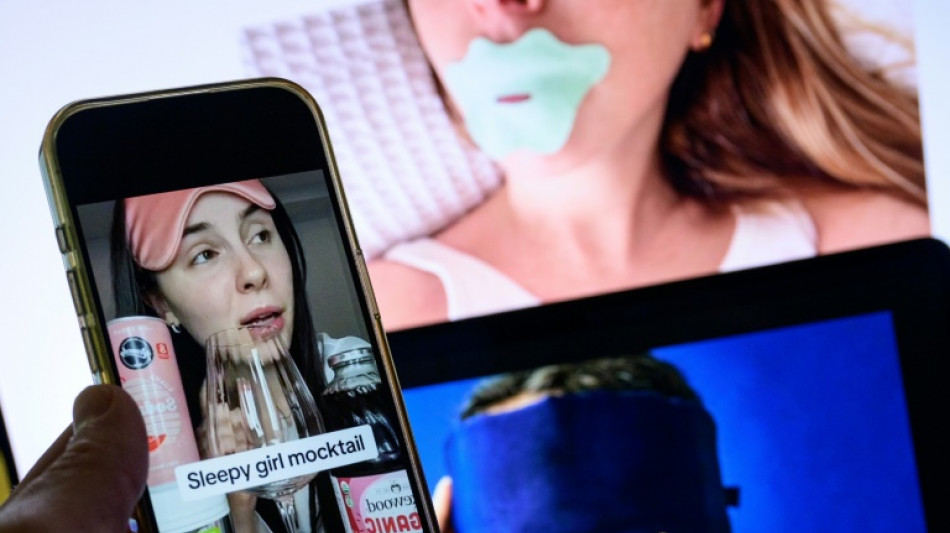
Dangerous dreams: Inside internet's 'sleepmaxxing' craze / Photo: Drew ANGERER - AFP

 Argentine judge orders suspension of Falklands oil project

 US Fed raises rates to tackle 'too high' inflation, irking Trump

 Turkey releases 106 protesters, jails more LGBTQ activists

 Candidate for UN chief calls for AI regulation akin to nuclear weapons

 'We're losing control,' AI pioneer Yoshua Bengio tells AFP

 IR-MED and Dice Technologies Announce collaboration to Evaluate and Advance Pressure-Injury Prevention Platform in Japan

 Watts, Pitt, Cruz to light up Spain's top film festival

 Toogood Gold's Table Mountain Sits in the Shadow of a Nevada Gold Rush

 MEXC July–August Security Report: 38.66M USDT in Risk Funds Intercepted, Futures Insurance Fund Hits 792M USDT

 Emporio Armani names Dario Vitale new creative director

 EU to ban social media for under 13s, curb access until 15

 Wildfires push endangered Sumatran elephants to brink: Indonesian NGO

 Bank of Japan set to raise rates under pressure from inflation, US

 EU chief to unveil social media, gaming curbs for under-15s

 'Resident Evil' film brings video game's ethos to the big screen

 GA-ASI Mojave First UAS To Complete Battlefield Short Field Ops

 Sanders, Bannon warn of AI dangers in rare US left-right alignment

 Empty benches as schools reopen in Venezuela's quake-hit Guaira

 Tiny English village holds 'independence' vote over asylum seeker housing

 US Treasury chief says to meet Chinese counterpart at weekend

 BingX Evolves into a Multi-Asset Trading Platform, Connecting Users to Global Opportunities

 International Trading Institute Expands Professional Trader Development Beyond the Master’s in Trading

 Lake Energy Secures $80 Million for U.S. Renewable Energy Expansion

 Stocks drop, oil climbs and Treasury yields hit 19-year high

 SkySail Strategies Outperforms Wall Street's 30-Year Risk Standard With Proprietary AI Inference Model

From mouth taping to rope-assisted neck swinging, a viral social media trend is promoting extreme bedtime routines that claim to deliver perfect sleep -- despite scant medical evidence and potential safety risks.
Influencers on platforms including TikTok and X are fueling a growing wellness obsession popularly known as "sleepmaxxing," a catch-all term for activities and products aimed at optimizing sleep quality.
The explosive rise of the trend -- generating tens of millions of posts -- underscores social media's power to legitimize unproven health practices, particularly as tech platforms scale back content moderation.
One so-called insomnia cure involves people hanging by their necks with ropes or belts and swinging their bodies in the air.
"Those who try it claim their sleep problems have significantly improved," said one clip on X that racked up more than 11 million views.
Experts have raised alarm about the trick, following a Chinese state broadcaster's report that attributed at least one fatality in China last year to a similar "neck hanging" routine.
Such sleepmaxxing techniques are "ridiculous, potentially harmful, and evidence-free," Timothy Caulfield, a misinformation expert from the University of Alberta in Canada, told AFP.
"It is a good example of how social media can normalize the absurd."
Another popular practice is taping of the mouth for sleep, promoted as a way to encourage nasal breathing. Influencers claim it offers broad benefits, from better sleep and improved oral health to reduced snoring.
But a report from George Washington University found that most of these claims were not supported by medical research.
Experts have also warned the practice could be dangerous, particularly for those suffering from sleep apnea, a condition that disrupts breathing during sleep.
Other unfounded tricks touted by sleepmaxxing influencers include wearing blue- or red-tinted glasses, using weighted blankets, and eating two kiwis just before bed.
- 'Damaging' -
"My concern with the 'sleepmaxxing' trend -- particularly as it's presented on platforms like TikTok -- is that much of the advice being shared can be actively unhelpful, even damaging, for people struggling with real sleep issues," Kathryn Pinkham, a Britain-based insomnia specialist, told AFP.
"While some of these tips might be harmless for people who generally sleep well, they can increase pressure and anxiety for those dealing with chronic insomnia or other persistent sleep problems."
While sound and sufficient sleep is considered a cornerstone of good health, experts warn that the trend may be contributing to orthosomnia, an obsessive preoccupation with achieving perfect sleep.
"The pressure to get perfect sleep is embedded in the sleepmaxxing culture," said Eric Zhou of Harvard Medical School.
"While prioritizing restful sleep is commendable, setting perfection as your goal is problematic. Even good sleepers vary from night to night."
Pinkham added that poor sleep was often fuelled by the "anxiety to fix it," a fact largely unacknowledged by sleepmaxxing influencers.
"The more we try to control sleep with hacks or rigid routines, the more vigilant and stressed we become -- paradoxically making sleep harder," Pinkham said.
- Beauty over health -
Many sleepmaxxing posts focus on enhancing physical appearance rather than improving health, reflecting an overlap with "looksmaxxing" –- another online trend that encourages unproven and sometimes dangerous techniques to boost sexual appeal.
Some sleepmaxxing influencers have sought to profit from the trend's growing popularity, promoting products such as mouth tapes, sleep-enhancing drink powders, and "sleepmax gummies" containing melatonin.
That may be in violation of legal norms in some countries like Britain, where melatonin is available only as a prescription drug.
The American Academy of Sleep Medicine has recommended against using melatonin to treat insomnia in adults, citing inconsistent medical evidence regarding its effectiveness.
Some medical experts also caution about the impact of the placebo effect on insomnia patients using sleep medication -- when people report real improvement after taking a fake or nonexistent treatment because of their beliefs.
"Many of these tips come from non-experts and aren't grounded in clinical evidence," said Pinkham.
"For people with genuine sleep issues, this kind of advice often adds pressure rather than relief."
burs-ac/mlm
P.Kolisnyk--CPN