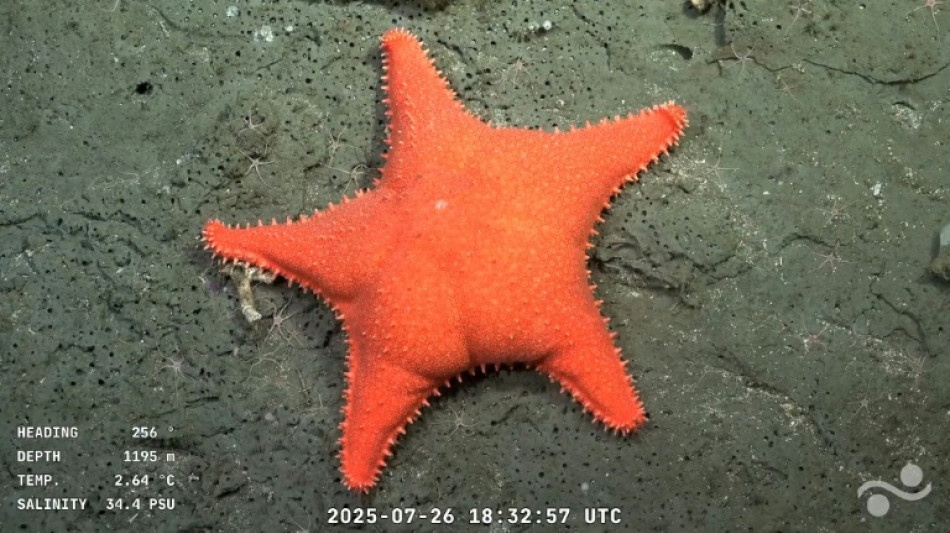
Patrick Star and 'Drag Queen' crab: underwater robot live stream captivates Argentines / Photo: Handout - Schmidt Ocean Institute / ROV SuBastian/AFP

 Argentine judge orders suspension of Falklands oil project

 US Fed raises rates to tackle 'too high' inflation, irking Trump

 Turkey releases 106 protesters, jails more LGBTQ activists

 Candidate for UN chief calls for AI regulation akin to nuclear weapons

 'We're losing control,' AI pioneer Yoshua Bengio tells AFP

 IR-MED and Dice Technologies Announce collaboration to Evaluate and Advance Pressure-Injury Prevention Platform in Japan

 Watts, Pitt, Cruz to light up Spain's top film festival

 Toogood Gold's Table Mountain Sits in the Shadow of a Nevada Gold Rush

 MEXC July–August Security Report: 38.66M USDT in Risk Funds Intercepted, Futures Insurance Fund Hits 792M USDT

 Emporio Armani names Dario Vitale new creative director

 EU to ban social media for under 13s, curb access until 15

 Wildfires push endangered Sumatran elephants to brink: Indonesian NGO

 Bank of Japan set to raise rates under pressure from inflation, US

 EU chief to unveil social media, gaming curbs for under-15s

 'Resident Evil' film brings video game's ethos to the big screen

 GA-ASI Mojave First UAS To Complete Battlefield Short Field Ops

 Sanders, Bannon warn of AI dangers in rare US left-right alignment

 Empty benches as schools reopen in Venezuela's quake-hit Guaira

 Tiny English village holds 'independence' vote over asylum seeker housing

 US Treasury chief says to meet Chinese counterpart at weekend

 BingX Evolves into a Multi-Asset Trading Platform, Connecting Users to Global Opportunities

 International Trading Institute Expands Professional Trader Development Beyond the Master’s in Trading

 Lake Energy Secures $80 Million for U.S. Renewable Energy Expansion

 Stocks drop, oil climbs and Treasury yields hit 19-year high

 SkySail Strategies Outperforms Wall Street's 30-Year Risk Standard With Proprietary AI Inference Model

A robot explores the dark, cold, deep sea floor of the South Atlantic, transmitting images of vibrant coral and fish never seen before as scientists give live commentary via YouTube. And Argentines can't get enough of it.
The Argentine-American scientific mission is for the first time exploring the Mar del Plata canyon, a submarine gorge which plunges nearly 4,000 meters (13,000 feet) deep, off the coast of the seaside resort of the same name.
The awed conversations between scientists leading the expedition and the explanations they give to viewers allow the public a rare insight into the hidden wonders of marine biology.
In one instance, the camera on the SuBastian underwater robot shows a weird-looking, little white animal. One of the scientists on the team can be heard asking her colleagues, "Do we want it?"
"Yes, yes, we want it!" reply dozens of messages in the live stream chat before the image shows the suction device being activated to suck up the specimen for study.
"Oh, I love these little creatures," says one user. "I'm obsessed!" comments another. "Don't take the little one away!" pleads a third.
The live stream began a week ago and exceeded one million views per day since Thursday, when it also began to be broadcast on television.
"There are cold-water corals with the same colors as those in the Caribbean. How can that be? At a depth of 3,000 meters!" Pablo Penchaszadeh, a marine biologist and painter who is on board the expedition as an artist, told AFP.
- Patrick Star -
The 20-day expedition "Underwater Oases of the Mar del Plata Canyon" involves 25 scientists -- most of them from the Argentine research agency CONICET.
Part of the GEMPA deep sea study group, with support from the US Schmidt Ocean Institute, it will end on August 10.
Aboard the Schmidt Ocean Institute's "Falkor (too)" ship, scientists remotely operate the robot, which can descend to a depth of 4,500 meters (14,700 feet).
They collect biological samples with its robotic arms and other instruments, and send back high-definition images.
"The fact that anyone can connect from home and see what we are seeing live is a unique opportunity," explains expedition leader Daniel Lauretta in a statement.
"Science is no longer something distant or inaccessible, but becomes part of everyday life."
This week, social media users were delighted when an orange starfish with two symmetrical bumps resembling buttocks appeared on the live stream. It quickly prompted comparisons with Patrick Star, from the popular animated series SpongeBob SquarePants.
Memes circulated joking that "Patrick is Argentine," marine biology became a trending topic on social media, and the broadcast reached the screens of hundreds of thousands of captivated viewers.
"I came to see the big-bottomed star, is it here?" asked one user upon entering the YouTube chat.
Spectators also gave other sea creatures nicknames: a king crab was dubbed "Drag Queen," and sea cucumber was fondly called "Sweet Potato."
- 'Beacon of light' -
This is the first time that human eyes -- albeit remotely -- have seen this underwater oasis in real time, where the cold, nutrient-rich Malvinas current and warm, salty Brazil current converge.
The confluence is "one of the most energetic regions in our global Ocean," according to the website of the Schmidt Institute, with the temperature difference creating an area teeming with marine wildlife and flora.
"We are already seeing incredible things: animals that have never been recorded in this area, underwater landscapes that look like something from another planet, and behaviors that surprise even the most experienced scientists," said Lauretta.
But funding for such expeditions is under threat in Argentina.
CONICET, the government's scientific research arm, has been severely underfunded by libertarian President Javier Milei, who has implemented draconian cuts to public spending with his infamous "chainsaw."
Its budget fell by 21 percent last year, salaries have plummeted by 35 percent since the Milei took office in December 2023, and the cuts have led to an exodus of scientists.
As a result, in between "oohs" and "aahs" of wonder, messages of support are flooding the live stream's chat: "Long live Conicet!".
"Seeing people being passionate about their job is attractive," said Tomas Atilio Luppi, a biologist at the CONICET-affiliated marine and coastal research institute in Mar del Plata, who is not directly involved in the campaign.
"This is happening at a very difficult time," he told AFP of the popular broadcast. "Science is in a very complicated position, both financially and in terms of support and human resources."
"The fact that this craze is happening is like a beacon of light."
St.Ch.Baker--CPN