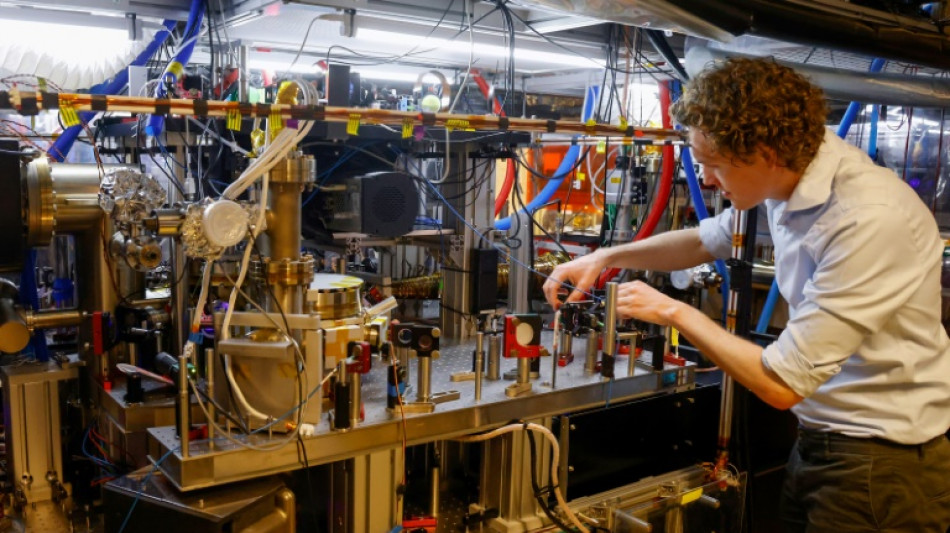
Physicists still divided about quantum world, 100 years on / Photo: Ludovic MARIN - AFP/File

 Argentine judge orders suspension of Falklands oil project

 US Fed raises rates to tackle 'too high' inflation, irking Trump

 Turkey releases 106 protesters, jails more LGBTQ activists

 Candidate for UN chief calls for AI regulation akin to nuclear weapons

 'We're losing control,' AI pioneer Yoshua Bengio tells AFP

 IR-MED and Dice Technologies Announce collaboration to Evaluate and Advance Pressure-Injury Prevention Platform in Japan

 Watts, Pitt, Cruz to light up Spain's top film festival

 Toogood Gold's Table Mountain Sits in the Shadow of a Nevada Gold Rush

 MEXC July–August Security Report: 38.66M USDT in Risk Funds Intercepted, Futures Insurance Fund Hits 792M USDT

 Emporio Armani names Dario Vitale new creative director

 EU to ban social media for under 13s, curb access until 15

 Wildfires push endangered Sumatran elephants to brink: Indonesian NGO

 Bank of Japan set to raise rates under pressure from inflation, US

 EU chief to unveil social media, gaming curbs for under-15s

 'Resident Evil' film brings video game's ethos to the big screen

 GA-ASI Mojave First UAS To Complete Battlefield Short Field Ops

 Sanders, Bannon warn of AI dangers in rare US left-right alignment

 Empty benches as schools reopen in Venezuela's quake-hit Guaira

 Tiny English village holds 'independence' vote over asylum seeker housing

 US Treasury chief says to meet Chinese counterpart at weekend

 BingX Evolves into a Multi-Asset Trading Platform, Connecting Users to Global Opportunities

 International Trading Institute Expands Professional Trader Development Beyond the Master’s in Trading

 Lake Energy Secures $80 Million for U.S. Renewable Energy Expansion

 Stocks drop, oil climbs and Treasury yields hit 19-year high

 SkySail Strategies Outperforms Wall Street's 30-Year Risk Standard With Proprietary AI Inference Model

The theory of quantum mechanics has transformed daily life since being proposed a century ago, yet how it works remains a mystery -- and physicists are deeply divided about what is actually going on, a survey in the journal Nature said Wednesday.
"Shut up and calculate!" is a famous quote in quantum physics that illustrates the frustration of scientists struggling to unravel one of the world's great paradoxes.
For the last century, equations based on quantum mechanics have consistently and accurately described the behaviour of extremely small objects.
However, no one knows what is happening in the physical reality behind the mathematics.
The problem started at the turn of the 20th century, when scientists realised that the classical principles of physics did not apply to things on the level on atoms.
Bafflingly, photons and electrons appear to behave like both particles and waves. They can also be in different positions simultaneously -- and have different speeds or levels of energy.
In 1925, Austrian physicist Erwin Schroedinger and Germany's Werner Heisenberg developed a set of complex mathematical tools that describe quantum mechanics using probabilities.
This "wave function" made it possible to predict the results of measurements of a particle.
These equations led to the development of a huge amount of modern technology, including lasers, LED lights, MRI scanners and the transistors used in computers and phones.
But the question remained: what exactly is happening in the world beyond the maths?
- A confusing cat -
To mark the 100th year of quantum mechanics, many of the world's leading physicists gathered last month on the German island of Heligoland, where Heisenberg wrote his famous equation.
More than 1,100 of them responded to a survey conducted by the leading scientific journal Nature.
The results showed there is a "striking lack of consensus among physicists about what quantum theory says about reality", Nature said in a statement.
More than a third -- 36 percent -- of the respondents favoured the mostly widely accepted theory, known as the Copenhagen interpretation.
In the classical world, everything has defined properties -- such as position or speed -- whether we observe them or not.
But this is not the case in the quantum realm, according to the Copenhagen interpretation developed by Heisenberg and Danish physicist Niels Bohr in the 1920s.
It is only when an observer measures a quantum object that it settles on a specific state from the possible options, goes the theory. This is described as its wave function "collapsing" into a single possibility.
The most famous depiction of this idea is Schroedinger's cat, which remains simultaneously alive and dead in a box -- until someone peeks inside.
The Copenhagen interpretation "is the simplest we have", Brazilian physics philosopher Decio Krause told Nature after responding to the survey.
Despite the theory's problems -- such as not explaining why measurement has this effect -- the alternatives "present other problems which, to me, are worse," he said.
- Enter the multiverse -
But the majority of the physicists supported other ideas.
Fifteen percent of the respondents opted for the "many worlds" interpretation, one of several theories in physics that propose we live in a multiverse.
It asserts that the wave function does not collapse, but instead branches off into as many universes as there are possible outcomes.
So when an observer measures a particle, they get the position for their world -- but it is in all other possible positions across many parallel universes.
"It requires a dramatic readjustment of our intuitions about the world, but to me that's just what we should expect from a fundamental theory of reality," US theoretical physicist Sean Carroll said in the survey.
The quantum experts were split on other big questions facing the field.
Is there some kind of boundary between the quantum and classical worlds, where the laws of physics suddenly change?
Forty-five percent of the physicists responded yes to this question -- and the exact same percentage responded no.
Just 24 percent said they were confident the quantum interpretation they chose was correct.
And three quarters believed that it will be replaced by a more comprehensive theory one day.
Y.Ibrahim--CPN