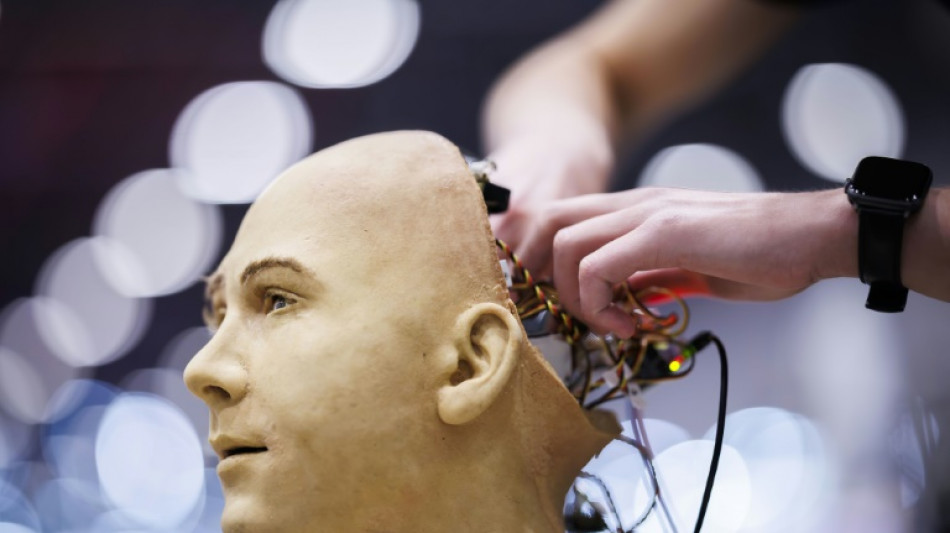
Urgent need for 'global approach' on AI regulation: UN tech chief / Photo: Valentin FLAURAUD - AFP/File

 Argentine judge orders suspension of Falklands oil project

 US Fed raises rates to tackle 'too high' inflation, irking Trump

 Turkey releases 106 protesters, jails more LGBTQ activists

 Candidate for UN chief calls for AI regulation akin to nuclear weapons

 'We're losing control,' AI pioneer Yoshua Bengio tells AFP

 IR-MED and Dice Technologies Announce collaboration to Evaluate and Advance Pressure-Injury Prevention Platform in Japan

 Watts, Pitt, Cruz to light up Spain's top film festival

 Toogood Gold's Table Mountain Sits in the Shadow of a Nevada Gold Rush

 MEXC July–August Security Report: 38.66M USDT in Risk Funds Intercepted, Futures Insurance Fund Hits 792M USDT

 Emporio Armani names Dario Vitale new creative director

 EU to ban social media for under 13s, curb access until 15

 Wildfires push endangered Sumatran elephants to brink: Indonesian NGO

 Bank of Japan set to raise rates under pressure from inflation, US

 EU chief to unveil social media, gaming curbs for under-15s

 'Resident Evil' film brings video game's ethos to the big screen

 GA-ASI Mojave First UAS To Complete Battlefield Short Field Ops

 Sanders, Bannon warn of AI dangers in rare US left-right alignment

 Empty benches as schools reopen in Venezuela's quake-hit Guaira

 Tiny English village holds 'independence' vote over asylum seeker housing

 US Treasury chief says to meet Chinese counterpart at weekend

 BingX Evolves into a Multi-Asset Trading Platform, Connecting Users to Global Opportunities

 International Trading Institute Expands Professional Trader Development Beyond the Master’s in Trading

 Lake Energy Secures $80 Million for U.S. Renewable Energy Expansion

 Stocks drop, oil climbs and Treasury yields hit 19-year high

 SkySail Strategies Outperforms Wall Street's 30-Year Risk Standard With Proprietary AI Inference Model

The world urgently needs to find a global approach on regulating artificial intelligence, the United Nations' top tech chief said this week, warning that fragmentation could deepen risks and inequalities.
Doreen Bogdan-Martin, head of the UN's International Telecommunications Union (ITU) agency, told AFP she hoped that AI "can actually benefit humanity".
But as concerns mount over the risks posed by the fast-moving technology -- including fears of mass job losses, the spread of deepfakes and disinformation, and society's fabric fraying -- she insisted that regulation was key.
"There's an urgency to try to get... the right framework in place," she said, stressing the need for "a global approach".
Her comments came after US President Donald Trump this week unveiled an aggressive, low-regulation strategy aimed at ensuring the United States stays ahead of China on AI.
Among more than 90 proposals, Trump's plan calls for sweeping deregulation, with the administration promising to "remove red tape and onerous regulation" that could hinder private sector AI development.
Asked if she had concerns about an approach that urges less, not more, regulation of AI technologies, Bogdan-Martin refrained from commenting, saying she was "still trying to digest" the US plan.
- 'Critical' -
"I think there are different approaches," she said.
"We have the EU approach. We have the Chinese approach. Now we're seeing the US approach. I think what's needed is for those approaches to dialogue," she said.
At the same time, she highlighted that "85 percent of countries don't yet have AI policies or strategies".
A consistent theme among those strategies that do exist is the focus on innovation, capacity building and infrastructure investments, Bogdan-Martin said.
"But where I think the debate still needs to happen at a global level is trying to figure out how much regulation, how little regulation, is needed," she said.
Bogdan-Martin, who grew up in New Jersey and has spent most of her more than three-decade career at the ITU, insisted the Geneva-based telecoms agency that sets standards for new technologies was well-placed to help facilitate much-needed dialogue on the issue.
"The need for a global approach I think is critical," she said, cautioning that "fragmented approaches will not help serve and reach all".
As countries and companies sprint to cement their dominance in the booming sector, there are concerns that precautions could be thrown to the wind -- and that those who lose the race or do not have the capacity to participate will be left behind.
- 'Huge gap' -
The ITU chief hailed "mind-blowing" advances within artificial intelligence, with the potential to improve everything from education to agriculture to health care -- but insisted the benefits must be shared.
Without a concerted effort, there is a risk that AI will end up standing for "advancing inequalities", she warned, cautioning against deepening an already dire digital divide worldwide.
"We have 2.6 billion people that have no access to the internet, which means they have no access to artificial intelligence", Bogdan-Martin pointed out.
"We have to tackle those divides if we're actually going to have something that is beneficial to all of humanity."
Bogdan-Martin, the first woman to serve as ITU secretary-general in the organisation's nearly 160-year history, also stressed the need to get more women into the digital space.
"We have a huge gap," she said.
"We definitely don't have enough women... in artificial intelligence."
The 59-year-old mother of four said it was "a big honour" to be the first woman in her position, to be "breaking the glass ceiling (and) paving the path for future generations".
But she acknowledged there was a lot of pressure, "not just to achieve, but to almost overachieve".
Bogdan-Martin, who is being backed by the Trump administration to stand for re-election when her four-year mandate ends next year, said she was eager to stay on for a second term.
"There is a lot to do."
Y.Ponomarenko--CPN