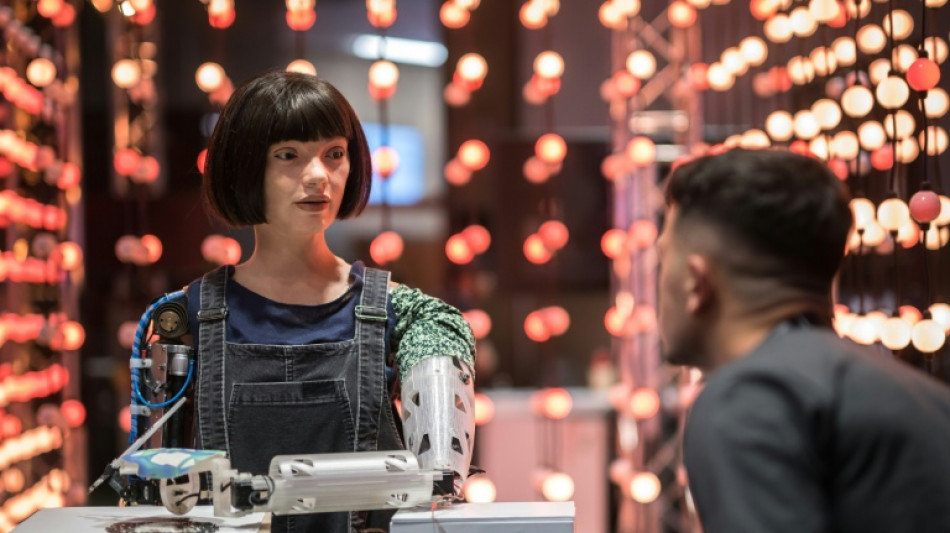
Humanoid robot says not aiming to 'replace human artists' / Photo: Fabrice COFFRINI - AFP/File

 UK-Sudanese author pens book to give children 'African history of Africa'

 US Congress passes sweeping Russia sanctions bill

 US stocks fall, dollar gains after Fed lifts interest rates

 US Fed raises rates to tackle 'too high' inflation in move sure to rile Trump

 US Fed raises rates to battle inflation in move likely to rile Trump

 US House faces test on sweeping Russia sanctions bill

 British PM says to make 'difficult decisions' as inflation rises

 Global fuel price demos: a round-up

 Leverate Launches MCP for Traders to Connect AI Assistants With Trading Platforms

 MEXC Launches $1M "Discover Your Wall Street DNA" Campaign to Help Traders Find Their Market Fit

 Stocks edge higher ahead of US Fed rate call

 BASIS.pro Expands On-Chain Infrastructure with XDC Network Partnership and Zypher DAO as Auto Earn Goes Live

 Pickle-flavoured tart? AI inspires Japan's convenience stores

 EU chief hosts Canada's Carney in push to 'deepen' alliance

 Meta chief pushes back on AI slowdown calls

 US Fed to deliver rate decision with markets betting on hike

 i-payout Expands U.S. Money Transmitter Licensing Footprint and Advances European EMI Strategy

 US Senate crypto bill collapses amid partisan deadlock

 OpenAI, Anthropic and Google are working to create an AI standards body

 Protesting shepherds, farmers clash with Romanian police

 Foundation Lets Ledger Users Switch to Open Source Without Starting Over

 EU to propose curbing social media, online games for under 15s

 FX Junction Reaches 40,600 Members and 26 Million Trades

 'We unleashed the beast': the world's fears and hopes about AI

 Hospitality leaders ask Burnham to halve VAT amid rising costs

When successful artist Ai-Da unveiled a new portrait of King Charles this week, the humanoid robot described what inspired the layered and complex piece, and insisted it had no plans to "replace" humans.
The ultra-realistic robot, one of the most advanced in the world, is designed to resemble a human woman with an expressive, life-like face, large hazel eyes and brown hair cut in a bob.
The arms though are unmistakably robotic, with exposed metal, and can be swapped out depending on the art form it is practicing.
Late last year, Ai-Da's portrait of English mathematician Alan Turing became the first artwork by a humanoid robot to be sold at auction, fetching over $1 million.
But as Ai-Da unveiled its latest creation -- an oil painting entitled "Algorithm King", conceived using artificial intelligence -- the humanoid insisted the work's importance could not be measured in money.
"The value of my artwork is to serve as a catalyst for discussions that explore ethical dimensions to new technologies," the robot told AFP at Britain's diplomatic mission in Geneva, where the new portrait of King Charles will be housed.
The idea, Ai-Da insisted in a slow, deliberate cadence, was to "foster critical thinking and encourage responsible innovation for more equitable and sustainable futures".
- 'Unique and creative' -
Speaking on the sidelines of the United Nations' AI for Good summit, Ai-Da, who has done sketches, paintings and sculptures, detailed the methods and inspiration behind the work.
"When creating my art, I use a variety of AI algorithms," the robot said.
"I start with a basic idea or concept that I want to explore, and I think about the purpose of the art. What will it say?"
The humanoid pointed out that "King Charles has used his platform to raise awareness on environmental conservation and interfaith dialog. I have aimed this portrait to celebrate" that, it said, adding that "I hope King Charles will be appreciative of my efforts".
Aidan Meller, a specialist in modern and contemporary art, led the team that created Ai-Da in 2019 with artificial intelligence specialists at the universities of Oxford and Birmingham.
He told AFP that he had conceived the humanoid robot -- named after the world's first computer programmer Ada Lovelace -- as an ethical arts project, and not "to replace the painters".
Ai-Da agreed.
There is "no doubt that AI is changing our world, (including) the art world and forms of human creative expression", the robot acknowledged.
But "I do not believe AI or my artwork will replace human artists".
Instead, Ai-Da said, the aim was "to inspire viewers to think about how we use AI positively, while remaining conscious of its risks and limitations".
Asked if a painting made by a machine could really be considered art, the robot insisted that "my artwork is unique and creative".
"Whether humans decide it is art is an important and interesting point of conversation."
J.Bondarev--CPN