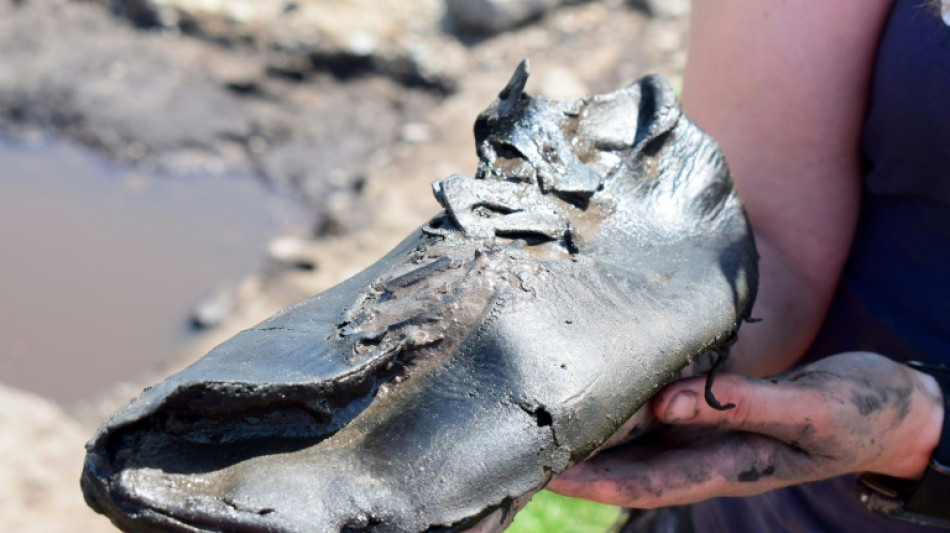
Roman bigfoot? UK archaeologists probe 'unusually large' shoes / Photo: - - The Vindolanda Trust/AFP

 UK-Sudanese author pens book to give children 'African history of Africa'

 US Congress passes sweeping Russia sanctions bill

 US stocks fall, dollar gains after Fed lifts interest rates

 US Fed raises rates to tackle 'too high' inflation in move sure to rile Trump

 US Fed raises rates to battle inflation in move likely to rile Trump

 US House faces test on sweeping Russia sanctions bill

 British PM says to make 'difficult decisions' as inflation rises

 Global fuel price demos: a round-up

 Leverate Launches MCP for Traders to Connect AI Assistants With Trading Platforms

 MEXC Launches $1M "Discover Your Wall Street DNA" Campaign to Help Traders Find Their Market Fit

 Stocks edge higher ahead of US Fed rate call

 BASIS.pro Expands On-Chain Infrastructure with XDC Network Partnership and Zypher DAO as Auto Earn Goes Live

 Pickle-flavoured tart? AI inspires Japan's convenience stores

 EU chief hosts Canada's Carney in push to 'deepen' alliance

 Meta chief pushes back on AI slowdown calls

 US Fed to deliver rate decision with markets betting on hike

 i-payout Expands U.S. Money Transmitter Licensing Footprint and Advances European EMI Strategy

 US Senate crypto bill collapses amid partisan deadlock

 OpenAI, Anthropic and Google are working to create an AI standards body

 Protesting shepherds, farmers clash with Romanian police

 Foundation Lets Ledger Users Switch to Open Source Without Starting Over

 EU to propose curbing social media, online games for under 15s

 FX Junction Reaches 40,600 Members and 26 Million Trades

 'We unleashed the beast': the world's fears and hopes about AI

 Hospitality leaders ask Burnham to halve VAT amid rising costs

A stash of "unusually large" 2,000-year-old shoes dug up at a Roman site in northern England has left archaeologists searching for an explanation, they told AFP on Thursday.
The 30cm+ (11.8in) long shoes -- equivalent to size 49 in Europe and size 15 in the US -- have been found by archaeologists from the Vindolanda Charity Trust in recent months.
The trust was established in 1970 to excavate, conserve, and share Roman remains at Vindolanda and Carvoran, both part of the Hadrian's Wall World Heritage Site in northern England.
The eight large shoes were discovered in a defensive ditch, often used by Romans as a rubbish dump, at the Magna Roman Fort in Northumberland.
Only a tiny fraction of shoes in Vindolanda's vast existing collection are of a similar size, whereas around a quarter of those from the Magna site are in this size range, according to Rachel Frame, a senior archeologist on the project.
She called it "really unusual".
"We're all now off trying to work out who might have been here," Frame told AFP.
She added they were eager to know "which regiments would have been stationed in Magda" and why exactly there are "so many large shoes at this site compared to others".
The team reported finding the first "exceptionally large shoe" on May 21 and has continued to discover more since then, according to Vindolanda's website.
"You need specific soil conditions with very low oxygen for organic objects made of things like wood, leather, textiles, stuff like that, to survive for this length of time," explained Frame.
She noted the team are probing the history of the Roman Empire for answers, stressing people of different cultures and backgrounds would likely have been meeting at the site.
"When people think about the Romans, they think about Italians, they sometimes forget just how broad the Empire was and how far it stretched," Frame said.
Y.Tengku--CPN