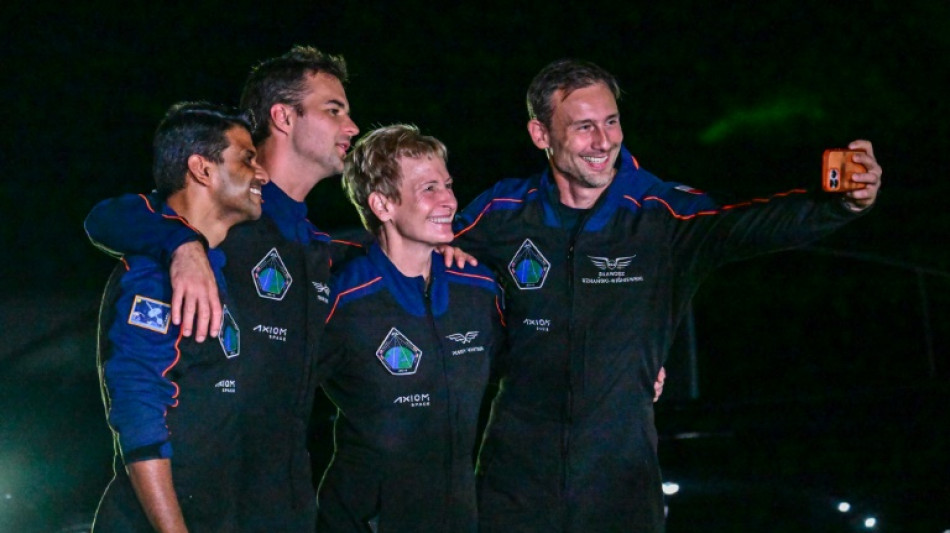
Spaceship carrying astronauts from India, Poland, Hungary, docks with ISS / Photo: Giorgio VIERA - AFP/File

 UK-Sudanese author pens book to give children 'African history of Africa'

 US Congress passes sweeping Russia sanctions bill

 US stocks fall, dollar gains after Fed lifts interest rates

 US Fed raises rates to tackle 'too high' inflation in move sure to rile Trump

 US Fed raises rates to battle inflation in move likely to rile Trump

 US House faces test on sweeping Russia sanctions bill

 British PM says to make 'difficult decisions' as inflation rises

 Global fuel price demos: a round-up

 Leverate Launches MCP for Traders to Connect AI Assistants With Trading Platforms

 MEXC Launches $1M "Discover Your Wall Street DNA" Campaign to Help Traders Find Their Market Fit

 Stocks edge higher ahead of US Fed rate call

 BASIS.pro Expands On-Chain Infrastructure with XDC Network Partnership and Zypher DAO as Auto Earn Goes Live

 Pickle-flavoured tart? AI inspires Japan's convenience stores

 EU chief hosts Canada's Carney in push to 'deepen' alliance

 Meta chief pushes back on AI slowdown calls

 US Fed to deliver rate decision with markets betting on hike

 i-payout Expands U.S. Money Transmitter Licensing Footprint and Advances European EMI Strategy

 US Senate crypto bill collapses amid partisan deadlock

 OpenAI, Anthropic and Google are working to create an AI standards body

 Protesting shepherds, farmers clash with Romanian police

 Foundation Lets Ledger Users Switch to Open Source Without Starting Over

 EU to propose curbing social media, online games for under 15s

 FX Junction Reaches 40,600 Members and 26 Million Trades

 'We unleashed the beast': the world's fears and hopes about AI

 Hospitality leaders ask Burnham to halve VAT amid rising costs

A US commercial mission carrying astronauts from India, Poland and Hungary docked with the International Space Station on Thursday, marking the first time in decades that these nations have sent crew to space.
Axiom Mission 4, or Ax-4, lifted off early Wednesday from NASA's Kennedy Space Center in Florida aboard a brand-new SpaceX Crew Dragon capsule riding a Falcon 9 rocket.
Onboard are pilot Shubhanshu Shukla of India; mission specialists Slawosz Uznanski-Wisniewski of Poland and Tibor Kapu of Hungary; and Commander Peggy Whitson of the United States, a former NASA astronaut now with Axiom Space, which organizes private spaceflights.
The capsule, the fifth and final Dragon in the SpaceX fleet, was christened "Grace" after reaching orbit.
It made "soft capture" with the orbital lab Thursday at 6:31 am Eastern Time (1031 GMT).
"We are honored to be here, thank you," Whitson said over a live stream of the docking.
The crew will complete docking procedures and spend about 14 days aboard the station, conducting some 60 experiments -- including studies on microalgae, sprouting salad seeds, and the hardiness of microscopic tardigrades in space.
The last time India, Poland or Hungary sent people to space, their current crop of astronauts had not yet been born -- and back then they were called cosmonauts, as they all flew on Soviet missions before the fall of the Iron Curtain.
Shukla is the first Indian to reach space since Rakesh Sharma, who flew to the Salyut 7 station in 1984 as part of an Indo-Soviet mission.
India's space agency, ISRO, sees this flight as a key step toward its first independent crewed mission, slated for 2027 under the Gaganyaan ("sky craft") program.
"What a fantastic ride," Shukla said in Hindi after liftoff. "This isn't just the start of my journey to the International Space Station -- it's the beginning of India's human space program."
Each country is funding its astronaut's seat.
Poland has spent 65 million euros for its astronaut's flight, according to the Polish Space Agency. Hungary announced a $100 million deal with Axiom in 2022, according to spacenews.com, while India has not officially commented.
The Ax-4 launch comes after technical issues delayed the mission, originally slated for early June.
It also follows an online spat between US President Donald Trump and SpaceX chief Elon Musk, the world's richest person and, until recently, Trump's ally and advisor.
Trump threatened to yank SpaceX's federal contracts -- worth tens of billions of dollars -- prompting Musk to threaten an early retirement of Dragon, the only US spacecraft currently certified to carry astronauts to the ISS.
Musk walked back the threat a few hours later and in the days that followed continued to deescalate, stating on X that he had gone "too far."
Any falling out between SpaceX and the US government would be massively disruptive, given NASA and the Pentagon's reliance on Falcon 9 and Falcon Heavy to send up crew, cargo, satellites and probes.
But for now, analysts believe both sides are too entangled to risk a serious break.
A.Leibowitz--CPN