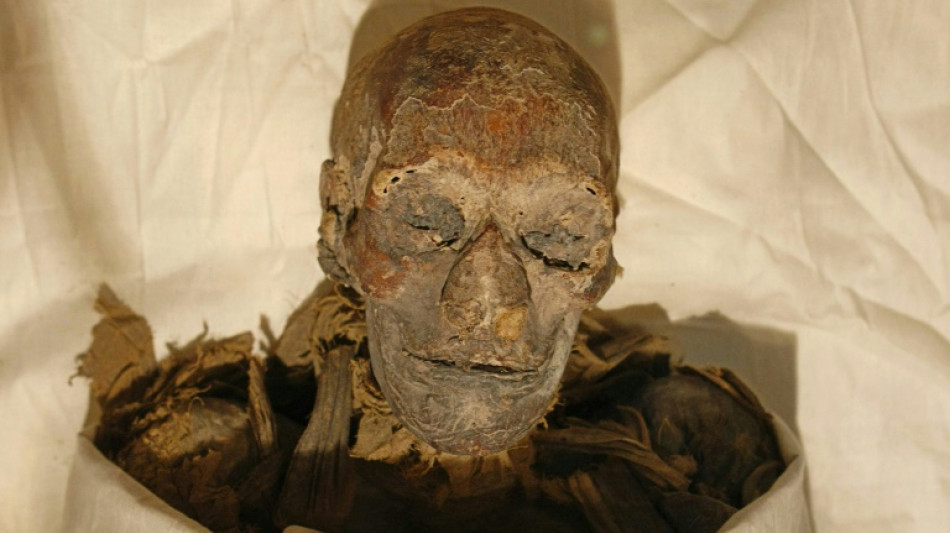
Gender not main factor in attacks on Egyptian woman pharaoh: study / Photo: CRIS BOURONCLE - AFP

 UK-Sudanese author pens book to give children 'African history of Africa'

 US Congress passes sweeping Russia sanctions bill

 US stocks fall, dollar gains after Fed lifts interest rates

 US Fed raises rates to tackle 'too high' inflation in move sure to rile Trump

 US Fed raises rates to battle inflation in move likely to rile Trump

 US House faces test on sweeping Russia sanctions bill

 British PM says to make 'difficult decisions' as inflation rises

 Global fuel price demos: a round-up

 Leverate Launches MCP for Traders to Connect AI Assistants With Trading Platforms

 MEXC Launches $1M "Discover Your Wall Street DNA" Campaign to Help Traders Find Their Market Fit

 Stocks edge higher ahead of US Fed rate call

 BASIS.pro Expands On-Chain Infrastructure with XDC Network Partnership and Zypher DAO as Auto Earn Goes Live

 Pickle-flavoured tart? AI inspires Japan's convenience stores

 EU chief hosts Canada's Carney in push to 'deepen' alliance

 Meta chief pushes back on AI slowdown calls

 US Fed to deliver rate decision with markets betting on hike

 i-payout Expands U.S. Money Transmitter Licensing Footprint and Advances European EMI Strategy

 US Senate crypto bill collapses amid partisan deadlock

 OpenAI, Anthropic and Google are working to create an AI standards body

 Protesting shepherds, farmers clash with Romanian police

 Foundation Lets Ledger Users Switch to Open Source Without Starting Over

 EU to propose curbing social media, online games for under 15s

 FX Junction Reaches 40,600 Members and 26 Million Trades

 'We unleashed the beast': the world's fears and hopes about AI

 Hospitality leaders ask Burnham to halve VAT amid rising costs

She was one of ancient Egypt's most successful rulers, a rare female pharaoh who preceded Cleopatra by 1,500 years, but Queen Hatshepsut's legacy was systematically erased by her stepson successor after her death.
The question of why her impressive reign was so methodically scrubbed has attracted significant debate, but in new research published Monday, University of Toronto scholar Jun Wong argues far too much emphasis has been placed on her gender.
"It's quite a romantic question: why was this pharaoh attacked after her death?" Wong told AFP, explaining his interest in a monarch who steered ancient Egypt through a period of extraordinary prosperity.
Earlier scholars believed Queen Hatshepsut's stepson Thutmose III unleashed a posthumous campaign of defilement against her out of revenge and hatred, including because he wanted to purge any notion that a woman could successfully rule.
"The way in which (Hatshepsut's) reign has been understood has always been colored by her gender," Wong said, referencing beliefs that Thutmose III may have viewed her as "a kind of an evil stepmother."
His research, which builds on other recent scholarship and is being published in the journal Antiquity, argues Thutmose III's motivations were far more nuanced, casting further doubt on the theory of backlash against a woman in charge.
Hatshepsut ruled Egypt roughly 3,500 years ago, taking over following the death of her husband Thutmose II.
She first served as regent to her stepson, the king-in-waiting, but successfully consolidated power in her own right, establishing herself as a female pharaoh.
Experts say she expanded trade routes and commissioned extraordinary structures, including an unparallelled mortuary in the Valley of the Kings on the Nile's west bank.
Wong reassessed a range of material from damaged statues uncovered during excavations from 1922 to 1928.
He said there is no doubt Thutmose III worked to eliminate evidence of Hatshepsut's achievements, but his efforts were "perhaps driven by ritual necessity rather than outright antipathy," Wong said.
Thutmose III may have been trying to neutralize the power of his predecessor in a practical and common way, not out of malice.
He also found that some of the statues depicting Hatshepsut were likely damaged because later generations wanted to reuse them as building materials.
"For a long time, it has been assumed that Hatshepsut's statuary sustained a vindictive attack," Wong said, arguing that a fresh look at the archives suggests "this is not the case."
S.F.Lacroix--CPN