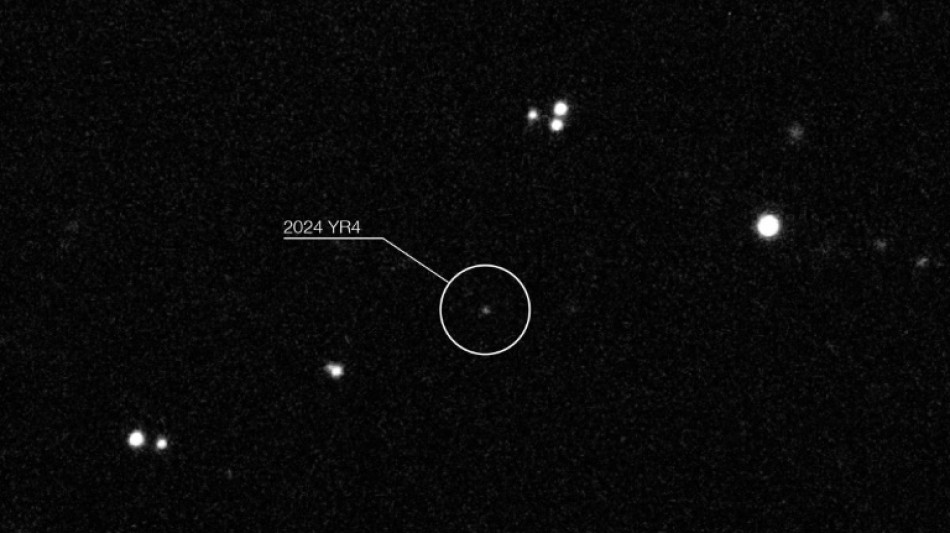
Earth's satellites at risk if asteroid smashes into Moon: study / Photo: Handout - European Southern Observatory/AFP/File

 UK-Sudanese author pens book to give children 'African history of Africa'

 US Congress passes sweeping Russia sanctions bill

 US stocks fall, dollar gains after Fed lifts interest rates

 US Fed raises rates to tackle 'too high' inflation in move sure to rile Trump

 US Fed raises rates to battle inflation in move likely to rile Trump

 US House faces test on sweeping Russia sanctions bill

 British PM says to make 'difficult decisions' as inflation rises

 Global fuel price demos: a round-up

 Leverate Launches MCP for Traders to Connect AI Assistants With Trading Platforms

 MEXC Launches $1M "Discover Your Wall Street DNA" Campaign to Help Traders Find Their Market Fit

 Stocks edge higher ahead of US Fed rate call

 BASIS.pro Expands On-Chain Infrastructure with XDC Network Partnership and Zypher DAO as Auto Earn Goes Live

 Pickle-flavoured tart? AI inspires Japan's convenience stores

 EU chief hosts Canada's Carney in push to 'deepen' alliance

 Meta chief pushes back on AI slowdown calls

 US Fed to deliver rate decision with markets betting on hike

 i-payout Expands U.S. Money Transmitter Licensing Footprint and Advances European EMI Strategy

 US Senate crypto bill collapses amid partisan deadlock

 OpenAI, Anthropic and Google are working to create an AI standards body

 Protesting shepherds, farmers clash with Romanian police

 Foundation Lets Ledger Users Switch to Open Source Without Starting Over

 EU to propose curbing social media, online games for under 15s

 FX Junction Reaches 40,600 Members and 26 Million Trades

 'We unleashed the beast': the world's fears and hopes about AI

 Hospitality leaders ask Burnham to halve VAT amid rising costs

If a huge asteroid smashes into the Moon in 2032, the gigantic explosion would send debris streaming towards Earth that would threaten satellites and create a spectacular meteor shower, according to researchers.
Earlier this year there were briefly fears that the 60-metre-wide (200-foot-wide) asteroid called 2024 YR4, which is big enough to level a city, would strike Earth on December 22, 2032.
It was given the highest chance -- 3.1 percent -- of hitting our home planet that scientists have ever measured for such a giant space rock.
Subsequent observations from telescopes definitively ruled out a direct hit on Earth.
However, the odds that it will crash into the Moon have risen to 4.3 percent, according to data from the James Webb space telescope in May.
A new preprint study, which has not been peer-reviewed, is the first to estimate how such a collision could affect Earth.
It would be the largest asteroid to hit the Moon in around 5,000 years, lead study author Paul Wiegert of Canada's University of Western Ontario told AFP.
The impact would be "comparable to a large nuclear explosion in terms of the amount of energy released", he added.
Up to 100 million kilograms (220 million pounds) of material would shoot out from the Moon's surface, according to a series of simulations run by the researchers.
If the asteroid hit the side of the Moon facing Earth -- which is roughly a 50-percent chance -- up to 10 percent of this debris could be pulled in by Earth's gravity over the following days, they said.
- 'Like a bullet' -
Earth's atmosphere would protect the surface from the millimetre- to centimetre-sized lunar rocks, Weigert said. 0.04-2.54
But these meteors could be capable of destroying some satellites -- and there are expected to be a lot more of those orbiting the planet by 2032.
"A centimetre-sized rock travelling at tens of thousands of metres per second is a lot like a bullet," Wiegert said.
In the days after the impact, there could be more than 1,000 times the normal number of meteors threatening Earth's satellites, he added.
Meanwhile, those of us on the ground would be treated to a "spectacular" meteor shower lighting up the night sky, the study said.
But the current odds of a direct hit on the near side of the Moon remain at just two percent, Wiegert emphasised.
The asteroid is not expected to be visible again until 2028, so the world will have to wait to find out more.
If a direct hit is eventually found to be likely, humanity probably has enough time to plan a mission to spare the Moon.
"I'm sure it will be considered," Wiegert said.
The asteroid is half as wide and has 10 percent of the mass of Dimorphos, which NASA's DART mission smashed into in 2022, successfully changing its trajectory.
If 2024 YR4 is on a collision course with the Moon, it would be "a good target" for another test of our planetary defences, Wiegert said.
But if not, trying to deflect something zooming so close to Earth could be a little "dangerous", he added.
The preprint study, which published on the arXiv database last week, has been submitted to the Astrophysical Journal Letters.
Y.Uduike--CPN