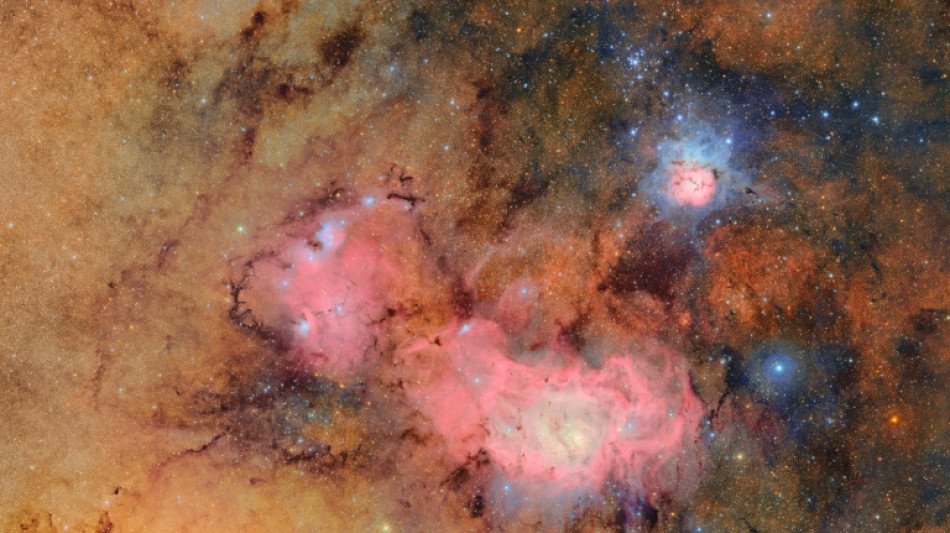
Groundbreaking Vera Rubin Observatory reveals first images / Photo: HANDOUT - NSF-DOE Vera C. Rubin Observatory/AFP

 UK-Sudanese author pens book to give children 'African history of Africa'

 US Congress passes sweeping Russia sanctions bill

 US stocks fall, dollar gains after Fed lifts interest rates

 US Fed raises rates to tackle 'too high' inflation in move sure to rile Trump

 US Fed raises rates to battle inflation in move likely to rile Trump

 US House faces test on sweeping Russia sanctions bill

 British PM says to make 'difficult decisions' as inflation rises

 Global fuel price demos: a round-up

 Leverate Launches MCP for Traders to Connect AI Assistants With Trading Platforms

 MEXC Launches $1M "Discover Your Wall Street DNA" Campaign to Help Traders Find Their Market Fit

 Stocks edge higher ahead of US Fed rate call

 BASIS.pro Expands On-Chain Infrastructure with XDC Network Partnership and Zypher DAO as Auto Earn Goes Live

 Pickle-flavoured tart? AI inspires Japan's convenience stores

 EU chief hosts Canada's Carney in push to 'deepen' alliance

 Meta chief pushes back on AI slowdown calls

 US Fed to deliver rate decision with markets betting on hike

 i-payout Expands U.S. Money Transmitter Licensing Footprint and Advances European EMI Strategy

 US Senate crypto bill collapses amid partisan deadlock

 OpenAI, Anthropic and Google are working to create an AI standards body

 Protesting shepherds, farmers clash with Romanian police

 Foundation Lets Ledger Users Switch to Open Source Without Starting Over

 EU to propose curbing social media, online games for under 15s

 FX Junction Reaches 40,600 Members and 26 Million Trades

 'We unleashed the beast': the world's fears and hopes about AI

 Hospitality leaders ask Burnham to halve VAT amid rising costs

The team behind the long-awaited Vera Rubin Observatory in Chile published their first images on Monday, revealing breathtaking views of star-forming regions as well as distant galaxies.
More than two decades in the making, the giant US-funded telescope sits perched at the summit of Cerro Pachon in central Chile, where dark skies and dry air provide ideal conditions for observing the cosmos.
One of the debut images is a composite of 678 exposures taken over just seven hours, capturing the Trifid Nebula and the Lagoon Nebula -- both several thousand light-years from Earth -- glowing in vivid pinks against orange-red backdrops.
The image reveals these stellar nurseries within our Milky Way in unprecedented detail, with previously faint or invisible features now clearly visible.
Another image offers a sweeping view of the Virgo Cluster of galaxies.
The team also released a video dubbed the "cosmic treasure chest," which begins with a close-up of two galaxies before zooming out to reveal approximately 10 million more.
"The Rubin Observatory is an investment in our future, which will lay down a cornerstone of knowledge today on which our children will proudly build tomorrow," said Michael Kratsios, director of the White House Office of Science and Technology Policy.
Equipped with an advanced 8.4-meter telescope and the largest digital camera ever built, the Rubin Observatory is supported by a powerful data-processing system.
Later this year, it will begin its flagship project, the Legacy Survey of Space and Time (LSST). Over the next decade, it will scan the night sky nightly, capturing even the subtlest visible changes with unmatched precision.
The observatory is named after pioneering American astronomer Vera C. Rubin, whose research provided the first conclusive evidence for the existence of dark matter -- a mysterious substance that does not emit light but exerts gravitational influence on galaxies.
Dark energy refers to the equally mysterious and immensely powerful force believed to be driving the accelerating expansion of the universe. Together, dark matter and dark energy are thought to make up 95 percent of the cosmos, yet their true nature remains unknown.
The observatory, a joint initiative of the US National Science Foundation and Department of Energy, has also been hailed as one of the most powerful tools ever built for tracking asteroids.
In just 10 hours of observations, the Rubin Observatory discovered 2,104 previously undetected asteroids in our solar system, including seven near-Earth objects -- all of which pose no threat.
For comparison, all other ground- and space-based observatories combined discover about 20,000 new asteroids per year.
Rubin is also set to be the most effective observatory at spotting interstellar objects passing through the solar system.
More images from the observatory are expected to be released later Monday morning.
H.Meyer--CPN