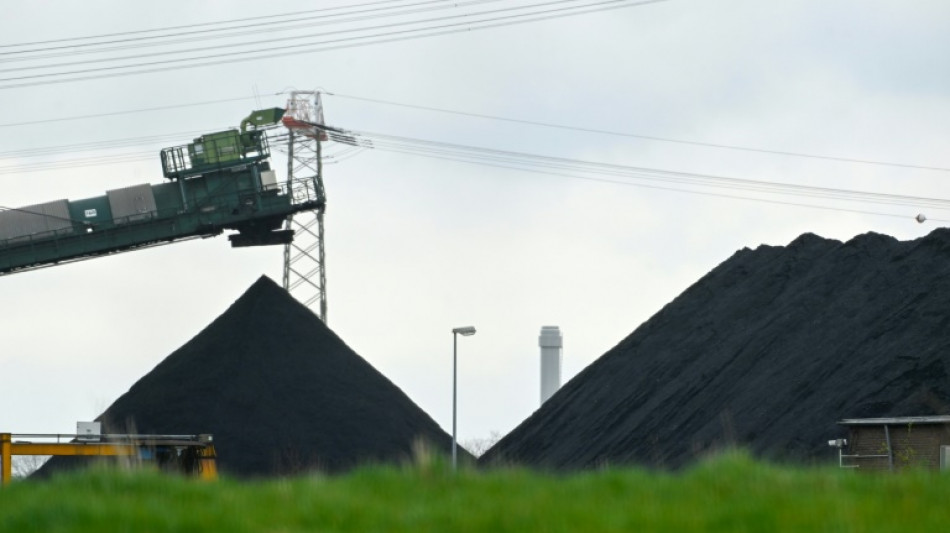
As Russia cuts gas, coal makes a comeback in Europe / Photo: Ina FASSBENDER - AFP/File

 Emporio Armani names Dario Vitale new creative director

 EU to ban social media for under 13s, curb access until 15

 Wildfires push endangered Sumatran elephants to brink: Indonesian NGO

 Bank of Japan set to raise rates under pressure from inflation, US

 EU chief to unveil social media, gaming curbs for under-15s

 'Resident Evil' film brings video game's ethos to the big screen

 i-payout Expands U.S. Money Transmitter Licensing Footprint and Advances European EMI Strategy

 US Senate crypto bill collapses amid partisan deadlock

 OpenAI, Anthropic and Google are working to create an AI standards body

 Protesting shepherds, farmers clash with Romanian police

 Foundation Lets Ledger Users Switch to Open Source Without Starting Over

 EU to propose curbing social media, online games for under 15s

 FX Junction Reaches 40,600 Members and 26 Million Trades

 'We unleashed the beast': the world's fears and hopes about AI

 Hospitality leaders ask Burnham to halve VAT amid rising costs

 Worcestershire invited to nominate groups for 2027 King’s volunteer award

 Berlin's run-down public spaces at heart of election campaign
 'Widow's Bay' and 'The Pitt' win big at Emmy Awards

 Most markets drop as oil extends gains ahead of expected US rate hike

 Sri Lanka's famed beach shack battles demolition

 Vserv targets ₹1,000 crore revenue by 2030 through AI expansion

 India prohibits bank fees on UPI payments up to ₹2,000

 Brazil's Amazon defender Raoni has cancer
 Trump rejects AI slowdown concerns as UN urges coordinated controls

 Higher wages draw migrant workers to Kashmir despite attacks

Russia's gas cuts to Europe have prompted a clutch of countries to revert to burning coal, raising concerns as the EU seeks to become climate neutral by 2050.
Here is a look at the situation:
- Coal still here, but declining -
Globally, coal is the main source of energy for electricity production, but it is also the top producer of greenhouse gases.
Its use is declining in the European Union, where 202 coal-fired plants with production capacity of 111 gigawatts were in operation earlier this year, according to the Global Energy Monitor, a US-based non-governmental organisation.
Germany is home to the most plants with 63, followed by 44 in neighbouring Poland and 24 in the Czech Republic.
But their use is falling in the 27-nation EU, with coal behind 13 percent of electricity production in 2020, compared to 25 percent in 2013, thanks in part to the rising cost of CO2 emission permits.
"Since 2015, all European countries have gradually pledged to abandon coal, including Poland which was very opposed to that," noted Nicolas Berghmans at the Paris-based Institute for Sustainable Development and International Relations.
There are no new coal projects underway in Europe, unlike other regions such as Asia.
Some countries, like Portugal, have completely eliminated the use of the fossil fuel.
- A temporary reprieve -
Russia's halt in natural gas deliveries threatens to rapidly create shortages, so several countries have announced temporary measures in favour of coal.
One such country is Germany, where coal-fired electricity plants will operate longer than planned. Berlin has insisted this does not change its plans to exit coal in 2030.
Austria, Italy and the Netherlands have made similar announcements.
Germany has already stepped up coal use: in the first five months of the year, electricity produced by coal jumped 20 percent, according to Rystad Energy, a research and business intelligence firm.
The EU has decided to ban Russian coal from the month of August, so it will need to import hard coal supplies from elsewhere. Europe is nearly sufficient in brown coal, which is the most polluting.
The German association of hard coal importers estimated in March that Russian imports could be quickly replaced by supplies from countries such as the United States, Colombia, South Africa, Australia, Mozambique and Indonesia.
- A bit of elbow room -
EU officials have called for using the crisis to push forward in the transition to clean energy rather than reverting to dirty fuels.
Berghmans noted that using coal plants would cause a temporary rise in carbon emissions.
"Nevertheless, the advantage of calling upon these plants that were due to close is that there is no investment in new capacity," he said.
Europe is thus in a completely different situation than Asia, where projects for new coal-fired electricity plants are still being undertaken. These facilities will likely be in operation for decades.
The International Energy Agency (IEA) has flagged a worrying increase in investment in coal projects, a 10 percent rise in 2021 centred in Asia. A similar gain is expected in 2022.
EU members are currently discussing a plan called RepowerEU that would accelerate the push towards renewable energy sources and reduce overall demand.
Berghmans expressed confidence that renewables and demand reduction would allow Europe to "turn the corner" and achieve its climate objectives.
The IEA, which has presented a plan to help Europe reduce its dependence upon Russian gas, believes there is a bit of room for the continent to revert to coal use without increasing carbon emissions.
According to its calculations, Europe can replace about 14 percent of imported Russian gas with coal-fired electricity without producing more pollution.
H.Cho--CPN