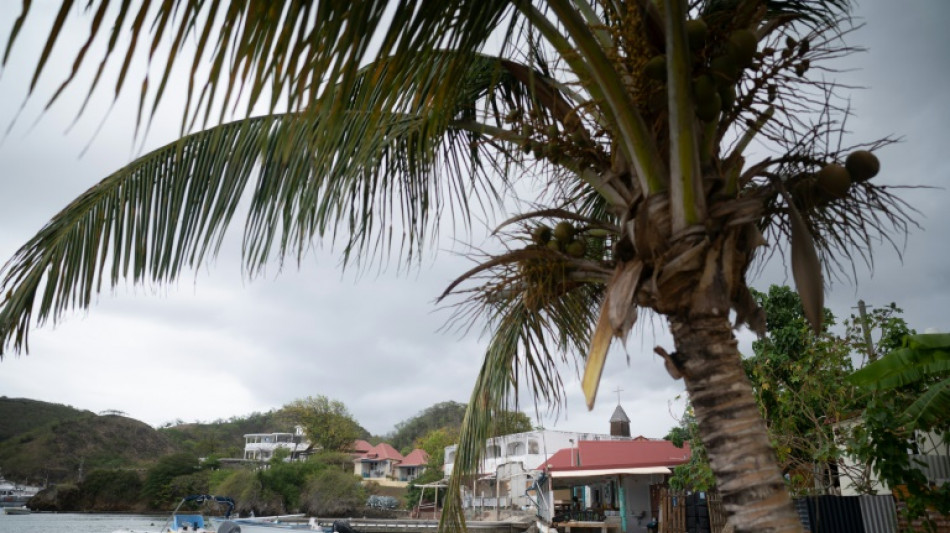
French scientists find new blood type in Guadeloupe woman / Photo: LOIC VENANCE - AFP

 UK-Sudanese author pens book to give children 'African history of Africa'

 US Congress passes sweeping Russia sanctions bill

 US stocks fall, dollar gains after Fed lifts interest rates

 US Fed raises rates to tackle 'too high' inflation in move sure to rile Trump

 US Fed raises rates to battle inflation in move likely to rile Trump

 US House faces test on sweeping Russia sanctions bill

 British PM says to make 'difficult decisions' as inflation rises

 Global fuel price demos: a round-up

 Leverate Launches MCP for Traders to Connect AI Assistants With Trading Platforms

 MEXC Launches $1M "Discover Your Wall Street DNA" Campaign to Help Traders Find Their Market Fit

 Stocks edge higher ahead of US Fed rate call

 BASIS.pro Expands On-Chain Infrastructure with XDC Network Partnership and Zypher DAO as Auto Earn Goes Live

 Pickle-flavoured tart? AI inspires Japan's convenience stores

 EU chief hosts Canada's Carney in push to 'deepen' alliance

 Meta chief pushes back on AI slowdown calls

 US Fed to deliver rate decision with markets betting on hike

 i-payout Expands U.S. Money Transmitter Licensing Footprint and Advances European EMI Strategy

 US Senate crypto bill collapses amid partisan deadlock

 OpenAI, Anthropic and Google are working to create an AI standards body

 Protesting shepherds, farmers clash with Romanian police

 Foundation Lets Ledger Users Switch to Open Source Without Starting Over

 EU to propose curbing social media, online games for under 15s

 FX Junction Reaches 40,600 Members and 26 Million Trades

 'We unleashed the beast': the world's fears and hopes about AI

 Hospitality leaders ask Burnham to halve VAT amid rising costs

A French woman from the Caribbean island of Guadeloupe has been identified as the only known carrier of a new blood type, dubbed "Gwada negative," France's blood supply agency has announced.
The announcement was made 15 years after researchers received a blood sample from a patient who was undergoing routine tests ahead of surgery, the French Blood Establishment (EFS) said on Friday.
"The EFS has just discovered the 48th blood group system in the world!" the agency said in a statement on social network LinkedIn.
"This discovery was officially recognised in early June in Milan by the International Society of Blood Transfusion (ISBT)."
The scientific association had until now recognised 47 blood group systems.
Thierry Peyrard, a medical biologist at the EFS involved in the discovery, told AFP that a "very unusual" antibody was first found in the patient in 2011.
However, resources at the time did not allow for further research, he added.
Scientists were finally able to unravel the mystery in 2019 thanks to "high-throughput DNA sequencing", which highlighted a genetic mutation, Peyrard said.
The patient, who was 54 at the time and lived in Paris, was undergoing routine tests before surgery when the unknown antibody was detected, Peyrard said.
This woman "is undoubtedly the only known case in the world," said the expert.
"She is the only person in the world who is compatible with herself," he said.
Peyrard said the woman inherited the blood type from her father and mother, who each had the mutated gene.
The name "Gwada negative", which refers to the patient's origins and "sounds good in all languages", has been popular with the experts, said Peyrard.
The ABO blood group system was first discovered in the early 1900s. Thanks to DNA sequencing the discovery of new blood groups has accelerated in recent years.
Peyrard and colleagues are now hoping to find other people with the same blood group.
"Discovering new blood groups means offering patients with rare blood types a better level of care," the EFS said.
T.Morelli--CPN