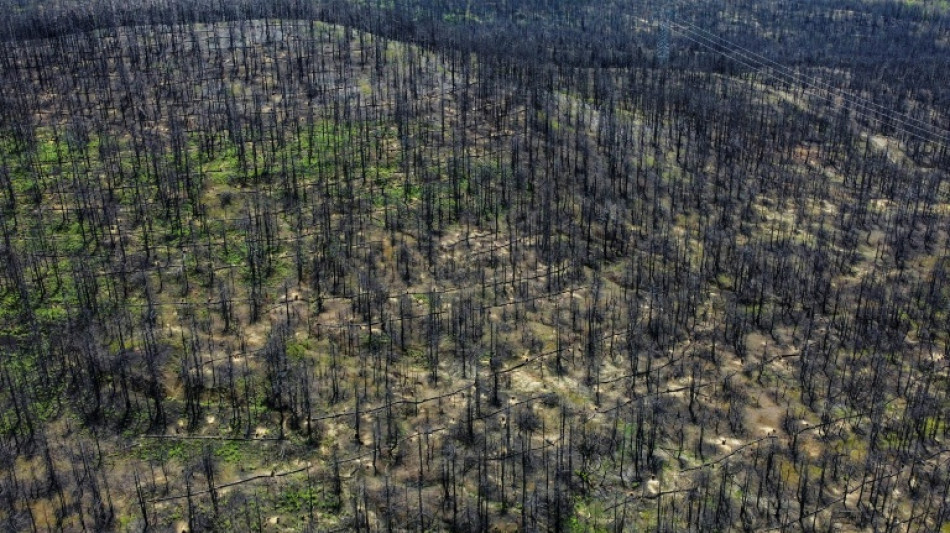
Greece's fire-ravaged Evia will take decades to heal / Photo: Louisa GOULIAMAKI - AFP

 Emporio Armani names Dario Vitale new creative director

 EU to ban social media for under 13s, curb access until 15

 Wildfires push endangered Sumatran elephants to brink: Indonesian NGO

 Bank of Japan set to raise rates under pressure from inflation, US

 EU chief to unveil social media, gaming curbs for under-15s

 'Resident Evil' film brings video game's ethos to the big screen

 i-payout Expands U.S. Money Transmitter Licensing Footprint and Advances European EMI Strategy

 US Senate crypto bill collapses amid partisan deadlock

 OpenAI, Anthropic and Google are working to create an AI standards body

 Protesting shepherds, farmers clash with Romanian police

 Foundation Lets Ledger Users Switch to Open Source Without Starting Over

 EU to propose curbing social media, online games for under 15s

 FX Junction Reaches 40,600 Members and 26 Million Trades

 'We unleashed the beast': the world's fears and hopes about AI

 Hospitality leaders ask Burnham to halve VAT amid rising costs

 Worcestershire invited to nominate groups for 2027 King’s volunteer award

 Berlin's run-down public spaces at heart of election campaign

 'Widow's Bay' and 'The Pitt' win big at Emmy Awards

 Most markets drop as oil extends gains ahead of expected US rate hike
 Sri Lanka's famed beach shack battles demolition

 Vserv targets ₹1,000 crore revenue by 2030 through AI expansion

 India prohibits bank fees on UPI payments up to ₹2,000

 Brazil's Amazon defender Raoni has cancer

 Trump rejects AI slowdown concerns as UN urges coordinated controls

 Higher wages draw migrant workers to Kashmir despite attacks

Nearly a year after Greece's second-largest island of Evia was devastated by some of the worst wildfires in the country's history, nature is making a slow comeback.
Grass is growing on blackened mountainsides under the carcasses of burnt trees and birds are singing again.
And while the woods and meadows that once produced some of Greece's best honey will likely need two decades to recover, experts say the best method is to let nature do the heavy lifting itself.
"There is rebirth, in some places better than others," Nikos Georgiadis of the World Wildlife Fund Greece told AFP.
In two weeks last August, more than 46,000 hectares went up in smoke on Evia -- 80 kilometres (50 miles) east of Athens -- laying waste to homes, pine forests, olive groves, beehives and livestock after a prolonged heatwave.
- Apocalyptic -
Thousands of locals and tourists fled from the north of the island amid apocalyptic scenes, with authorities forced to stage a mass evacuation to avoid a repeat of the 2018 fire near Athens that claimed over 100 lives.
Three people died in Greek wildfires last year during a brutal summer for a swathe of southern Europe from Spain to France, Italy, Croatia and Cyprus. Blazes also claimed lives in Turkey and Algeria.
Scientists have warned that extreme weather and fierce fires will become increasingly common due to man-made global warming, and Greece's conservative prime minister has linked the blazes to climate change.
In the wake of the destruction on Evia, premier Kyriakos Mitsotakis pledged hundreds of millions of euros for reconstruction, reforestation and flood prevention works, and a 1.7-billion-euro ($1.78 billion) overhaul of the civil protection agency.
- Letting nature grow -
Forester Elias Apostolidis, whose company is involved in the state's reconstruction plan, said inspections so far have shown that only a little human intervention is needed for regrowth.
The worst-hit zones -- around five percent of the burned area -- will be replanted with seeds gathered elsewhere on the island, he told AFP.
The fact that the destruction was so total in some areas also enables foresters to replant with more fire-resistant trees.
"We have recorded per species the percentage of plants that survived," Apostolidis said.
For example, only six percent of black pine was saved, compared to 42 percent of broadleaf oak, he said.
"This means that some plants are more resistant than others. We now know practically how forests behave in relation to fire and we must take that into account in the future so that we can make them more resistant" to blazes, he said.
But it will take "close to 20 to 25 years" for the forest to be restored, said WWF's Georgiadis, provided that the area is not grazed and not hit by another wildfire.
Premier Mitsotakis vowed to "rebuild northern Evia better and more beautiful than it was", announcing an aid package for the region worth 500 million euros.
The state has already removed unsavable trees in some badly affected areas and begun infrastructural works to assist reforestation and prevent soil erosion and flash floods.
- 'We are done' -
But for many locals, it is already too late.
Giannis Dimou, a 66-year-old shepherd, lost more than 60 animals and his three goat folds in the fire.
He now has just a dozen animals left, not enough to keep him in business.
And because his pens were not fully licensed, he was not eligible for state help.
"There is nothing you can do with so few animals left," he said. "We are done."
The situation is equally dire for beekeepers on an island that was home to around 40 percent of national honey production.
"The beekeepers of the region are facing huge issues and essentially they won't be able to collect honey from the area" for years and will have to move elsewhere, said Stathis Albanis, president of the Istiaia beekeepers cooperative.
M.García--CPN