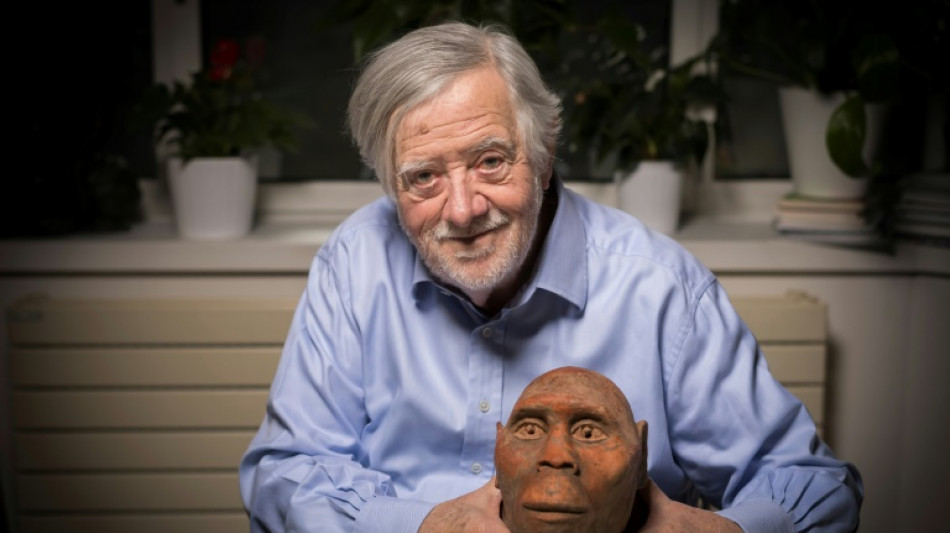
French co-discoverer of 'Lucy' dies at 87 / Photo: LIONEL BONAVENTURE, - - AFP/File

 Emporio Armani names Dario Vitale new creative director

 EU to ban social media for under 13s, curb access until 15

 Wildfires push endangered Sumatran elephants to brink: Indonesian NGO

 Bank of Japan set to raise rates under pressure from inflation, US

 EU chief to unveil social media, gaming curbs for under-15s

 'Resident Evil' film brings video game's ethos to the big screen

 i-payout Expands U.S. Money Transmitter Licensing Footprint and Advances European EMI Strategy

 US Senate crypto bill collapses amid partisan deadlock

 OpenAI, Anthropic and Google are working to create an AI standards body

 Protesting shepherds, farmers clash with Romanian police

 Foundation Lets Ledger Users Switch to Open Source Without Starting Over

 EU to propose curbing social media, online games for under 15s

 FX Junction Reaches 40,600 Members and 26 Million Trades

 'We unleashed the beast': the world's fears and hopes about AI

 Hospitality leaders ask Burnham to halve VAT amid rising costs

 Worcestershire invited to nominate groups for 2027 King’s volunteer award

 Berlin's run-down public spaces at heart of election campaign

 'Widow's Bay' and 'The Pitt' win big at Emmy Awards

 Most markets drop as oil extends gains ahead of expected US rate hike

 Sri Lanka's famed beach shack battles demolition

 Vserv targets ₹1,000 crore revenue by 2030 through AI expansion

 India prohibits bank fees on UPI payments up to ₹2,000

 Brazil's Amazon defender Raoni has cancer

 Trump rejects AI slowdown concerns as UN urges coordinated controls

 Higher wages draw migrant workers to Kashmir despite attacks

French palaeontologist Yves Coppens, credited with the co-discovery of the famous fossil find known as "Lucy", died on Wednesday aged 87 after a long illness, his publisher said.
"France has lost one of its great men," publisher Odile Jacob tweeted, adding that beyond his science skills, Coppens had also been "a talented writer, storyteller and non-fiction author".
He was, with Maurice Taieb and Donald Johanson, part of the team that found the most complete remnants of an Australopithecus afarensis ever discovered, in 1974 in Hadar, Ethiopia.
The team nicknamed the 3.2- million-year-old female hominid "Lucy" after the Beatles song "Lucy in the Sky with Diamonds" which they listened to while labelling the fossils.
Based on the large part of Lucy they found, 40 percent of her skeleton, the scientists were able to determine her height (one metre, 3.5 feet) and show that she was muscular and able to climb trees as well as walk upright.
Coppens, who was born in Britanny and was the son of a nuclear physicist father, co-signed six hominid discoveries over his career.
"At six or seven years old I already wanted to become an archaeologist," Coppens told AFP in 2016. "All my holiday time was spent at digs," he added.
Coppens was admitted to France's prestigious CNRS scientific centre in 1956 when he was still only 22.
He began travelling to Africa from the 1960s, starting with Algeria and Chad.
His first major discovery came in 1967, a 2.6-million-year-old fossil in the Omo valley in Ethiopia.
Then in 1974 came the international expedition in Ethiopia's Afar triangle that was to make Coppens, his friend and fellow Frenchman Taieb and Donald Johanson, an American, world famous for the discovery of Lucy.
Coppens often referred to himself as one of Lucy's "daddies" ("papas" in French).
For a long time after the find, which comprised 52 bone fragments, scientists believed that she was a direct ancestor of humanity.
But this claim is no longer widely believed, and Coppens as well as other palaeontologists came instead to view Lucy as a distant cousin of mankind.
Later Coppens ran digs in Mauritania, the Philippines, Indonesia, Siberia, China and Mongolia.
Back home, he became director of the Musee de l'Homme (Museum of Mankind) in Paris, was given the palaeontology chair in the prestigious College de France, and joined France's Academy of Science.
He also won several prizes, served as an advisor on environmental questions to the French government, and wrote several books and more than a million scientific articles.
Besides the discovery of Lucy, Coppens once told AFP, he was particularly proud to have "made an irrefutable link between the emergence of man and climate change".
As forests gave place to savannas, man stopped climbing trees, began to walk upright and needed to develop brain power to keep carnivores at bay, he said.
burs-jh/har
L.Peeters--CPN