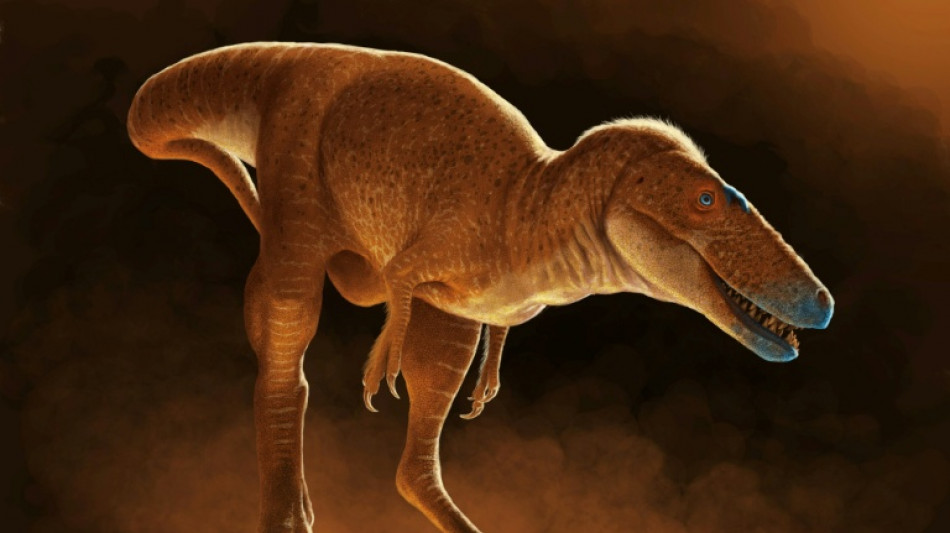
New T-Rex ancestor discovered in drawers of Mongolian institute / Photo: Julius CSOTONYI - University of Calgary/AFP

 UK-Sudanese author pens book to give children 'African history of Africa'

 US Congress passes sweeping Russia sanctions bill

 US stocks fall, dollar gains after Fed lifts interest rates

 US Fed raises rates to tackle 'too high' inflation in move sure to rile Trump

 US Fed raises rates to battle inflation in move likely to rile Trump

 US House faces test on sweeping Russia sanctions bill

 British PM says to make 'difficult decisions' as inflation rises

 Global fuel price demos: a round-up

 Leverate Launches MCP for Traders to Connect AI Assistants With Trading Platforms

 MEXC Launches $1M "Discover Your Wall Street DNA" Campaign to Help Traders Find Their Market Fit

 Stocks edge higher ahead of US Fed rate call

 BASIS.pro Expands On-Chain Infrastructure with XDC Network Partnership and Zypher DAO as Auto Earn Goes Live

 Pickle-flavoured tart? AI inspires Japan's convenience stores

 EU chief hosts Canada's Carney in push to 'deepen' alliance

 Meta chief pushes back on AI slowdown calls

 US Fed to deliver rate decision with markets betting on hike

 i-payout Expands U.S. Money Transmitter Licensing Footprint and Advances European EMI Strategy

 US Senate crypto bill collapses amid partisan deadlock

 OpenAI, Anthropic and Google are working to create an AI standards body

 Protesting shepherds, farmers clash with Romanian police

 Foundation Lets Ledger Users Switch to Open Source Without Starting Over

 EU to propose curbing social media, online games for under 15s

 FX Junction Reaches 40,600 Members and 26 Million Trades

 'We unleashed the beast': the world's fears and hopes about AI

 Hospitality leaders ask Burnham to halve VAT amid rising costs

Misidentified bones that languished in the drawers of a Mongolian institute for 50 years belong to a new species of tyrannosaur that rewrites the family history of the mighty T-Rex, scientists said Wednesday.
This slender ancestor of the massive Tyrannosaurus Rex was around four metres (13 feet) long and weighed three quarters of a tonne, according to a new study in the journal Nature.
"It would have been the size of a very large horse," study co-author Darla Zelenitsky of Canada's University of Calgary told AFP.
The fossils were first dug up in southeastern Mongolia in the early 1970s but at the time were identified as belonging to a different tyrannosaur, Alectrosaurus.
For half a century, the fossils sat in the drawers at the Institute of Paleontology of the Mongolian Academy of Sciences in the capital Ulaanbaatar.
Then PhD student Jared Voris, who was on a trip to Mongolia, started looking through the drawers and noticed something was wrong, Zelenitsky said.
It turned out the fossils were well-preserved, partial skeletons of two different individuals of a completely new species.
"It is quite possible that discoveries like this are sitting in other museums that just have not been recognised," Zelenitsky added.
- 'Messy' family history -
They named the new species Khankhuuluu mongoliensis, which roughly means the dragon prince of Mongolia because it is smaller than the "king" T-Rex.
Zelenitsky said the discovery "helped us clarify a lot about the family history of the tyrannosaur group because it was really messy previously".
The T-Rex represented the end of the family line.
It was the apex predator in North America until 66 million years ago, when an asteroid bigger than Mount Everest slammed into the Gulf of Mexico.
Three quarters of life on Earth was wiped out, including all the dinosaurs that did not evolve into birds.
Around 20 million years earlier, Khankhuuluu -- or another closely related family member -- is now believed to have migrated from Asia to North America using the land bridge that once connected Siberia and Alaska.
This led to tyrannosaurs evolving across North America.
Then one of these species is thought to have crossed back over to Asia, where two tyrannosaur subgroups emerged.
One was much smaller, weighing under a tonne, and was nicknamed Pinocchio rex for its long snout.
The other subgroup was huge and included behemoths like the Tarbosaurus, which was only a little smaller than the T-rex.
One of the gigantic dinosaurs then left Asia again for North America, eventually giving rise to the T-Rex, which dominated for just two million years -- until the asteroid struck.
J.Bondarev--CPN