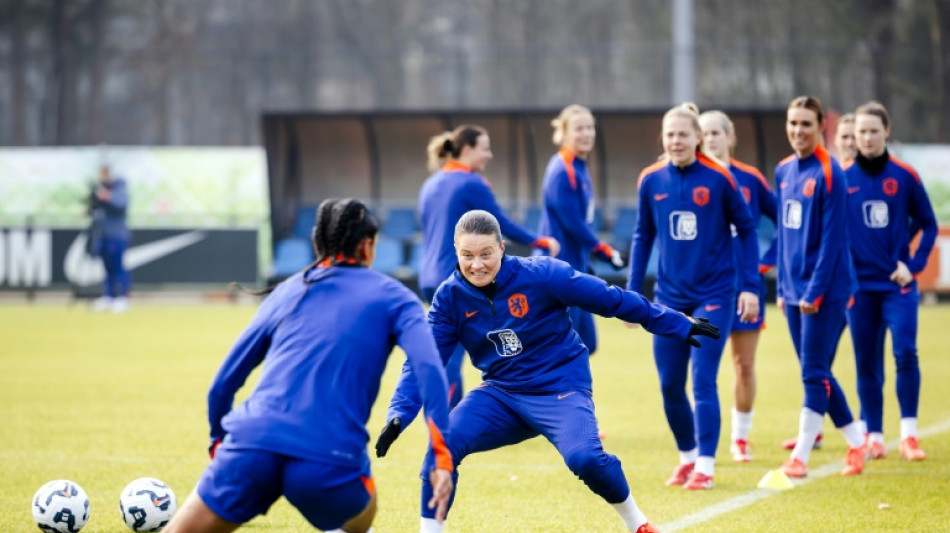
Dutch girl footballers tackle crippling knee injuries / Photo: Sem van der Wal - ANP/AFP

 UK-Sudanese author pens book to give children 'African history of Africa'

 US Congress passes sweeping Russia sanctions bill

 US stocks fall, dollar gains after Fed lifts interest rates

 US Fed raises rates to tackle 'too high' inflation in move sure to rile Trump

 US Fed raises rates to battle inflation in move likely to rile Trump

 US House faces test on sweeping Russia sanctions bill

 British PM says to make 'difficult decisions' as inflation rises

 Global fuel price demos: a round-up

 Leverate Launches MCP for Traders to Connect AI Assistants With Trading Platforms

 MEXC Launches $1M "Discover Your Wall Street DNA" Campaign to Help Traders Find Their Market Fit

 Stocks edge higher ahead of US Fed rate call

 BASIS.pro Expands On-Chain Infrastructure with XDC Network Partnership and Zypher DAO as Auto Earn Goes Live

 Pickle-flavoured tart? AI inspires Japan's convenience stores

 EU chief hosts Canada's Carney in push to 'deepen' alliance

 Meta chief pushes back on AI slowdown calls

 US Fed to deliver rate decision with markets betting on hike

 i-payout Expands U.S. Money Transmitter Licensing Footprint and Advances European EMI Strategy

 US Senate crypto bill collapses amid partisan deadlock

 OpenAI, Anthropic and Google are working to create an AI standards body

 Protesting shepherds, farmers clash with Romanian police

 Foundation Lets Ledger Users Switch to Open Source Without Starting Over

 EU to propose curbing social media, online games for under 15s

 FX Junction Reaches 40,600 Members and 26 Million Trades

 'We unleashed the beast': the world's fears and hopes about AI

 Hospitality leaders ask Burnham to halve VAT amid rising costs

Fifteen-year-old Esmee Stuut sprints between cones on a football pitch in the Netherlands, her every movement captured on camera as part of a study into a crippling knee injury that affects girls more than boys.
Cruciate ligament injuries can rule out a footballer for several months and teenage girls are especially at risk -- for physical and mental reasons.
The study Esmee, a youth striker at FC Groningen in the north of the country, is taking part in aims to improve the movement of female teenage footballers like her.
"A lot of girls of my age have had it. I'm happy to be able to do my bit to help out," the young player told AFP, breathless from the sprinting exercise.
The Netherlands is a hotbed for women's football, with the national team crowned European Champions in 2017 and reaching the World Cup Final in 2019.
The small country has 175,000 women club members, with the figure constantly rising. France, for example, has just over 250,000 for a much bigger population.
"Girls are between four to eight times more likely to get injured than boys at puberty," said Anne Benjaminse, a professor at Groningen University.
"The difference starts at around 12," the sports science specialist told AFP.
- 'Just bad luck' -
And the problem is not just physical -- Benjaminse is also looking into the mental health aspect which she believes plays a major role.
Girls mature at different times to boys, ligaments are more fragile during periods. Add to this stress, mood, and fatigue and you get a potent cocktail that results in injury.
"Divorce, death, moving around, but also a bad grade at school, an argument. These are small things to us but are big problems for them" that can contribute to physical injury, Benjaminse told AFP.
Her study, run in co-ordination with European football's governing body UEFA and the Dutch Football Association, looks at girls and young women aged between 12 and 21.
In addition to examining physical movement, participants fill out a form detailing their moods over the previous week, enabling researchers to make a link to mental health.
The aim is that mental health and movement become a "standard element" in clubs' training methods at the same level as gym work and nutrition, she said.
"This should no longer be called into question. Girls should be able to speak out if they don't feel right and coaches should take it into account," the 44-year-old said.
Back on the pitch, Esmee Stuut performs shuttle runs with rapid changes of direction, with and without the ball, then takes on a defender who appears suddenly.
Henderika Kingma, 28, manager of the FC Groningen women's team and Esmee's coach, says two of her players suffered cruciate ligament injuries right at the end of the season.
"We have to do everything we can to prevent this injury happening to our young players," Kingma told AFP.
"Thanks to this study, I know that my girls have become aware" of the issue, she added.
Despite the study and raising awareness of the problem, sports scientist Benjaminse is also philosophical about the injury.
"Sometimes it's just bad luck."
M.Davis--CPN