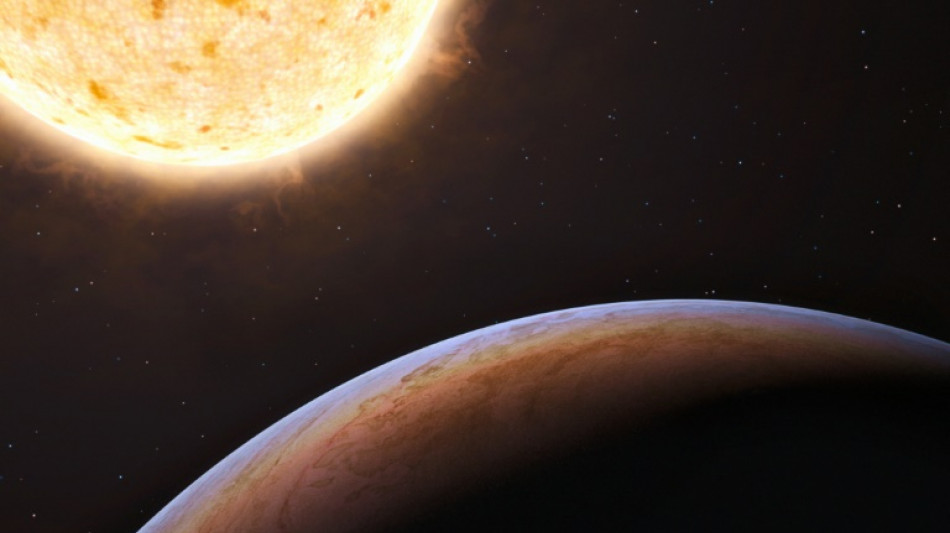
Huge planet discovered orbiting tiny star puzzles scientists / Photo: HO - ESO/AFP/File

 UK-Sudanese author pens book to give children 'African history of Africa'

 US Congress passes sweeping Russia sanctions bill

 US stocks fall, dollar gains after Fed lifts interest rates

 US Fed raises rates to tackle 'too high' inflation in move sure to rile Trump

 US Fed raises rates to battle inflation in move likely to rile Trump

 US House faces test on sweeping Russia sanctions bill

 British PM says to make 'difficult decisions' as inflation rises

 Global fuel price demos: a round-up

 Leverate Launches MCP for Traders to Connect AI Assistants With Trading Platforms

 MEXC Launches $1M "Discover Your Wall Street DNA" Campaign to Help Traders Find Their Market Fit

 Stocks edge higher ahead of US Fed rate call

 BASIS.pro Expands On-Chain Infrastructure with XDC Network Partnership and Zypher DAO as Auto Earn Goes Live

 Pickle-flavoured tart? AI inspires Japan's convenience stores

 EU chief hosts Canada's Carney in push to 'deepen' alliance

 Meta chief pushes back on AI slowdown calls

 US Fed to deliver rate decision with markets betting on hike

 i-payout Expands U.S. Money Transmitter Licensing Footprint and Advances European EMI Strategy

 US Senate crypto bill collapses amid partisan deadlock

 OpenAI, Anthropic and Google are working to create an AI standards body

 Protesting shepherds, farmers clash with Romanian police

 Foundation Lets Ledger Users Switch to Open Source Without Starting Over

 EU to propose curbing social media, online games for under 15s

 FX Junction Reaches 40,600 Members and 26 Million Trades

 'We unleashed the beast': the world's fears and hopes about AI

 Hospitality leaders ask Burnham to halve VAT amid rising costs

Astronomers announced Wednesday they have discovered a massive planet orbiting a tiny star, a bizarre pairing that has stumped scientists.
Most of the stars across the Milky Way are small red dwarfs like TOI-6894, which has only 20 percent the mass of our Sun.
It had not been thought possible that such puny, weak stars could provide the conditions needed to form and host huge planets.
But an international team of astronomers have detected the unmistakable signature of a gas giant planet orbiting the undersized TOI-6894, according to a study in the journal Nature Astronomy.
This makes the star the smallest star yet known to host a gas giant.
The planet has a slightly larger radius than Saturn, but only half its mass. It orbits its star in a little over three days.
The astronomers discovered the planet when searching through more than 91,000 low-mass red dwarfs observed by NASA's TESS space telescope.
Its existence was then confirmed by ground-based telescopes, including Chile's Very Large Telescope.
"The fact that this star hosts a giant planet has big implications for the total number of giant planets we estimate exist in our galaxy," study co-author Daniel Bayliss of the UK's Warwick University said in a statement.
Another co-author, Vincent Van Eylen, of University College London, said it was an "intriguing discovery".
"We don't really understand how a star with so little mass can form such a massive planet!" he said.
"This is one of the goals of the search for more exoplanets. By finding planetary systems different from our solar system, we can test our models and better understand how our own solar system formed."
- How do you make a planet? -
The most prominent theory for how planets form is called core accretion.
The process begins when a ring of gas and dust -- called a protoplanetary disc -- which surrounds a newly formed star builds up into a planetary core. This core attracts more gas that forms an atmosphere, eventually snowballing into a gas giant.
Under this theory, it is difficult for low-mass stars to host giant planets because there is not enough gas and dust to begin building a core in the first place.
A rival theory proposes that these planets instead form when their protoplanetary disc becomes gravitationally unstable and breaks up, with the collapsing gas and dust forming a planet.
However neither theory seems to explain the existence of the newly discovered planet, TOI-6894b, the researchers said.
The planet also interests scientists because it is strangely cold.
Most of the gas giants discovered outside our Solar System so far have been what are known as "hot Jupiters", where temperatures soar well over 1,000 degrees Celsius.
But the newly discovered planet appears to be under 150C, the researchers said.
"Temperatures are low enough that atmospheric observations could even show us ammonia, which would be the first time it is found in an exoplanet atmosphere," said study co-author Amaury Triaud of Birmingham University.
The James Webb space telescope is scheduled to turn its powerful gaze towards the planet in the next year, which could help uncover some more mysteries of this strange planet.
O.Hansen--CPN