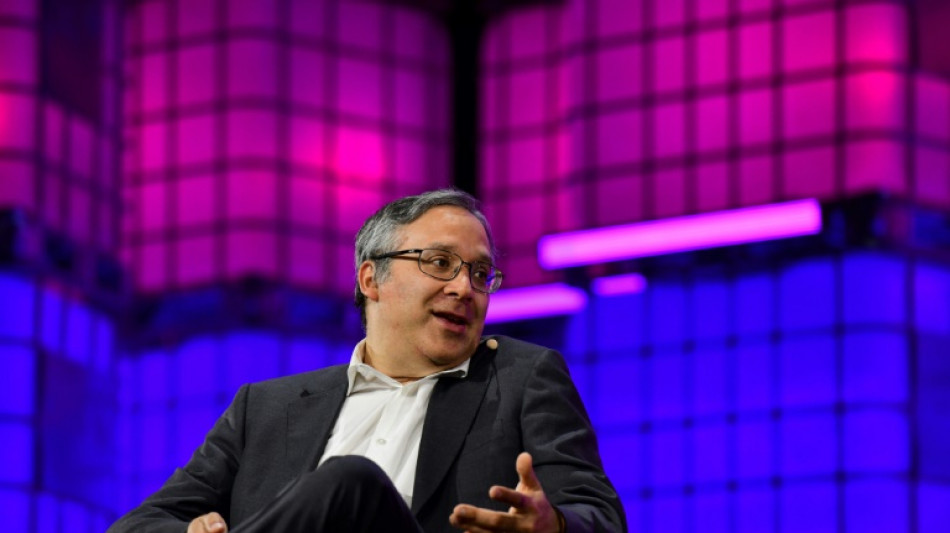
Generative AI's most prominent skeptic doubles down / Photo: Don MacKinnon - AFP

 UK-Sudanese author pens book to give children 'African history of Africa'

 US Congress passes sweeping Russia sanctions bill

 US stocks fall, dollar gains after Fed lifts interest rates

 US Fed raises rates to tackle 'too high' inflation in move sure to rile Trump

 US Fed raises rates to battle inflation in move likely to rile Trump

 US House faces test on sweeping Russia sanctions bill

 British PM says to make 'difficult decisions' as inflation rises

 Global fuel price demos: a round-up

 Leverate Launches MCP for Traders to Connect AI Assistants With Trading Platforms

 MEXC Launches $1M "Discover Your Wall Street DNA" Campaign to Help Traders Find Their Market Fit

 Stocks edge higher ahead of US Fed rate call

 BASIS.pro Expands On-Chain Infrastructure with XDC Network Partnership and Zypher DAO as Auto Earn Goes Live

 Pickle-flavoured tart? AI inspires Japan's convenience stores

 EU chief hosts Canada's Carney in push to 'deepen' alliance

 Meta chief pushes back on AI slowdown calls

 US Fed to deliver rate decision with markets betting on hike

 i-payout Expands U.S. Money Transmitter Licensing Footprint and Advances European EMI Strategy

 US Senate crypto bill collapses amid partisan deadlock

 OpenAI, Anthropic and Google are working to create an AI standards body

 Protesting shepherds, farmers clash with Romanian police

 Foundation Lets Ledger Users Switch to Open Source Without Starting Over

 EU to propose curbing social media, online games for under 15s

 FX Junction Reaches 40,600 Members and 26 Million Trades

 'We unleashed the beast': the world's fears and hopes about AI

 Hospitality leaders ask Burnham to halve VAT amid rising costs

Two and a half years since ChatGPT rocked the world, scientist and writer Gary Marcus still remains generative artificial intelligence's great skeptic, playing a counter-narrative to Silicon Valley's AI true believers.
Marcus became a prominent figure of the AI revolution in 2023, when he sat beside OpenAI chief Sam Altman at a Senate hearing in Washington as both men urged politicians to take the technology seriously and consider regulation.
Much has changed since then. Altman has abandoned his calls for caution, instead teaming up with Japan's SoftBank and funds in the Middle East to propel his company to sky-high valuations as he tries to make ChatGPT the next era-defining tech behemoth.
"Sam's not getting money anymore from the Silicon Valley establishment," and his seeking funding from abroad is a sign of "desperation," Marcus told AFP on the sidelines of the Web Summit in Vancouver, Canada.
Marcus's criticism centers on a fundamental belief: generative AI, the predictive technology that churns out seemingly human-level content, is simply too flawed to be transformative.
The large language models (LLMs) that power these capabilities are inherently broken, he argues, and will never deliver on Silicon Valley's grand promises.
"I'm skeptical of AI as it is currently practiced," he said. "I think AI could have tremendous value, but LLMs are not the way there. And I think the companies running it are not mostly the best people in the world."
His skepticism stands in stark contrast to the prevailing mood at the Web Summit, where most conversations among 15,000 attendees focused on generative AI's seemingly infinite promise.
Many believe humanity stands on the cusp of achieving super intelligence or artificial general intelligence (AGI) technology that could match and even surpass human capability.
That optimism has driven OpenAI's valuation to $300 billion, unprecedented levels for a startup, with billionaire Elon Musk's xAI racing to keep pace.
Yet for all the hype, the practical gains remain limited.
The technology excels mainly at coding assistance for programmers and text generation for office work. AI-created images, while often entertaining, serve primarily as memes or deepfakes, offering little obvious benefit to society or business.
Marcus, a longtime New York University professor, champions a fundamentally different approach to building AI -- one he believes might actually achieve human-level intelligence in ways that current generative AI never will.
"One consequence of going all-in on LLMs is that any alternative approach that might be better gets starved out," he explained.
This tunnel vision will "cause a delay in getting to AI that can help us beyond just coding -- a waste of resources."
- 'Right answers matter' -
Instead, Marcus advocates for neurosymbolic AI, an approach that attempts to rebuild human logic artificially rather than simply training computer models on vast datasets, as is done with ChatGPT and similar products like Google's Gemini or Anthropic's Claude.
He dismisses fears that generative AI will eliminate white-collar jobs, citing a simple reality: "There are too many white-collar jobs where getting the right answer actually matters."
This points to AI's most persistent problem: hallucinations, the technology's well-documented tendency to produce confident-sounding mistakes.
Even AI's strongest advocates acknowledge this flaw may be impossible to eliminate.
Marcus recalls a telling exchange from 2023 with LinkedIn founder Reid Hoffman, a Silicon Valley heavyweight: "He bet me any amount of money that hallucinations would go away in three months. I offered him $100,000 and he wouldn't take the bet."
Looking ahead, Marcus warns of a darker consequence once investors realize generative AI's limitations. Companies like OpenAI will inevitably monetize their most valuable asset: user data.
"The people who put in all this money will want their returns, and I think that's leading them toward surveillance," he said, pointing to Orwellian risks for society.
"They have all this private data, so they can sell that as a consolation prize."
Marcus acknowledges that generative AI will find useful applications in areas where occasional errors don't matter much.
"They're very useful for auto-complete on steroids: coding, brainstorming, and stuff like that," he said.
"But nobody's going to make much money off it because they're expensive to run, and everybody has the same product."
P.Kolisnyk--CPN