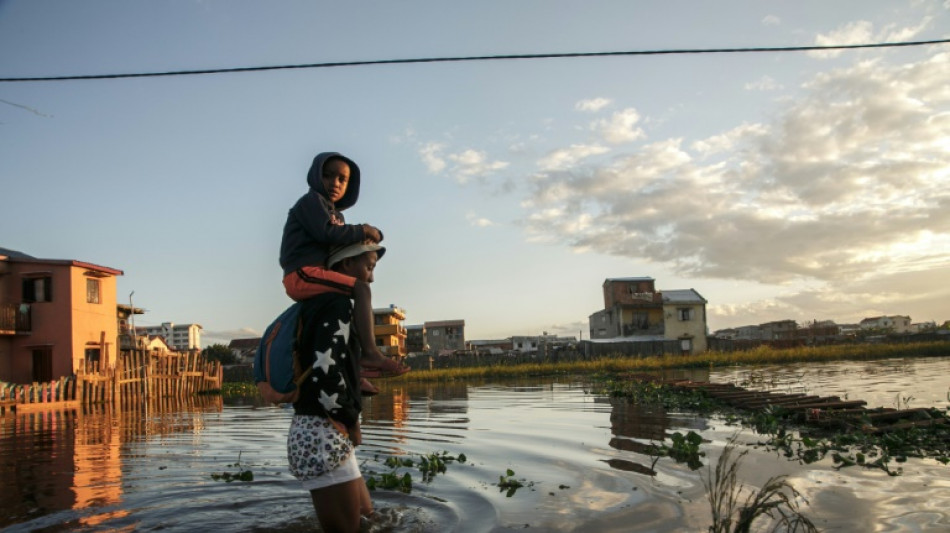
Developing countries left 'disappointed' at climate talks / Photo: RIJASOLO - AFP/File

 Emporio Armani names Dario Vitale new creative director

 EU to ban social media for under 13s, curb access until 15

 Wildfires push endangered Sumatran elephants to brink: Indonesian NGO

 Bank of Japan set to raise rates under pressure from inflation, US

 EU chief to unveil social media, gaming curbs for under-15s

 'Resident Evil' film brings video game's ethos to the big screen

 i-payout Expands U.S. Money Transmitter Licensing Footprint and Advances European EMI Strategy

 US Senate crypto bill collapses amid partisan deadlock

 OpenAI, Anthropic and Google are working to create an AI standards body

 Protesting shepherds, farmers clash with Romanian police

 Foundation Lets Ledger Users Switch to Open Source Without Starting Over

 EU to propose curbing social media, online games for under 15s

 FX Junction Reaches 40,600 Members and 26 Million Trades

 'We unleashed the beast': the world's fears and hopes about AI

 Hospitality leaders ask Burnham to halve VAT amid rising costs

 Worcestershire invited to nominate groups for 2027 King’s volunteer award

 Berlin's run-down public spaces at heart of election campaign

 'Widow's Bay' and 'The Pitt' win big at Emmy Awards

 Most markets drop as oil extends gains ahead of expected US rate hike

 Sri Lanka's famed beach shack battles demolition

 Vserv targets ₹1,000 crore revenue by 2030 through AI expansion

 India prohibits bank fees on UPI payments up to ₹2,000

 Brazil's Amazon defender Raoni has cancer

 Trump rejects AI slowdown concerns as UN urges coordinated controls

 Higher wages draw migrant workers to Kashmir despite attacks

Developing countries voiced "disappointment" as climate talks in Germany ended Thursday with frustrations flaring over a lack of momentum on helping vulnerable nations cope with the impacts of warming.
With world attention drawn towards other challenges, notably Russia's invasion of Ukraine and spiralling food, energy and economic crises, the technical discussions meant to lay the groundwork for key United Nations negotiations later this year were mired in disagreements.
Representatives of nearly 200 countries arrived in the city of Bonn buoyed by the ambition displayed six months ago during the UN COP26 negotiations in Glasgow, where countries rallied around the urgent threat of climate change.
"After that sense of emergency had been established, probably the expectations were very high," said Preety Bhandari, senior climate adviser at the World Resources Institute.
But the meeting produced little tangible progress, even on the emissions-cutting ambitions that countries have agreed are needed to meet the Paris agreement goal of limiting warming to preferably 1.5 degrees Celsius.
Finance is an ongoing sore point, with a promise of $100 billion a year from 2020 to help developing countries adapt to a warming world still not met.
Another flashpoint at the talks has been the slow pace of work on "loss and damage", the accelerating onslaught of impacts already being felt by vulnerable countries, like floods, heatwaves and storms.
Developing nations want a specific funding "facility" to help poor countries least responsible for climate change to cope with its impacts.
But that call has been rejected by wealthy nations, particularly the European Union and United States, who have said funding can be channelled through a network of existing humanitarian, development and climate organisations.
As the Bonn talks wrapped up, developing countries lined up to convey their displeasure at the slow progress on loss and damage, which is now being dealt with as a rolling "dialogue" that will end in 2024 with no clear outcome emerging.
They want the issue to be on the agenda at the COP27 meeting in Sharm el-Sheik in November.
Pakistan's representative, speaking on behalf of the G77 and China major developing countries, said the group was "dissatisfied", while Zambia, speaking on behalf of Africa, said they were "concerned by the lack of progress".
"We are disappointed by the lack of substantive progress," said the representative of Antigua and Barbados speaking on behalf of the Alliance of Small Island States (AOSIS).
He said countries were still waiting for assurances that "the finance we need now will be delivered at speed, or any time by 2025".
- 'Hypocritical' -
Wealthy nations are concerned about any suggestion of legal liability that would put them on the hook for billions, if not trillions.
The European Union told delegates it had "engaged constructively" and promised to continue.
But campaigners say the current system puts the economic burden on the shoulders of the most vulnerable.
Harjeet Singh, Senior Climate Impacts Adviser, at Climate Action Network International said the EU "consistently blocked" discussions around finance for loss and damage and accused the bloc of having a "hypocritical stance".
"If the EU wants to step up as a climate champion it needs to align with the most vulnerable in their fight for justice," he said.
Bhandari said work on cutting emissions could stall if countries do not give more weight to both adaptation and mitigation, adding that it would be up to political leaders to reignite the momentum in the run up to the UN meeting in Egypt.
Nearly 1.2 degrees Celsius of warming since the mid-nineteenth century has been enough to unleash a torrent of disasters across the planet.
Alden Meyer, senior associate at E3G, said it has reached "boiling point" as impacts mount, adding that countries can also see the billions that the US and EU are mobilising for the Ukraine conflict.
"It's not a matter of the money's not there. It's a matter of priorities," he told AFP.
"And if you're saying climate is an existential crisis, and yet you're treating other things as much more important in terms of where you're putting your money, that doesn't go unnoticed."
C.Smith--CPN