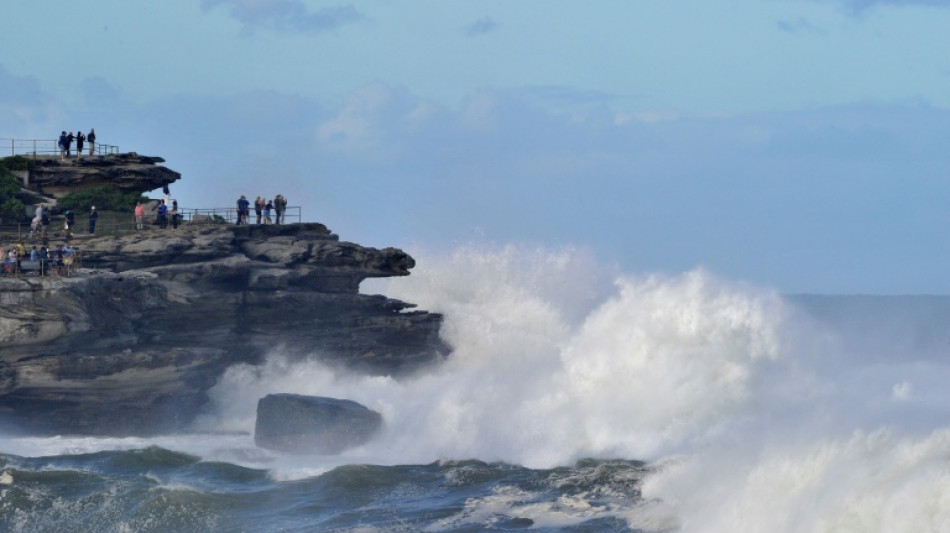
Australia submits more ambitious 2030 emissions target to UN / Photo: Muhammad FAROOQ - AFP

 Emporio Armani names Dario Vitale new creative director

 EU to ban social media for under 13s, curb access until 15

 Wildfires push endangered Sumatran elephants to brink: Indonesian NGO

 Bank of Japan set to raise rates under pressure from inflation, US

 EU chief to unveil social media, gaming curbs for under-15s

 'Resident Evil' film brings video game's ethos to the big screen

 i-payout Expands U.S. Money Transmitter Licensing Footprint and Advances European EMI Strategy

 US Senate crypto bill collapses amid partisan deadlock

 OpenAI, Anthropic and Google are working to create an AI standards body

 Protesting shepherds, farmers clash with Romanian police

 Foundation Lets Ledger Users Switch to Open Source Without Starting Over

 EU to propose curbing social media, online games for under 15s

 FX Junction Reaches 40,600 Members and 26 Million Trades

 'We unleashed the beast': the world's fears and hopes about AI

 Hospitality leaders ask Burnham to halve VAT amid rising costs

 Worcestershire invited to nominate groups for 2027 King’s volunteer award
 Berlin's run-down public spaces at heart of election campaign
 'Widow's Bay' and 'The Pitt' win big at Emmy Awards

 Most markets drop as oil extends gains ahead of expected US rate hike

 Sri Lanka's famed beach shack battles demolition

 Vserv targets ₹1,000 crore revenue by 2030 through AI expansion

 India prohibits bank fees on UPI payments up to ₹2,000

 Brazil's Amazon defender Raoni has cancer

 Trump rejects AI slowdown concerns as UN urges coordinated controls

 Higher wages draw migrant workers to Kashmir despite attacks

Australia's new centre-left government submitted more ambitious emissions targets to the United Nations Thursday, seeking to end a decade of footdragging on climate change.
Prime Minister Anthony Albanese raised the country's 2030 emissions reduction target to 43 percent, up from a more modest previous target of 26-28 percent.
The new goal "sets Australia up for a prosperous future, a future powered by cleaner, cheaper energy," Albanese said.
Despite being ravaged by floods, fires and droughts, Australia has long been seen as a laggard on climate action.
The vast continent-country is replete with fossil fuel deposits and is one of the world's top exporters of coal and gas.
Coal still plays a key role in domestic electricity production.
In 2022, MIT ranked Australia 52nd of 76 nations on its Green Future Index, which rates how much countries are shifting towards an environmentally sustainable economy.
- The 'climate wars' -
But Albanese made emissions cuts a centrepiece of his recent election campaign and pledged to "end the climate wars" that led to decades of policy stasis.
Albanese sought to frame the decision as an economic boon: "What business has been crying out for is investment certainty," he said.
The Business Council of Australia welcomed the raised targets, saying they "should be a line in the sand."
"Australia can't afford to stall progress again because failure will see Australians miss out on new opportunities, new industries and better jobs," the council's chief executive Jennifer Westacott said.
- 'Seize the opportunity' -
Albanese said Thursday that world leaders had "all welcomed Australia's changed position" on climate action during his conversations with them since taking power last month.
The issue of emissions reduction and fossil fuel exports was a key point of tension between Australia's previous government and Pacific leaders, who have labelled climate change the greatest threat to their region.
Albanese tried to sidestep criticism that higher targets could harm Australian jobs saying he wanted to "seize the opportunity that is there from acting on climate change".
The new targets would give business the certainty it needed to "invest over a longer time frame than the political cycle of three years," he said.
But he has so far refused to set a deadline for phasing out coal, in line with other rich countries.
Even before the announcement, Australia's fossil fuel industry was in flux with many major companies seeking to decarbonise their operations.
On Wednesday, global miner BHP announced it had been unable to find a buyer for its coal mines in the Australian state of New South Wales and would instead close the project by 2030.
The news came just a day after fossil fuel giant BP announced it would take out a 40.5 per cent stake in a renewables project in Australia, billed as the largest power station on earth.
Anja-Isabel Dotzenrath, BP's executive vice president of gas and low carbon energy, said the company believed that "Australia has the potential to be a powerhouse in the global energy transition".
P.Kolisnyk--CPN