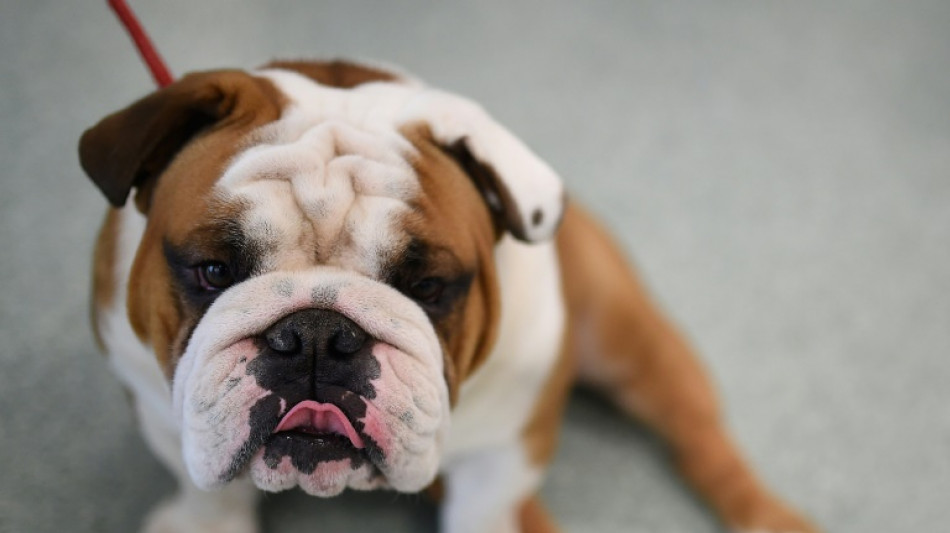
English bulldogs 'suffering', twice at risk of health issues / Photo: Jamie McCarthy - GETTY IMAGES NORTH AMERICA/AFP/File

 Emporio Armani names Dario Vitale new creative director

 EU to ban social media for under 13s, curb access until 15

 Wildfires push endangered Sumatran elephants to brink: Indonesian NGO

 Bank of Japan set to raise rates under pressure from inflation, US

 EU chief to unveil social media, gaming curbs for under-15s

 'Resident Evil' film brings video game's ethos to the big screen

 i-payout Expands U.S. Money Transmitter Licensing Footprint and Advances European EMI Strategy

 US Senate crypto bill collapses amid partisan deadlock

 OpenAI, Anthropic and Google are working to create an AI standards body

 Protesting shepherds, farmers clash with Romanian police

 Foundation Lets Ledger Users Switch to Open Source Without Starting Over

 EU to propose curbing social media, online games for under 15s

 FX Junction Reaches 40,600 Members and 26 Million Trades

 'We unleashed the beast': the world's fears and hopes about AI

 Hospitality leaders ask Burnham to halve VAT amid rising costs

 Worcestershire invited to nominate groups for 2027 King’s volunteer award

 Berlin's run-down public spaces at heart of election campaign

 'Widow's Bay' and 'The Pitt' win big at Emmy Awards

 Most markets drop as oil extends gains ahead of expected US rate hike

 Sri Lanka's famed beach shack battles demolition

 Vserv targets ₹1,000 crore revenue by 2030 through AI expansion

 India prohibits bank fees on UPI payments up to ₹2,000

 Brazil's Amazon defender Raoni has cancer

 Trump rejects AI slowdown concerns as UN urges coordinated controls

 Higher wages draw migrant workers to Kashmir despite attacks

English bulldogs are twice as likely to get common health problems than other dogs, new research published Wednesday found, as vets urged people to look beyond the cuteness of flat-faced breeds to see that they are "suffering".
The hugely popular dogs are 38 times more likely to develop skin fold infections, 27 times at greater risk of a disorder called "cherry eye" and nearly 20 times more likely to have breathing problems than other dogs, the research found.
Dan O'Neill of Britain's Royal Veterinary College, one of the authors of the study, emphasised that it is not the dogs' fault, saying they "often are truly lovely".
"This isn't a dog problem, the dogs are suffering, this is a human problem," he told AFP.
The researchers took a random sample of more than 2,650 English bulldogs and 22,000 other companion dogs that had veterinary care in the UK in 2016, collected from the database of the Royal Veterinary College's VetCompass project.
The study, published in the journal Canine Medicine and Genetics, found that English bulldogs have double the odds of having at least one common health disorder per year than other dogs.
Research using VetCompass data earlier this year showed that English bulldogs have a life expectancy of 7.4 years, compared to the average of 11.2 years for other companion dogs.
There have also been recent studies using VetCompass data showing the health problems suffered by fellow flat-faced pugs and French bulldogs.
Wednesday's study meanwhile found that English bulldogs were less likely to get some illnesses, such as dental disease, heart murmur and flea infestation.
But even these positives are likely connected to their extreme breeding, O'Neill said.
Because bulldogs "have so many head and oral issues they salivate all the time... that drooling might actually be helping their teeth because it's flushing out their mouth," he said.
- Pricey pup -
Sonia Saxon of the UK's Bulldog Breed Council said a big problem was that many dogs were not being bred to the country's breed standard.
Saxon, her bulldog Martha snoring gently at her side, told AFP from Britain that some English bulldogs were being bred to be smaller, or have different colours, as a way to market them as unique.
"On social media they're classing them as rare and charging 30,000 to 40,000 pounds ($36,000 to $48,000)," she said.
"The more extreme, the more money they ask for."
O'Neill, who worked as a vet for more than 20 years, said that simply banning English bulldogs would not solve the problem -- the wider problem is "extreme conformation".
Conformation is how dogs are bred to conform with the expected standards of their breed.
What needs to change is "our mental image of what a bulldog should look like," he said.
"They can have longer noses, get rid of those skin folds, smaller heads -- they can still be a bulldog, but not like the ones we have."
He told those considering buying a flat-faced breed to "walk a day -- even an hour -- in that dog's life".
"Every minute of every day, struggling to breathe. Every minute of every day with skin that is likely to be painful and infected because of all the folds," he said.
"Why not choose a puppy with good innate health," he said, "as opposed to a puppy that is highly likely to have severe health issues?"
A.Leibowitz--CPN